Let's cut to the chase: keeping a WhatsApp Business account alive in 2026 isn't about some "secret hack" or "cracked patch." It's about building an operation that genuinely respects the platform's rules. The biggest frustration I hear from cross-border sellers this year? You can "nurture" an account perfectly and still lose it overnight because of one poorly-timed broadcast.
Here's a painful trend I've observed firsthand: the "bulk registration via emulator + protocol sending" playbook that worked in early 2025 was basically extinct by mid-year. It's not even about ban rates anymore—the account sellers themselves have vanished. WhatsApp's risk control now detects subtle anomalies in device fingerprints, behavioral patterns, and even network environments.
Cross-border sellers often tell me they're using the official WhatsApp Business app and nurturing their accounts diligently—so why the ban? The answer usually lies in "invisible violations."
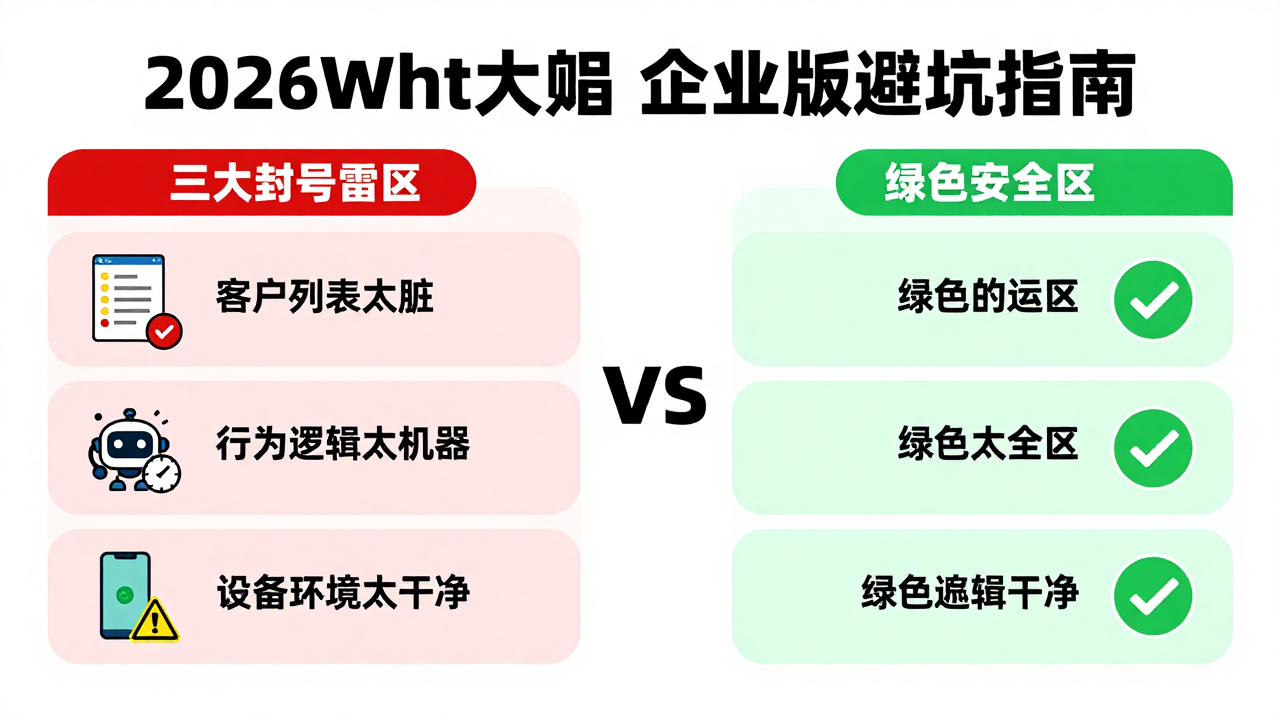
Industry consensus is clear: ban triggers have shifted from "quantity" to "quality." Previously, you might send 500 messages before tripping the alarm. Now, sending just 50 messages with sensitive keywords, a newly-registered link domain, or logging into more than 3 business accounts on the same WiFi network can get you flagged.
From my analysis, these are the three most common pitfalls:
Here's a concrete example. A home goods seller I know used a third-party tool to blast 2,000 customers with discount code images before peak season. The next day, his main account was banned—no appeal option in sight. Post-mortem analysis revealed the tool's API had already been flagged as high-risk by WhatsApp, and the discount code link domain was freshly registered. Double trigger.
So in 2026, the first rule of account safety is to "think like a human," not "execute like a tool."
Given how hard it is to build a safe system in-house, many businesses turn to service providers. But the 2026 provider landscape is murkier than you'd expect.
Early providers mainly sold "clean accounts" or "aged accounts," but that model can no longer guarantee stability. An account is just a vessel—what determines its fate is the operational environment around it. If a provider hands you an account without IP isolation or anti-association measures, that account likely won't survive a month.
Platforms with a solid industry reputation, like Getfollow, operate on this compliance-first logic. They don't just deliver an account; they provide a package of "isolated environment + behavior simulation + risk alerts." For instance, each business account gets a dedicated residential IP, and the system automatically mimics human reply delays to reduce flagging risk.
But here's my honest warning: even these platforms can't guarantee 100% ban-free operation. In 2026, any provider claiming "absolute stability" is either exaggerating or gambling with shady methods (like protocol accounts).
If you're considering external help, run potential providers through these four filters. It'll eliminate most of the bad options:

I've noticed a trend this year: many providers now push "account nurturing services," where they grow the account for 15 days before handing it over. The upside is the account has passed the "newbie protection period" and carries more risk-control weight. The downside? Costs double, and you have zero visibility into the content quality during that nurturing phase.
If you think "no ban" is the ultimate goal, you're missing the bigger picture. This year, keeping an account alive is just the entry ticket. The real challenge is "stable reach" and "stable conversion."
Many sellers report their accounts aren't banned, but all their messages land in the "notifications" folder—customers never see them. WhatsApp's algorithm has become far more aggressive in folding marketing messages. If your open rate drops below 15%, the system automatically reduces your reach weight, creating a vicious cycle.
My advice to every team using WhatsApp Business: treat "staying unbanned" and "getting opened" as one integrated operation. Here's how:
Here's a counterintuitive insight: in 2026, WhatsApp Business treats "saved contacts" with far more tolerance than "unknown numbers." So even if your contact list is just 100 people—as long as you've mutually saved each other's numbers—your account is safer than one with 10,000 strangers. That's why brands focused on private traffic are shifting from "growing followers" to "deepening engagement."
Back to the original question—can you keep a WhatsApp Business account stable and unbanned in 2026? My answer: yes, but only if you abandon the "get rich overnight" fantasy and embrace the reality of meticulous, compliant operations.
Whether you build your own team or partner with a compliance-focused provider like Getfollow, the core principles remain the same: isolated environment, human-like behavior, and disciplined content. Any solution claiming to bypass these three pillars is gambling with your business account.
One final piece of responsible advice: no matter how impressive a provider's pitch sounds, always start with a small test. Run 1–2 accounts through the full workflow, confirm your ban rate, reach rate, and conversion rate all meet expectations, then consider scaling up. The 2026 WhatsApp ecosystem belongs to those willing to go slow.
Based on 2026's risk-control logic, Business accounts face higher scrutiny because they involve commercial behavior and higher message frequency. However, Business accounts have access to official API channels—if you use the legitimate API route, stability far exceeds personal accounts. The key difference is whether you're using the "official interface" or a "third-party reverse-engineered interface."
Industry best practice: Days 1–3, browse only, don't post. Day 4, add 5–10 contacts. Day 5, post a status update. Day 6, have a meaningful conversation with a contact. Day 7, run your first small broadcast test. This pacing closely mimics real human behavior patterns.
Beyond checking for "ban compensation" guarantees, ask this directly: "If my account gets banned, what data can you provide for the appeal?" A reliable provider will give you complete login logs, device fingerprints, and IP records—these are critical for successful appeals. Platforms like Getfollow typically include appeal support in their service terms.
In 2026, personal account appeals succeed less than 20% of the time. But business accounts with official API or enterprise verification can push that to around 50%. The caveat: this assumes no severe violations (like sending prohibited content). If it's a wrongful ban, prepare your business license and法人 ID, go through the official support channel, and expect to wait 3–5 business days.