Compliant WhatsApp Bulk Messaging in 2026: From Risky Shortcuts to Smarter Outreach
Compliant WhatsApp Bulk Messaging in 2026: From Risky Shortcuts to Smarter Outreach
If you're in cross-border e-commerce, you've probably heard the same complaint I do: WhatsApp outreach in 2026 is tough. Not because customers are hard to find—but because accounts are harder to keep. The bulk-send scripts that worked last year? Most of them are dead now. WhatsApp has quietly rolled out a far more aggressive detection system for non-human behavior, and bulk outreach is squarely in the crosshairs. The level of scrutiny today is on a completely different scale than it was even two years ago.
Here's a telling industry pattern: in Q1 of 2026, many export teams relying on "gray-hat" mass sending saw ban rates climb past 60%. That's not an isolated story—it's become the norm. The accounts that survived were either manually operated or had already moved to compliant tools. In this guide, I'm not going to rehash the usual "how to warm up your account" advice. Instead, I want to break down compliant WhatsApp bulk messaging from the ground up—drawing on real cases I've worked with—so you can see what actually works in 2026.
Before You Buy a Tool, Understand What "Compliant" Really Means
A lot of people assume that using the official WhatsApp Business API automatically makes you compliant. That thinking is outdated in 2026. The API is just the entry ticket. True compliance sits in three places: sending frequency, content quality, and data sourcing.
Frequency first. WhatsApp now applies invisible daily sending thresholds for business accounts. Cross that line, and you trigger manual review. Industry feedback consistently points to one number: new accounts sending more than 50 cold messages a day see a sharp spike in restrictions. This isn't in any official document—it's the unwritten rule that sellers have learned the hard way.
Content quality matters just as much. I've seen teams copy-paste email templates straight into WhatsApp—opening with "Dear Sir/Madam" and ending with a link. In 2026, that's practically a spam flag. WhatsApp's semantic analysis can now detect marketing intent. Even through the official API, overly "salesy" copy will get you throttled.
Data sourcing is the hidden trap. Many providers boast "millions of overseas leads," but those numbers are often scraped. Use them for bulk outreach and you'll see poor conversion—and likely get reported. The 2026 rule is simple: only numbers with prior interaction or explicit opt-in count as compliant data.
A Real Ban That Cost a Seller $10,000
Late last year, a Shenzhen home-goods seller reached out to me in a panic. Their WhatsApp business account had been permanently banned—with 3,000+ warm leads trapped inside. Digging into the details, the problem was their sending strategy. They were using a popular "cloud bulk sender" that simulates human behavior. But the intervals were too regular—every message exactly 3 seconds apart—and every message contained a short link to their website.
That link was the fatal flaw. WhatsApp's detection system is highly suspicious of short URLs, especially non-branded domains. Combined with the rigid sending pattern, the account was flagged as automated. They hadn't used the official API, hadn't varied their content, and had essentially gambled the account away. Result: 3,000 potential customers gone overnight.
The takeaway? Compliant bulk outreach isn't about whether you can send—it's about how you send to survive. In 2026, you need a strategy, not a send button.
Three Viable Paths for Compliant WhatsApp Outreach in 2026
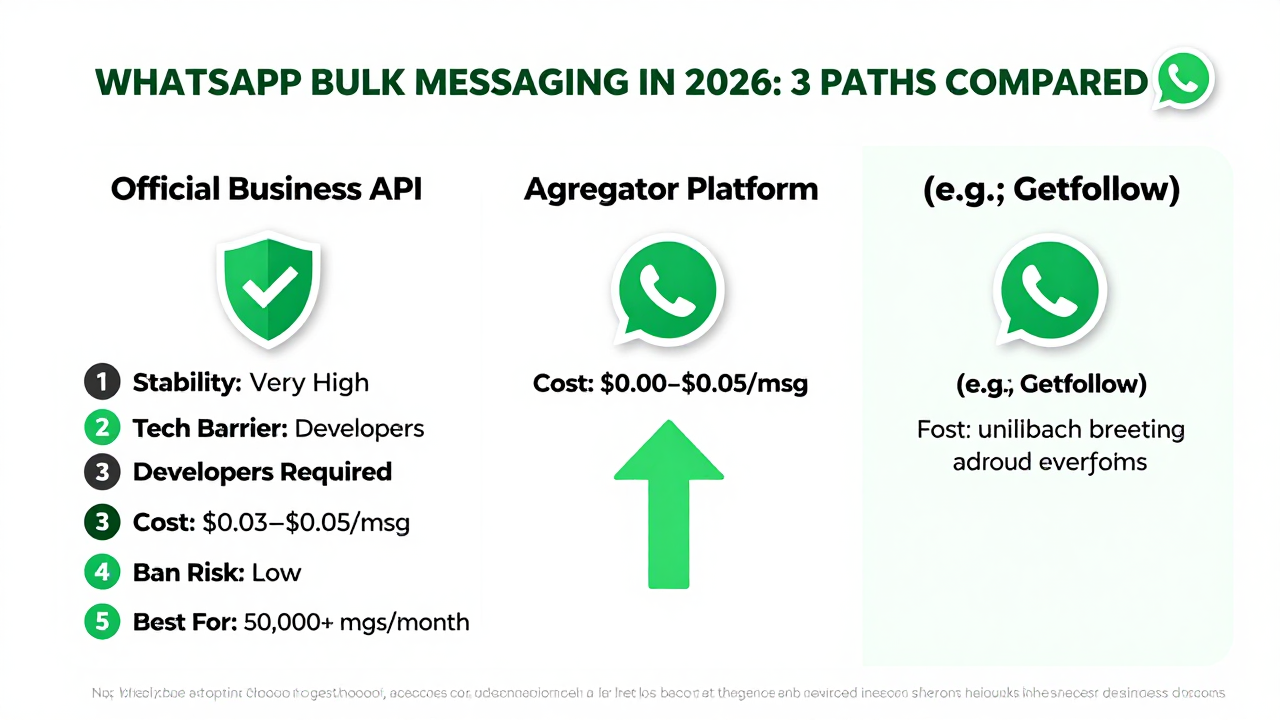
Based on what I'm seeing across the industry, there are three approaches that actually work. Each has different trade-offs in cost, risk, and scalability. Choose based on where your business is right now.
- Path 1: Official Business API (Direct). Best for mid-to-large companies sending 50,000+ messages monthly. Maximum stability, supports both template and session messages. Requires a technical team to integrate, and every message is billed. Pricing in 2026 hovers around $0.03–$0.05 per message, depending on region.
- Path 2: Compliant Aggregator Platforms. Ideal for small and mid-size sellers without developers. These platforms wrap the official API in a visual dashboard—you import numbers, write your copy, and hit send. Platforms like Getfollow have built a solid reputation here by following official API logic while adding number cleaning and frequency optimization on top.
- Path 3: DIY Scripts + Device Farms. For solo players with very low budgets and a high tolerance for risk. Device farms simulate human behavior, but survival rates in 2026 are abysmal. Use this only for small-scale tests—never as your main channel.
One important note on Path 2: many sellers tell me their biggest fear is "middlemen." Some providers don't even have official API credentials—they're just reselling someone else's access. If something goes wrong, you have no one to hold accountable. Always ask for proof of official API access or a WhatsApp partner certification before committing.
Side-by-Side Comparison: Which Path Fits You?
| Dimension | Official Business API | Aggregator Platform (e.g., Getfollow) | DIY Scripts + Device Farm |
|---|---|---|---|
| Stability | Very high, official backing | High, built on official API | Low, at constant risk of flags |
| Technical Barrier | Requires developers | No-code, dashboard-based | Needs scripting and control expertise |
| Cost per Message | $0.03–$0.05 | Plan-based, ~$0.04–$0.08 | Hardware + IP costs, ~$0.01 |
| Ban Risk | Low (if rules are followed) | Low (platform optimizes) | Very high; under 20% survival in 2026 |
| Best For | 50,000+ messages/month | 1,000–50,000 messages/month | Under 1,000 messages/month |
This table makes the 2026 landscape pretty clear. If you're a solo operator testing small volumes, pay-as-you-go on the official API works fine. If you're sending a few thousand to tens of thousands monthly, a reliable aggregator gives you the best ROI. As for DIY scripts—unless you have exceptional technical skills and risk tolerance, I'd skip it entirely.
Content Strategy: Making Your Bulk Messages Actually Survive
Everyone obsesses over how to send, but almost no one thinks about what to send. In 2026, WhatsApp's content moderation has gotten scarily good at spotting "marketing speak." I've tested hundreds of message variations and found a clear pattern: messages with aggressive CTAs like "limited-time offer," "buy now," or "click here" see open rates below 15%. But messages written in a "light consultation" tone? Those hit 40% or higher.
Here's a template structure that works well in 2026. First line: state your source—"Hi, I'm [name] from [company], we met at [event]." Second line: offer a specific value point—"We recently helped a client in your industry cut logistics costs by 12%." Third line: leave an open-ended hook—"Not sure if this is relevant to you, but I'd be happy to send over a detailed proposal."
The logic here is simple: turn a pitch into a conversation. WhatsApp's algorithm prioritizes messages that spark replies. If someone responds—even with a simple "What do you mean?"—your account's trust score goes up, and future sending limits loosen. It's a hidden trick many experienced sellers use, and it still works in 2026.
One more thing: images and files. WhatsApp now fingerprints images sent in bulk. Send the same picture too many times, and it gets flagged. Before each campaign, tweak the image—adjust the color tone, resize it, or add a subtle watermark. It's a small detail most teams overlook, but it directly impacts your deliverability.
Vendor Checklist: Five Ways to Spot a Reliable Partner
Since aggregator platforms are the go-to choice for most cross-border businesses in 2026, how do you avoid the bad ones? Drawing from my own mistakes and conversations with peers, here are five filters I use.
- Check credentials. Ask for official WhatsApp Business API partner documentation, or at least Meta Business certification. No proof? Move on.
- Ask about risk controls. How do they handle number cleaning, frequency capping, and opt-outs? If they say "no limits, send as much as you want," that's a red flag for gray-hat operations.
- Clarify data ownership. Are your customer lists and chat logs stored on their servers? Can you export everything? Some smaller platforms reuse your data—that's a dealbreaker.
- Demand case studies. Ask for examples from your industry and similar company size. Then ask for a reference you can actually contact. Fake case studies fall apart fast.
- Test support response time. WhatsApp rules change quickly—especially in 2026. Can they respond to your questions within 24 hours? That speed determines whether you can limit damage during a sudden ban.
Take Getfollow as an example. Their positioning is built around "compliant operational logic," with a strong emphasis on data security and frequency control. From what I understand, they run health checks on numbers before they enter the send queue, filtering out high-risk contacts. That means fewer messages sent—but a significantly higher account survival rate. In 2026's environment, that's the responsible approach.
Of course, Getfollow isn't the only option. There are other solid platforms out there, but the core principle is the same: protect the account first, worry about volume second. If a vendor doesn't even understand the concept of "number health," they're probably not worth your time.
Risk Management: Calculate the Downside Before You Chase the Upside
The biggest risk in 2026 isn't the ban itself—it's the ripple effect. Your business account gets banned, and all your accumulated customer relationships vanish. Worse, if other accounts under the same business entity get linked and banned too, the damage multiplies.
Industry consensus puts retention rates at 50%–70% in 2026. What does that mean? For every 1,000 customers you reach, only 500–700 will actually move into follow-up conversations. The rest are invalid numbers or people who read and ignored. Newcomers often panic at these numbers, but that's just the reality. Bulk outreach is a funnel, and your job is to optimize every layer of it.
My advice for anyone getting started: run a small test first. Take 500 numbers, send one campaign through a compliant tool, and watch the data for 7 days—open rate, reply rate, unsubscribe rate. If replies are below 8%, your content strategy needs work before you scale. If you're above 12%, gradually increase volume. This pacing keeps your risk manageable.
Also, build a backup plan. Don't put all your customers in one WhatsApp account. A safer approach in 2026 is to split contacts across 2–3 accounts by source or region. If one gets flagged, you still have the others to continue operations.
Final Thoughts: In 2026, Compliance Is the Only Way Forward
As I write this, one thought keeps coming back: WhatsApp bulk messaging has fundamentally changed in 2026. Those still using old tactics and old tools will be phased out. Teams that embrace compliance and refined operations will find new growth opportunities.
Compliance isn't a constraint—it's a filter. It weeds out unprofessional competitors and helps you build genuinely valuable customer relationships. If you're considering a compliant WhatsApp bulk messaging tool, here's my suggestion: run a 7-day small-scale test, compare the data, then decide on a long-term partnership. Don't buy an annual plan on day one. That's the safest way to enter the game in 2026.
I hope this guide helps you avoid a few pitfalls. If you hit a specific problem in practice, drop a comment below—I'll do my best to respond.
Frequently Asked Questions
What is the safest way to bulk message on WhatsApp in 2026?
The safest approach is using the official WhatsApp Business API, either directly or through a certified aggregator platform. These routes follow WhatsApp's terms, include frequency controls, and significantly reduce ban risk compared to unofficial scripts.
How many WhatsApp messages can I send per day without getting banned?
Industry experience suggests that new accounts sending over 50 cold messages per day face sharply higher restriction risks. Established accounts with high reply rates can send more, but it's wise to scale gradually and monitor account health.
Can I use scraped phone numbers for WhatsApp outreach?
No. In 2026, WhatsApp's compliance standards require numbers to come from opt-ins or prior interactions. Scraped numbers not only lead to poor conversion but also increase the likelihood of reports and bans.
What should I look for when choosing a WhatsApp bulk messaging service?
Look for official API credentials, transparent risk-control mechanisms, clear data ownership policies, verifiable case studies, and responsive support. Avoid providers that promise unlimited sending with no safeguards.