WhatsApp Compliance Tools for Export Marketing: Why "Batch and Pray" Is a Losing Game in 2026
WhatsApp Compliance Tools for Export Marketing: Why "Batch and Pray" Is a Losing Game in 2026
If you're still blasting messages to random groups and hoping for the best in 2026, you're basically asking for your account to be shut down. The WhatsApp ecosystem has changed dramatically over the past few years. I've watched plenty of B2B contacts start the year worried about a lack of orders, buy a flashy "marketing tool," and get their primary accounts permanently banned within 48 hours.
This isn't an isolated story. Industry consensus is clear: WhatsApp's risk-control systems in 2026 have become frighteningly good at detecting "unnatural behavior." If you're relying on software to mass-send messages and hoping inquiries will follow, the likely outcome is simple—you lose your money, your number, and your customers. So let's skip the fluff and talk practically about how to choose and use compliant WhatsApp marketing tools that actually survive this ecosystem.
Reality Check: Why "Rogue Tactics" Are Officially Dead in 2026
Cross-border sellers have noticed a fundamental shift in how WhatsApp handles bans this year. In the past, it was mostly about sending frequency. Now, it's about "relationship anomalies." What does that mean? If a brand-new WhatsApp account with zero chat history or contact building suddenly starts blasting marketing content to strangers, the system flags it as "non-human behavior" almost instantly.
I'm talking seconds. One home goods trader I know bought a popular "unlimited broadcast" tool, set it to send a message every 30 seconds, and lost all five of his work accounts before lunch. When we reviewed what happened, the tool didn't even have a basic "simulated typing delay" feature. Every message went out in the same rigid format—an obvious machine signature.
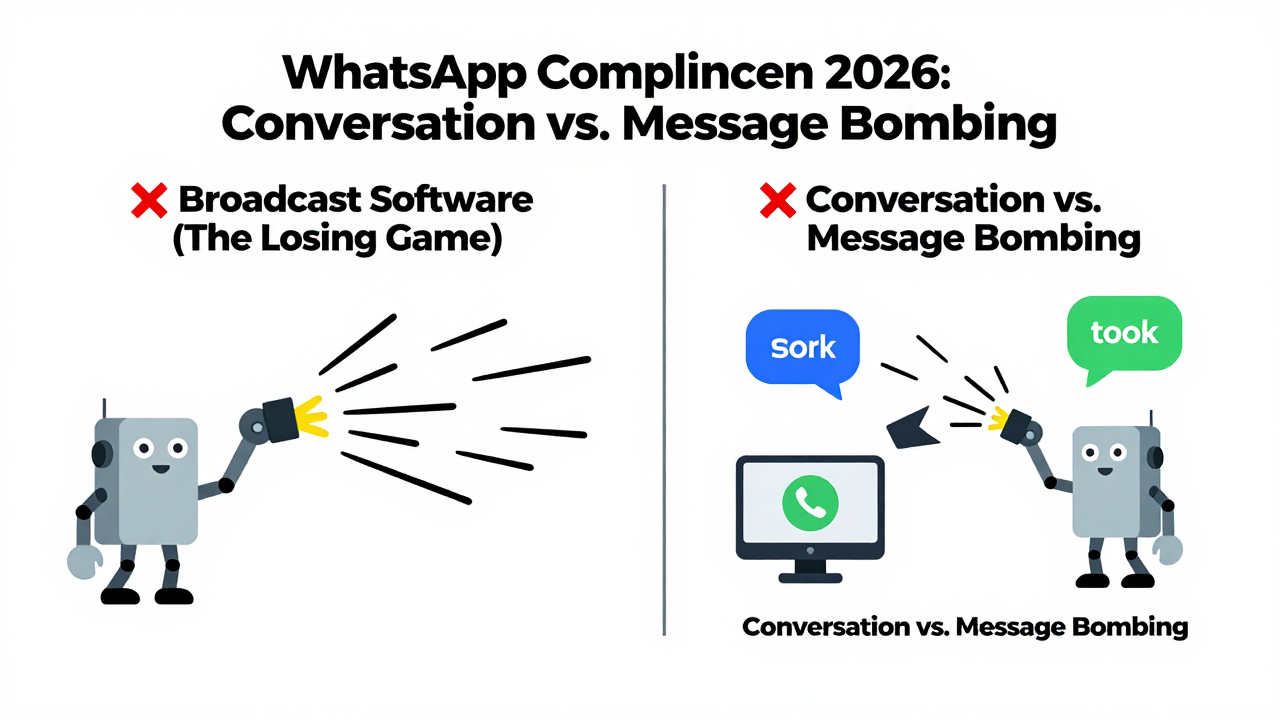
This brings us to the first major fork in the road for 2026 compliance tools: Is it helping you have conversations, or is it sending messages for you? Get this wrong, and no amount of budget will save you.
What Compliance Tools Actually Do: Customer Management, Not Message Bombing
Here's an interesting pattern I've noticed: the WhatsApp marketing providers still thriving in 2026 have all pivoted to "SCRM management tools" rather than "broadcast software." The difference? The former focuses on customer tagging, conversation routing, and content organization. The latter only cares about how many messages you can fire off per minute.
Let me give you a concrete example. Under the 2026 WhatsApp Business API policies, template message reviews are brutally strict. If your content contains aggressive sales language like "limited-time offer" or "buy now" without prior opt-in confirmation from users, complaint rates spike, and your account rating takes a hit. A proper compliance tool helps you separate customers who've agreed to receive messages from those who haven't—cleanly and automatically.
Platforms like Getfollow have built a solid reputation in this space precisely because they follow this compliance-first logic. They don't promise "100,000 messages a day." Instead, they focus on improving your team's reply rates and follow-up efficiency. This is the 2026 export marketing playbook in a nutshell: stop casting a wide net and start fishing with precision.
A Real Cautionary Tale: How an "Auto-Join Groups" Feature Backfired
Let me share a firsthand experience. Earlier this year, I was helping a client in the machinery parts industry figure out why their inquiries had dropped off a cliff. Turns out, the tool they were using had an "auto-join relevant groups" feature. He figured it was a shortcut to new leads, so he switched it on.
Bad move. WhatsApp's risk-control system weighs "joining multiple groups in a short window" very heavily. Not only did his account get restricted from joining more groups, but his private messages stopped going through entirely—flagged as a "suspicious account." To make things worse, he'd posted ads in those groups, got reported by group admins, and his account was banned as a result. The lesson here is simple: any feature designed to exploit platform loopholes is a ticking time bomb under 2026's risk-control model.
How to Spot Real Compliance vs. Fake Compliance: 3 Checks That Matter
If you're going to invest in a tool, you need clear criteria. Plenty of products slap the word "compliant" on their packaging while running the same old playbook underneath. Here are three practical things I look at:
- Connection method: Does it use the official WhatsApp Business API, or does it ask you to scan a QR code and log into WhatsApp Web? The former is an officially sanctioned pathway—stable data, lower risk of triggering safeguards. The latter is essentially a simulator that can fail en masse whenever WhatsApp pushes an update. In 2026, any tool still asking you to "scan and leave your phone on" is a hard pass.
- Sending logic: Does the tool let you set a daily send cap? Does it enforce random delays? A responsible compliance tool will actively limit your send frequency—and warn you if you're setting it too high. If any software tells you "unlimited sends, zero bans," it's lying to you.
- Data ownership: Are your customer chat logs and contact data stored on your own server, or uploaded to the provider's cloud? In 2026, data security is the lifeline of any export business. If a tool provider can browse your customer data at will, you're handing over your trade secrets.
On that first point, there are quite a few API integration providers out there now, but very few handle "multi-account rotation" and "conversation context memory" well. Many tools technically connect via API but deliver a clunky chat interface that sales reps refuse to use. So they end up falling back to the consumer WhatsApp app, and everything descends into chaos.
The Real Numbers for 2026: Retention Rates and Cost Breakdowns
Bosses often ask me whether WhatsApp marketing is getting too expensive. Here's the math I usually walk them through. In 2026, the cost per qualified inquiry through compliant tools runs about 30% lower than pure ad spend in 2024—but only if you survive the initial "account warm-up" phase.
Retention data tells the same story. Accounts managed through compliant API integrations maintain customer reply rates between 50% and 70%. Accounts using unofficial broadcast tools might show high message delivery rates in the short term, but reply rates often fall below 20%, and account lifespans are brutally short. Run those numbers, and the picture gets very clear.
A special note for solo operators and small studios: you don't have an IT team to maintain servers and integrations, so you need a plug-and-play SaaS platform. Providers like Getfollow have wrapped complex API integrations into a simple dashboard. You upload your customer spreadsheet, set up your message templates, and the system handles outreach at a compliant pace. The upside is peace of mind; the downside is a monthly subscription fee. But compared to the cost of rebuilding your customer list after a ban, it's money well spent.
The Transactional View: What Are You Actually Paying For?
Since this is a purchase-intent search, let's be direct. When you buy a WhatsApp marketing tool in 2026, you're not buying "software." You're buying long-term safety for your customer assets.
I've watched too many people try to save a few bucks a month on cracked or free tools. The result? Their account reputation gets destroyed, their IP gets blacklisted, and even their device fingerprint gets flagged. By the time they try to move to a legitimate tool, they've already gone from "new user" to "permanently banned." That's the most expensive outcome possible.
So here's my advice: whatever provider you're considering, never start with a long-term package. Buy one month of "small-scale testing" first. Test your target market's open rates (whether that's the Middle East or Southeast Asia), test how quickly your sales team adapts to the new system, and test the provider's customer support response time. Only when all three pass should you consider a longer commitment.
Let me wrap this up. The keywords for WhatsApp export marketing in 2026 are restraint and precision. Tools are amplifiers—if your customer list is garbage data, no compliance tool in the world will save you. Instead of chasing "black hat tricks," invest the time to nurture relationships with every potential customer using compliant tools. In an algorithm-driven world, authenticity is still the most advanced strategy there is.
Frequently Asked Questions
What's the safest way to warm up a new WhatsApp Business account in 2026?
Start by importing a small list of contacts you already have a relationship with—past clients, trade show leads, or people who've opted in. Send personalized messages manually for the first week or two. Gradually increase volume while keeping a natural conversation rhythm. Most compliant SCRM tools include a "warm-up mode" that paces your outreach automatically.
Can I use the same WhatsApp number for both personal and business marketing?
Technically yes, but it's strongly discouraged. WhatsApp's algorithm evaluates behavior patterns per number. Mixing personal chats with mass outreach makes your account look erratic and increases the chance of restrictions. Most exporters maintain separate numbers for business use, often managed through a single dashboard with multi-account support.
How much does a compliant WhatsApp marketing tool cost in 2026?
Pricing varies by provider and feature set, but you can expect to pay anywhere from $50 to $300 per month for a solid SCRM platform with API integration, multi-account management, and template approval support. Enterprise-level solutions with dedicated support and advanced analytics run higher. Always start with a monthly plan before committing to annual billing.
What happens if my account gets banned while using a compliance tool?
Most reputable providers offer guidance on submitting an appeal to WhatsApp, but they can't guarantee recovery. The best protection is prevention: use official API connections, respect sending limits, and maintain clean data. Some platforms also offer "account health monitoring" that alerts you before your rating drops to dangerous levels.
Is it worth investing in WhatsApp marketing if I already use email campaigns?
Yes, and here's why: WhatsApp open rates in B2B contexts typically exceed 80%, compared to 20-30% for email. The conversation format also allows for instant follow-ups and richer media sharing. That said, WhatsApp works best as a complement to email—use email for detailed documentation and WhatsApp for real-time engagement and relationship building.