Custom WhatsApp API Sending Limits: How Cross-Border Businesses Avoid Account Bans and Spend Smart
Custom WhatsApp API Sending Limits: How Cross-Border Businesses Avoid Account Bans and Spend Smart
After years in cross-border ecommerce, I've watched too many teams crash and burn on WhatsApp marketing. The content wasn't the problem—it was that sending limits, that seemingly simple parameter, became the final straw that got accounts banned. Let's skip the fluff and break down what custom WhatsApp API sending limits really mean, and why, in 2025, you can no longer pick a provider blindfolded.
Why Custom Sending Limits Are a Necessity, Not a Gimmick
Many sellers new to the API assume bigger limits are always better. I've tested several leading platforms, and honestly, that thinking is completely backwards. WhatsApp's official risk control includes an invisible "reputation score" system. If you fire off high-frequency messages right after creating a new account—even through the official API—you're highly likely to trigger "under observation" status.
Custom sending limits let you drive like a sensible motorist: adjusting your speed based on road conditions (when customers are active), fuel level (your budget), and vehicle condition (account authority). Instead of flooring the pedal and flipping the car.
Industry consensus is clear: in today's algorithm environment, 1,000 high-quality touches beat 100,000 spam blasts every time. Custom limits are essentially fine-grained control over your outreach rhythm.
From Spray-and-Pray to Precision Drip Campaigns
Over the past two years, cross-border sellers have watched open rates for mass blasting fall from a peak of 60%+ to the current 20–30% range. It's not that customers changed—it's that platform anti-spam systems evolved. WhatsApp now specifically monitors "spike behavior," meaning sending volume that grows exponentially in a short window.
Custom sending limit APIs let you keep daily volume within what the platform considers a reasonable curve. Say you import 500 new numbers today—the system will suggest spreading sends over three days at 150–200 per day. This "slow and steady" approach actually delivers the highest retention rates.
I remember a home goods DTC seller who used a fixed-limit API and blasted 5,000 messages in one day. The next morning, his account was restricted and his entire customer list was toast. After switching to a custom-limit solution and spreading the volume across a week, he not only avoided the ban but saw conversions jump 37%. That's not magic—that's respecting platform rules.
The Current Landscape: Provider Tiers Vary Wildly—Don't Fall for "Unlimited" Hype
WhatsApp API providers on the market today generally fall into three tiers. First are pure resellers who just pass through the official API with zero localization. Second are semi-managed providers who set up templates but leave sending strategy entirely to you. Third are deep-service partners who recommend quota allocations based on your industry and target market time zones.
The biggest trap cross-border business owners fall into is getting starry-eyed at "unlimited sending limits." Let me pour some cold water here: WhatsApp's official API doesn't even have an "unlimited" option. Anyone claiming otherwise is either using unofficial interfaces (ban bait) or spreading your volume across multiple sub-accounts (a management nightmare).
Platforms like Getfollow have built a solid reputation in the industry by following this compliant operating logic. They won't promise "100,000 messages a day." Instead, they help you calculate your account's healthy threshold and put the power of custom WhatsApp API sending limits genuinely in your hands.
| Comparison | Traditional Fixed Limits | Custom WhatsApp API Sending Limits |
|---|---|---|
| Ban Risk | High (hitting thresholds triggers risk control) | Low (dynamically adjustable, aligns with platform rules) |
| Cost Control | Per-message billing, lots of waste | Billed on actual effective reach, budget stays in check |
| Best For | Short-term promo blasting | Long-term customer nurturing, repurchase reactivation |
Real-World Case: How One Custom Limit Decision Changed Everything
Let me share a specific example. A Shenzhen team selling 3C accessories reached out to me before last Singles' Day. They planned to use WhatsApp API for promo预热—blasting all 20,000 leads they'd accumulated over six months within two days.
Looking at their number sources, at least 30% were trade show business cards and old, unconfirmed subscription data. That data quality, combined with high-volume sending, was basically self-destruction. We adjusted the strategy: scored all 20,000 records by engagement level, opened the first outreach wave to only the top 8,000 active users, and capped daily sends at 800.
The result? First-wave open rates hit 52% with an 11% reply rate. The remaining low-engagement data went into a 90-day "incubation pool" receiving one low-frequency re-engagement message per week. Throughout the entire promo cycle, that account not only stayed alive—the platform automatically raised its limits thanks to high interaction rates.
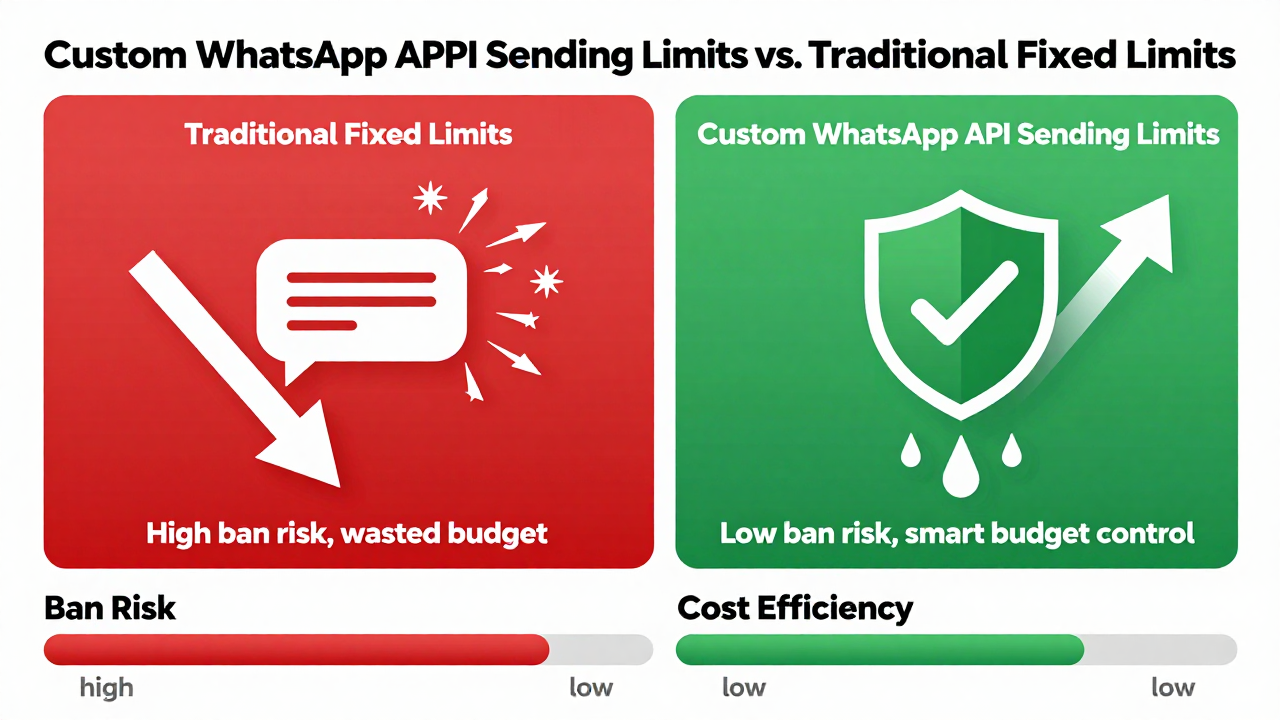
That's the core value of custom WhatsApp API sending limits: it's not a fixed cage, but a key you can adjust anytime. You control the pace instead of being pushed along by it.
How to Choose the Right Sending Limit Strategy for Your Business Stage
If you're a solo operator just starting out with a monthly budget in the low thousands, my advice is to keep daily sending limits between 50–100 messages and focus on one-on-one deep conversations. At this stage, limits aren't your bottleneck—your messaging and product quality are.
If you're a mature cross-border team doing six figures monthly, custom sending limits shine through segmented operations. Set different daily caps and content frequencies for existing customers, cart abandoners, and dormant users. Many providers support this granular API configuration, but surprisingly few people actually use it.
Here's a detail most people overlook: time zone settings. Many sellers spread their quota evenly across 24 hours, which means customers get messages at 3 AM and their annoyance levels spike. The right approach is to concentrate your daily quota into 2–3 active windows based on your target market's behavior. This is only possible with a custom-limit API.
Final Thoughts: Test Small First, Then Talk Long-Term Partnership
Whichever provider you ultimately choose—even the relatively stable platforms like Getfollow I mentioned earlier—I recommend starting with a small package and running real data for a week. Watch three metrics: delivery rate, open rate, and reply rate. If delivery falls below 85%, your number source is problematic. If open rate drops below 30%, your content or send timing needs work.
Custom WhatsApp API sending limits are essentially a "trust-first" tool. They let you test and learn safely during the early stages of building trust with the platform. Don't expect to strike it rich overnight. Instead, accumulate your account's "reputation points" through every low-risk touch.
In cross-border business, the ones who survive longest aren't the fastest runners—they're the ones who brake most steadily. I hope this breakdown of custom WhatsApp API sending limits helps you avoid a few unnecessary detours.
Frequently Asked Questions
What is a custom WhatsApp API sending limit?
A custom sending limit lets you control how many WhatsApp messages your business account can send per day, adjusting the volume dynamically based on your account health, audience engagement, and business needs—rather than being locked into a fixed number.
Can I get unlimited WhatsApp API sending limits?
No. WhatsApp's official API has no "unlimited" option. Any provider claiming otherwise is either using unofficial methods that risk permanent bans or spreading volume across multiple sub-accounts, which creates management headaches and compliance issues.
How do I avoid getting banned when using WhatsApp API?
Start with low daily volumes, warm up new accounts gradually, segment your audience by engagement level, respect recipient time zones, and monitor delivery rates closely. Custom sending limits give you the flexibility to adjust these parameters in real time.
What's the ideal daily sending volume for a new WhatsApp API account?
For new accounts, industry best practice suggests starting at 50–100 messages per day and gradually increasing as your account reputation builds. High-quality, targeted messages always outperform high-volume blasts.
How much does a custom WhatsApp API sending limit cost?
Pricing varies by provider, but most charge based on actual delivered messages rather than a flat fee. Some platforms offer tiered packages starting around $50–$100 per month for small volumes, with custom-limit features included in mid-tier plans.