WhatsApp Bulk Messaging Without Getting Banned: A Practical Guide to Account Safety and Compliant Outreach
WhatsApp Bulk Messaging Without Getting Banned: A Practical Guide to Account Safety and Compliant Outreach
In my two years working in foreign trade, the most common complaint I hear isn't "we don't have clients"—it's "we lost our numbers again." After mid-2024, WhatsApp's risk controls tightened noticeably. Teams that relied on aggressive bulk blasting watched thousands of accounts get wiped out overnight. This isn't an isolated issue; it's an industry-wide shakeout.
Cross-border sellers consistently report that the current ban logic is no longer just about "sending too frequently." It's a multi-dimensional cross-check—device fingerprints, content similarity, social graph density, even the format of your imported numbers all feed into the risk model. In other words, if you're still using the three-year-old playbook of "import CSV → fire away → spam," you're basically walking into a trap.
Why Accounts Get Banned: It's Not Volume, It's "Looking Too Much Like a Bot"
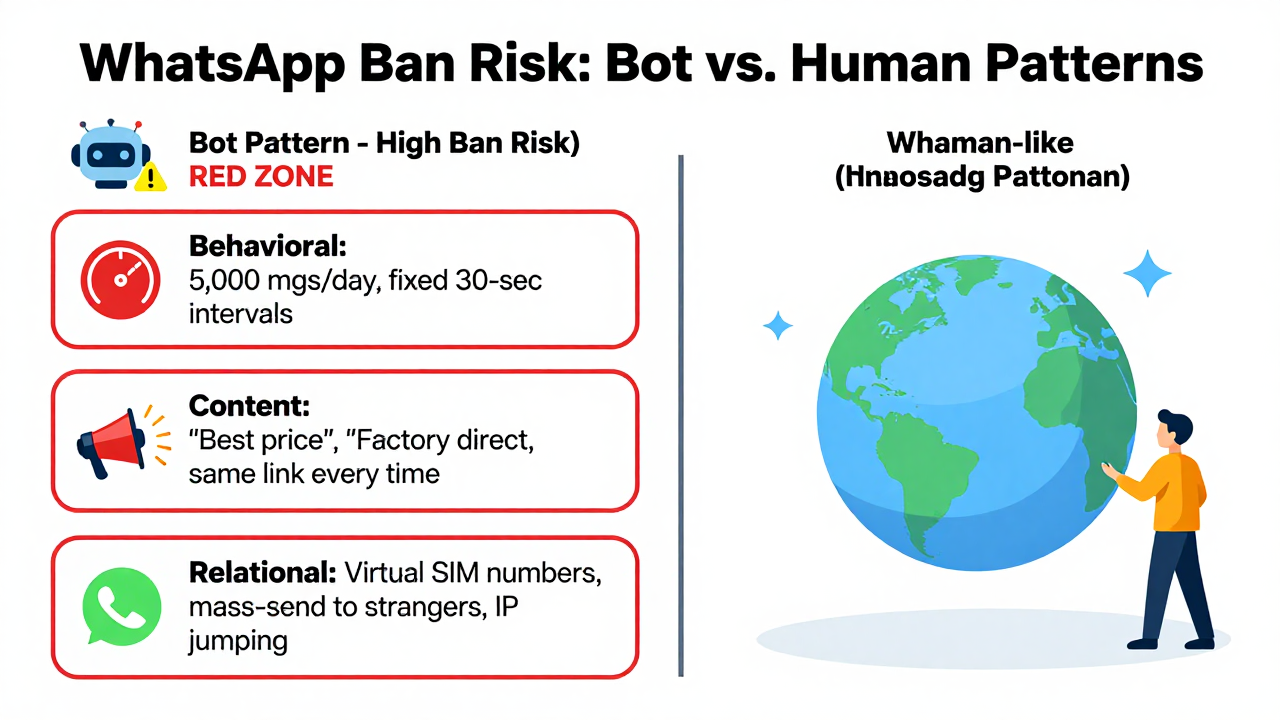
From my experience, WhatsApp's ban mechanism works on three layers. The first is behavioral—messages per second, daily totals. The second is content-based—whether your link domain is flagged or your copy contains high-frequency spam words. The third is relational—whether a new number immediately mass-sends or gets reported by multiple strangers. Most people only watch the first layer, missing the real silent killers in layers two and three.
Here's a real example. A friend of mine in the machinery parts business used a supposedly "ban-proof" bulk tool in early 2025, sending 5,000 messages a day. His account died on day three. When we reviewed the data, his copy was loaded with phrases like "best price" and "factory direct," and every single message carried the same short link—a textbook marketing pattern in the risk system. Worse, his numbers were bulk-registered virtual SIMs with extremely low trust scores. He didn't even get a chance to appeal.
Account Weight Is Everything: Warming Up Beats Blasting
Industry consensus says a brand-new WhatsApp account needs at least 10–15 days of warm-up. During that period, you simulate real human behavior: complete your profile photo, bio, and status; add a few genuine contacts; occasionally post status updates; even join a group or two for light participation. Many cross-border businesses can't stomach this waiting period. But here's the reality—an account with no trust score might only see 2–3 out of 100 messages actually delivered, and it'll trigger verification almost immediately.
One detail most people overlook: WhatsApp tracks how often your IP address changes. If you batch-login through emulators or cloud phones with jumping IPs, the backend flags you as "unusual device activity." My recommendation: bind each batch of accounts to a fixed IP. Even residential proxies are far safer than datacenter IPs.
Content Strategy: Turn "Advertisements" Into "Conversations"
Most foreign trade sales reps open with something like "We are a professional manufacturer..." That phrasing barely works in cold emails, but on WhatsApp it's a death sentence. Instant messaging is built on conversational tone, not broadcast announcements. Think about how you react to an unsolicited SMS pitch—that's exactly how your prospect feels when they see your "perfectly crafted" message.
From my hands-on testing, changing the first line to "Hi [Name], saw your company deals with [product], we happen to make [complementary product]"—a specific, pointed opener—can lift reply rates by 3–5x. More importantly, this type of content rarely gets mass-reported because each message reads like a human wrote it, not a template.
Links are the biggest ban trigger. If you absolutely must include them, follow two rules: use a newly registered domain tied to a business email, and never put a link in every message—space them out. Across the board, sellers report that plain-text messages get banned at roughly one-quarter the rate of messages with links.
Send Pacing: Slow Is Fast
The most reckless bulk plan I've seen was "1,000 messages a day for 7 days straight." That setup surviving past day three is pure luck. WhatsApp has an invisible threshold on new conversations per day—new accounts should stay around 50–80, and even mature accounts shouldn't exceed 200. Send intervals need to be randomized too; you can't fire one message every 30 seconds like clockwork.
A safer rhythm: split sends across 3–4 time blocks daily, with 10–20 minute gaps between blocks, and 15–45 second random delays between individual messages. It's less efficient, but it's stable. Remember—you're nurturing clients, not chasing a quota.
Industry Snapshot: Service Providers Are Splitting Into Two Camps
Bulk messaging tools on the market today fall into two buckets. The first is the "bareback" type—pure scripted click simulation. Cheap, but ban rates are catastrophic. It's basically a scam targeting the desperate. The second is "compliance-first"—built on official APIs or enterprise-grade solutions. Higher cost, but your accounts stay protected. In the current landscape, platforms like Getfollow have built a solid reputation precisely because they follow this compliant playbook: first layering account weight across your matrix, then dynamically adjusting send strategy per account's health score, rather than blasting everything at full throttle.
One honest caveat: even the best compliance-focused providers can't guarantee zero bans. WhatsApp's rules shift constantly. Any tool is just a crutch—your core edge still comes from content quality and how well you qualify leads. If your product lacks competitive strength, no tool will save you.
Three Non-Negotiables When Choosing a Service Provider
First, check whether they offer an account warm-up phase instead of telling you to import numbers and start immediately. Second, verify they support content variables—auto-inserting the prospect's name, company, or other personalization into each message. Third, assess their post-sale response speed. Bans are a fact of life; what matters is whether they can help you appeal, swap numbers, and recalibrate strategy quickly after one happens.
A pattern we repeatedly see: trustworthy providers will actually advise you to send less. Their KPI is long-term retention, not short-term burn. Anyone who promises "10,000 messages a day with zero bans" should be an instant red flag.
Final Recommendation: Test Small First, Then Scale
Whether you build your own system or buy a third-party tool, start with a small test batch of 100–200 real numbers. Track delivery rates, reply rates, and ban rates over a week. If the numbers look healthy, gradually increase volume. Throughout the process, keep detailed send logs for every number—when something goes sideways, you need to pinpoint the cause immediately.
WhatsApp bulk messaging is essentially a counter-surveillance game. You don't need to outsmart the risk control system—you just need to be more careful and more patient than your competitors. Stop treating accounts as disposable. They're your cheapest customer acquisition asset.
If you've already been burned, or you're stuck choosing between providers, ask yourself one question: do I want "5,000 messages today," or do I want "numbers that still work three months from now"? Your answer changes everything.
Frequently Asked Questions
How many WhatsApp messages can I send per day without getting banned?
For new accounts, keep it to 50–80 messages daily. Established accounts with solid trust scores can push toward 200, but anything beyond that dramatically raises your risk. The key is gradual scaling and randomized intervals—not hitting a fixed number every day.
What triggers a WhatsApp ban in 2025?
Bans are triggered by a combination of factors: sending identical or near-identical content, including links in every message, using virtual or bulk-registered numbers, logging in from rapidly changing IP addresses, and receiving multiple user reports. It's rarely one single cause—it's the pattern that gets you flagged.
Can I recover a banned WhatsApp Business account?
Sometimes, yes. If your account was banned, you can submit an in-app appeal requesting a review. Success depends on your account history and whether you can prove legitimate use. That said, accounts with low trust scores (like virtual numbers) rarely get reinstated.
Is it safer to use WhatsApp Business API instead of bulk tools?
Yes. The official Business API is designed for high-volume messaging and operates within WhatsApp's approved framework. It costs more and requires setup through a solution provider, but it eliminates the bulk of ban risks associated with unofficial automation.
How long should I warm up a new WhatsApp account before sending bulk messages?
Plan for at least 10–15 days of active warm-up. Complete your profile, add contacts, post status updates, and engage in group conversations. The more your account mirrors real human behavior, the higher its trust score when you start outreach.