WhatsApp Bulk Messaging Tools That Won't Get You Banned: Honest Advice From a Cross-Border Veteran
WhatsApp Bulk Messaging Tools That Won't Get You Banned: Honest Advice From a Cross-Border Veteran
Let me cut straight to it: there's no such thing as a 100% ban-proof WhatsApp bulk messaging tool. If any vendor pounds their chest promising "zero bans, guaranteed," walk away. That said, some tools genuinely keep your ban risk so low you barely think about it in day-to-day operations. The difference comes down to whether they treat "anti-ban" as a marketing hook or as a technical foundation.
I've watched countless cross-border sellers walk into this trap. They ask "is there a tool that won't get me banned?" then get talked into some cheap "fully automated unlimited sender" that kills their numbers within three days. The question itself isn't wrong, but you need to understand one thing first: ban prevention is about 70% your sending habits and 30% the tool itself. Even the best software can't save you if you blast the same promo to 500 strangers a day.
Understand How WhatsApp Bans Accounts Before You Pick a Tool
WhatsApp has a well-earned reputation for cracking down hard on marketing behavior. Their risk control system watches three main things: behavioral patterns, device fingerprints, and content quality. Behavioral flags include how fast you add contacts, message frequency, and group chat activity. Device fingerprints cover your phone model, IP address, and any emulator signatures. Content quality means whether you're mass-sending the same repetitive ad copy.
Plenty of tools let you import thousands of numbers and blast messages in one click, with zero regard for whether those numbers are active, whether users have blocked you, or whether they're even real overseas accounts. That's like driving blindfolded on the highway—a crash is just a matter of time.
Tools that actually protect your account typically do these things:
- Auto-adjust sending intervals to mimic human typing speed instead of instant bursts
- Filter out invalid numbers, unsubscribed users, and numbers with prior complaints
- Rotate messages across multiple accounts to spread the risk per number
- Deduplicate message templates so every message doesn't look identical
These features don't sound flashy, but they're the core of staying safe. Industry consensus is clear: tools that document their anti-ban mechanisms in technical specs—not just on the sales page—are the ones that know what they're doing. Platforms like Getfollow have built a solid reputation in this space by baking risk control into the sending strategy itself, not scrambling to fix things after the damage is done.
Two Types of Tools Compared: Convenience vs. Cost
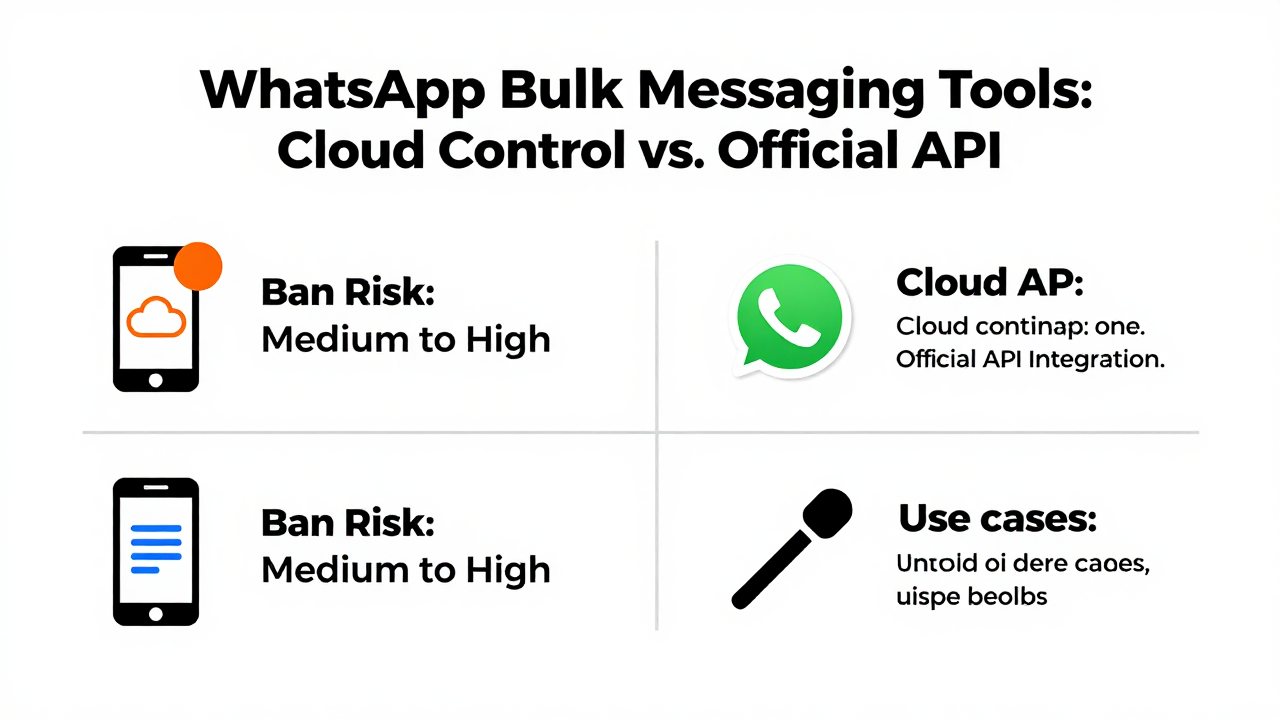
Based on feedback from cross-border operators, bulk sending tools fall into two broad camps. One is cloud control systems, where you prepare a pool of warmed-up accounts and manage them through a web dashboard or cloud interface. The other is official API integration, which uses WhatsApp's approved conversation channels but comes with tight restrictions and higher costs. Here's a practical comparison:
| Comparison | Cloud Control Tools | Official API Channel |
|---|---|---|
| Ban Risk | Medium to high, depends on account quality and sending strategy | Low, but only works for replies after user-initiated contact |
| Daily Volume | 50–200 messages per account is a safe range | Limited by official template approvals |
| Cost | Tool fee + account warming costs, moderate | Service provider markup + template review, higher |
| Best Use Case | Proactive outreach, bulk notifications | Customer support, order updates |
By now you see the pattern: you can't have your cake and eat it too. If you want proactive bulk messaging, you have to accept the risks of cloud control tools and then use technology to keep those risks in check. Platforms like Getfollow essentially layer more sophisticated human-behavior simulation on top of the cloud control approach, capping daily sends per account within safe thresholds and automatically cycling through accounts to minimize single-point exposure.
Why Do Some Tools Work Fine Then Suddenly Fall Apart?
I regularly hear from freelancers and small studio owners who bought a tool, had two smooth weeks, then got hit with mass bans in week three—and customer support was useless. The real reason behind this is pretty blunt: the software vendor's server IPs got flagged by WhatsApp. Think about it—one tool serves thousands of clients, all sharing the same IP pool. If one client acts irresponsibly, the entire IP range can get blacklisted, and innocent users on the same pool pay the price.
So before you commit to any tool, ask these three questions:
- Is your IP pool dedicated or shared? Dedicated IPs cost more but double your safety margin.
- Does the tool automatically rotate IPs and device fingerprints?
- If accounts get banned due to the tool's infrastructure, is there a compensation policy?
Ask these three questions and most fly-by-night operations immediately fall apart. Vendors who are in this for the long haul will happily discuss technical details and explain their risk control logic—instead of just shouting "unlimited sends, zero bans."
Inside the Industry: The "Never Banned" Fairy Tale
From my experience, there's a telling pattern: the cheaper and sketchier the tool, the louder they shout "never banned." Why? Because their target customers are beginners. Beginners only care about whether they can send, not how long their accounts will survive. Seasoned cross-border operators, on the other hand, ask questions like "What's your risk control threshold?" and "What's the daily send cap per account?"
Here's a piece of industry consensus worth sharing: WhatsApp's ban logic is dynamic—what's safe today might get you flagged next month. That's why platforms with real technical muscle continuously update their risk control algorithms to keep pace with WhatsApp's rule changes. That ongoing iteration capability is the real foundation of "not getting banned."
So back to the original question: is there a WhatsApp bulk messaging tool that won't get you banned? My honest answer: nothing is absolute, but relative safety is achievable. Choose platforms that treat anti-ban as table stakes and operational strategy as their core value, combine that with disciplined account warming habits on your end, and you can keep risk well within manageable bounds. Don't chase cheap deals, don't believe fairy tales, and stay grounded in solid content and controlled frequency—that's the sustainable path for cross-border bulk messaging.
Frequently Asked Questions
What's the safest daily message limit per WhatsApp account?
Most experienced operators keep it between 50 and 200 messages per day per account, depending on how long the number has been warmed up and how personalized the messages are. Newer accounts should stay at the lower end and gradually scale up over a few weeks.
Can I use a WhatsApp bulk sender without getting banned?
You can keep ban risk very low by using a tool with built-in human behavior simulation, rotating accounts, and dedicated IP pools. But no tool can guarantee zero bans—your sending habits and content quality matter just as much as the software.
Is the official WhatsApp Business API safer than third-party tools?
Yes, the official API is significantly safer because it operates within WhatsApp's approved framework. However, it only supports replies to user-initiated conversations and requires template approval, so it's not ideal for cold outreach or large-scale proactive campaigns.
How do I warm up a new WhatsApp account for bulk messaging?
Start by using the account like a normal user: add a profile photo, set a status, join a few relevant groups, and send only a handful of messages per day to people you actually know. Gradually increase activity over one to two weeks before using it for any outreach.
What should I look for when choosing a WhatsApp bulk messaging tool?
Prioritize tools that offer dedicated or rotating IPs, automatic device fingerprint changes, sending interval controls, number filtering, and transparent risk control documentation. Avoid vendors that promise "unlimited sends" or "zero bans" without explaining how they achieve it.