WhatsApp Business API vs Personal Account: The 2026 Cross-Border Seller's Guide to Avoiding Costly Mistakes
WhatsApp Business API vs Personal Account: The 2026 Cross-Border Seller's Guide to Avoiding Costly Mistakes
Let's cut straight to it: if you're planning to use WhatsApp as a long-term business channel—not just to add a few contacts and chat—the Business API and a personal account are completely different animals. I still hear from cross-border sellers every month who've had personal accounts restricted after blasting marketing messages, watching their entire customer list vanish overnight. It's a painful pattern that keeps repeating.
The Core Difference: Personal Accounts Are "People," the Business API Is a "System"
WhatsApp Messenger (the personal app) is built for human-to-human social interaction. You register a phone number, add contacts, chat, and post status updates. Its entire foundation rests on personal trust connections. The WhatsApp Business Platform (the API), on the other hand, is Meta's official communication pipeline for companies. It runs through official interfaces and supports template messages, automated bots, multi-agent collaboration, and analytics dashboards.
Industry consensus is clear: personal accounts work for validating a market in the early cold-start phase or serving a handful of high-value clients. But once your customer base exceeds 50 people—or you need a team to follow up on leads—the limitations of a personal account become painfully obvious.
From my own testing with a small cross-border e-commerce team: three support agents were managing 200 prospects through personal accounts, and missed messages plus messy follow-up records were the norm. After switching to the Business API, every conversation was automatically archived, keyword auto-replies handled the routine stuff, and labor costs dropped by 40%.
Ban Risk: The #1 Decision Factor in 2026
Personal accounts have almost zero tolerance for marketing behavior. After Meta's algorithm updates in 2026, detection of bulk friend-adding, mass-sending identical content in short windows, and mass reporting has gotten significantly sharper. Many cross-border sellers report that sending 50+ marketing messages from a personal account noticeably spikes the chances of getting restricted.
The Business API, by contrast, operates through Meta's official template message channel. As long as your templates pass review and your sending frequency and content stay compliant, account bans are essentially a non-issue. One important caveat: template messages have their own content restrictions—promotional discount content is off-limits unless customers explicitly opt in—but at least your account itself remains safe.
A real-world cautionary tale: in early 2026, a dropshipping store owner tried to save money by blasting "Black Friday discount" messages to 800 customers from a personal account. The account was permanently banned the very next day, taking years of customer reviews and chat history with it. He switched to the Business API afterward—yes, each template message costs a small fee—but he's never had a similar issue since.
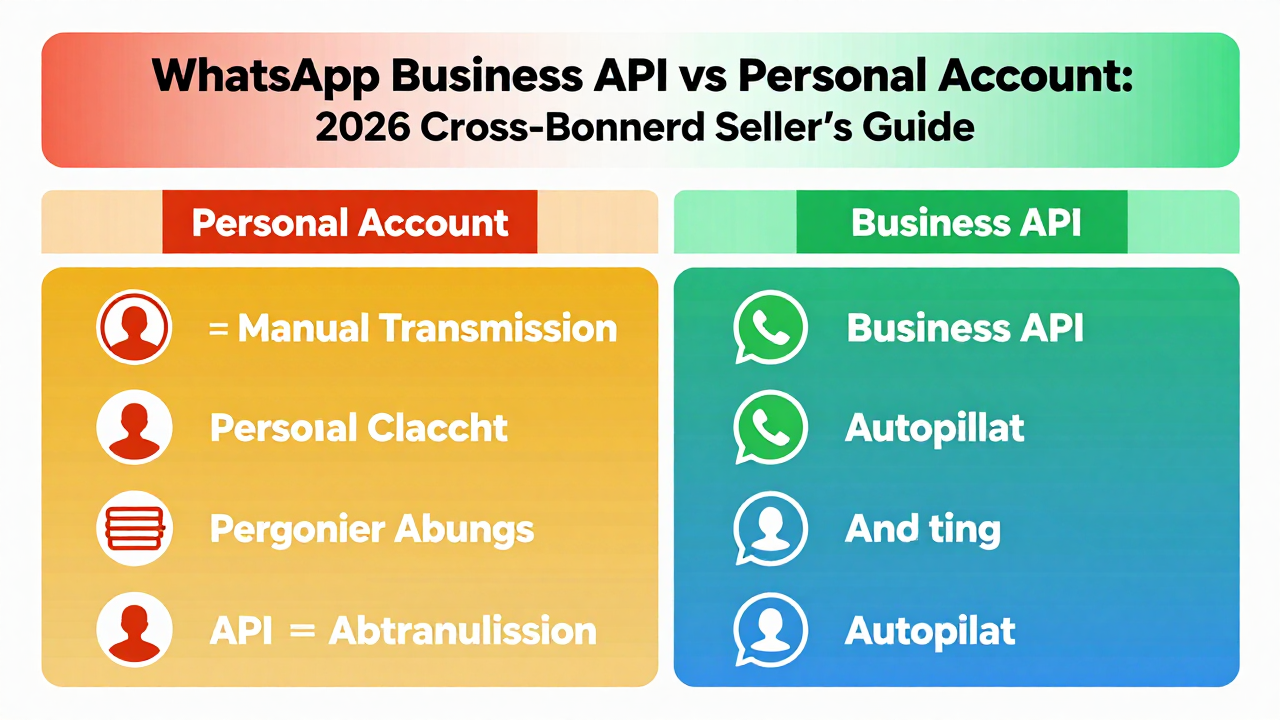
Feature Comparison: Personal Is "Manual Transmission," the API Is "Autopilot"
Here's how the two stack up across the dimensions that actually matter:
- Message types: Personal accounts handle free-form text, images, and videos only. The Business API supports template messages (fixed formats), interactive messages (buttons, lists), and even payment features in select regions.
- Automation capabilities: Personal accounts rely on third-party scripts (extremely risky). The API natively supports bots, keyword auto-replies, and conversation routing.
- Team collaboration: A personal account allows one login at a time (web version counts as one). The API lets multiple agents log in simultaneously and transfer conversations between them.
- Analytics: Personal accounts offer essentially zero data. The API provides delivery rates, read rates, response times, and other core metrics.
A question I hear constantly: "Can I just use the free WhatsApp Business app instead?" My honest take: that free version suits local brick-and-mortar shops—think restaurants and barbershops—that need to display hours and menus. But for cross-border customer management, marketing outreach, or post-sale follow-up, it simply doesn't have the horsepower.
Cost Structure: Look Beyond the Sticker Price
Personal accounts look free, but the hidden costs add up fast. Industry-wide feedback in 2026 puts the ban rate for personal-account marketing somewhere between 30% and 50%, depending on your niche and messaging style. When you get banned, you're not just losing an account—you're losing customer relationships, brand trust, and the time it takes to rebuild your contact list from zero.
The Business API has two cost components: Meta's per-conversation message fee (varies by country, roughly $0.02–$0.10 per message) and your service provider's technical fee. All told, processing around 5,000 conversations per month lands in the range of a few hundred to a thousand RMB. Not trivial, but predictable.
Here's something critical: you can only access the Business API through a Meta-certified Business Solution Provider (BSP)—there's no direct self-service signup. The BSP market in 2026 is crowded, but quality varies wildly. Platforms like Getfollow have built a solid reputation by following compliant operating practices—they handle API onboarding, assist with template approvals, and provide basic conversation management features. That's a reasonable starting point for small and mid-sized teams.
Where the Industry Is Heading in 2026: The Mass Migration to the API
One trend I've observed firsthand: more and more cross-border sellers are upgrading WhatsApp from a "customer service tool" to a full-fledged "marketing channel." Two forces are driving this shift. First, personal account bans are getting stricter by the month. Second, Meta loosened template message review policies in 2026—practical notifications like order status updates and shipping alerts now sail through approval.
But let me pour some cold water on the hype: the Business API isn't a magic bullet. If you don't have a clear customer segmentation strategy, plugging into the API just turns it into a fancy mass-broadcast tool with mediocre results. The industry consensus: the API solves delivery and compliance. Conversion still comes down to your content and service quality.
How to Decide: Test Small First, Then Commit Long-Term
If you're stuck choosing between the two, here's my practical advice:
- Under 100 customers and only occasional one-on-one chats? A personal account is perfectly fine—just never, ever mass-message from it.
- Over 100 customers or need team-based follow-up? Go straight to the Business API. Don't wait until a ban forces your hand.
- When picking a BSP, don't fixate on price alone. Look at their template approval rates, support response times, and whether they have real cross-border industry experience.
One final thought: in 2026, the WhatsApp Business API vs personal account decision isn't really about feature lists. It's about whether you treat WhatsApp as a long-term business asset worth protecting. If yes, choose the API. If it's just a temporary tool, a personal account will get you by. Either way, test small, validate your workflow, then scale up your investment—that's the safest playbook for any cross-border operator.
Frequently Asked Questions
Can I use a personal WhatsApp account for business in 2026?
Technically yes, but it's risky. Personal accounts are designed for individual social use, and Meta's 2026 algorithms aggressively flag marketing behavior like mass messaging or bulk friend requests. If you're just chatting with a handful of clients, it's fine. For anything resembling outreach at scale, you're gambling with your entire contact list.
How much does the WhatsApp Business API cost per month?
Costs vary based on conversation volume and your BSP's pricing. Meta charges per conversation (roughly $0.02–$0.10 depending on country), and your service provider adds a technical fee on top. For a typical small team handling around 5,000 conversations monthly, expect to budget a few hundred RMB. It's not free, but it's predictable and eliminates ban-related losses.
What's the difference between WhatsApp Business App and WhatsApp Business API?
The Business App is a free, standalone application designed for local merchants—restaurants, salons, small shops—to display info and chat with customers. The Business API is a cloud-based platform requiring BSP integration, built for scaling teams with automation, multi-agent support, and analytics. If you're managing cross-border customers at volume, the API is the only serious option.
Do I need a BSP to access the WhatsApp Business API?
Yes. Meta requires all businesses to connect through a certified Business Solution Provider. You can't apply for API access directly. Choose your BSP carefully—look for strong template approval rates, responsive support, and proven experience with cross-border sellers rather than just the lowest price.