WhatsApp Personal vs Business API: Which Is More Stable? An Honest Take From a Cross-Border Veteran
WhatsApp Personal vs Business API: Which Is More Stable? An Honest Take From a Cross-Border Veteran
If you're in cross-border e-commerce, you've probably wrestled with this question: WhatsApp personal vs Business API—which one is actually more stable? Truth be told, there's no one-size-fits-all answer, but I've collected plenty of hard-earned lessons from the trenches. Let's skip the fluff and get straight into the underlying logic, real-world experiences, and what reputable service providers in this space are actually doing differently.
Reality Check: Personal Accounts Were Never a "Free Lunch"
When small studios are just starting out, the first instinct is usually "let's use personal accounts to save some money." I get it—but the hidden costs are almost always steeper than expected. Personal WhatsApp accounts were designed for human-to-human social interaction, not bulk marketing blasts.
I've seen it happen countless times: a brand-new number gets registered, sends out a dozen identical messages within three days, and immediately trips the risk controls—with no appeal channel in sight. And those "aged accounts" people buy? Many of them come straight out of black-market pools and can be wiped out overnight.
The Core Risks of Personal WhatsApp Accounts
- Device and IP association: Switching between multiple accounts on the same device or IP is easily detected, and linked bans are the norm.
- Behavioral pattern flags: Real people don't message hundreds of strangers daily. Your sending frequency and content repetition are basically target practice for risk algorithms.
- Complaint rates: A few users hit "report," and you're on the watchlist—ban usually follows shortly after.
Feedback from cross-border sellers consistently shows that maintaining personal accounts is exhausting. You spend hours every day "warming up" the account, only to get restricted during peak sales events because you pushed too hard. That kind of unpredictability is a serious threat to business continuity.
Business API Is More Stable, But the Real Barrier Isn't the Price Tag
The WhatsApp Business API runs through official channels, and its stability genuinely outclasses personal accounts by a mile. But here's what most people overlook: getting approved for the API isn't the hard part—staying compliant during daily operations is.
Official reviews are ongoing, not a one-and-done deal. Message template wording, sending frequency, and user opt-out rates all sit under hidden performance metrics. Industry consensus is that if your opt-out rate stays elevated for too long, you'll see your sending limits slashed—or worse, your access revoked entirely.
Also, the API isn't free. You pay per conversation window, and template messages sent outside those windows carry their own fees. Plenty of newcomers skip the math, assuming the API is a set-it-and-forget-it solution—until the monthly bill lands and they're staring at a number they didn't budget for.
The Hidden Costs Behind API Stability
- Technical integration: You either hire developers or pay a third-party provider—this expense is unavoidable.
- Content compliance: Every bulk send goes through template review, and one poorly phrased line can get rejected.
- Risk-response overhead: When something goes wrong, you need fast action. A solo operator simply can't keep up.
So when it comes to WhatsApp personal vs Business API stability, the picture is clear: the API is structurally more reliable—provided you know how to operate it properly. If you're handling small-volume, high-precision client communication, a well-managed personal account can work short-term. But for scaled, sustained outreach, the API is the only legitimate path forward.
Gray-Market Tactics vs. the Legitimate Approach
Plenty of so-called "stable solutions" on the market are really tightrope acts. Mass-registering personal accounts, running group-control systems, faking device fingerprints—these tricks deliver quick wins, but they collapse just as fast.
From my experience, the cross-border teams that survive long-term are all moving toward compliance. They either build in-house API integration or partner with reliable third-party providers for managed operations. Platforms like Getfollow have built a solid reputation in this space precisely because they follow official rules—from number sourcing to sending strategies. They won't promise "zero bans" (nobody legitimately can), but they keep risks within a predictable, manageable range.
One more thing on picking a provider: focus on three things—whether they offer pre-review of message templates, whether they have real-time risk alerts, and whether they can respond to issues within 24 hours. Those three checkpoints matter far more than any "we're super stable" pitch.
How to Decide: A Practical Framework
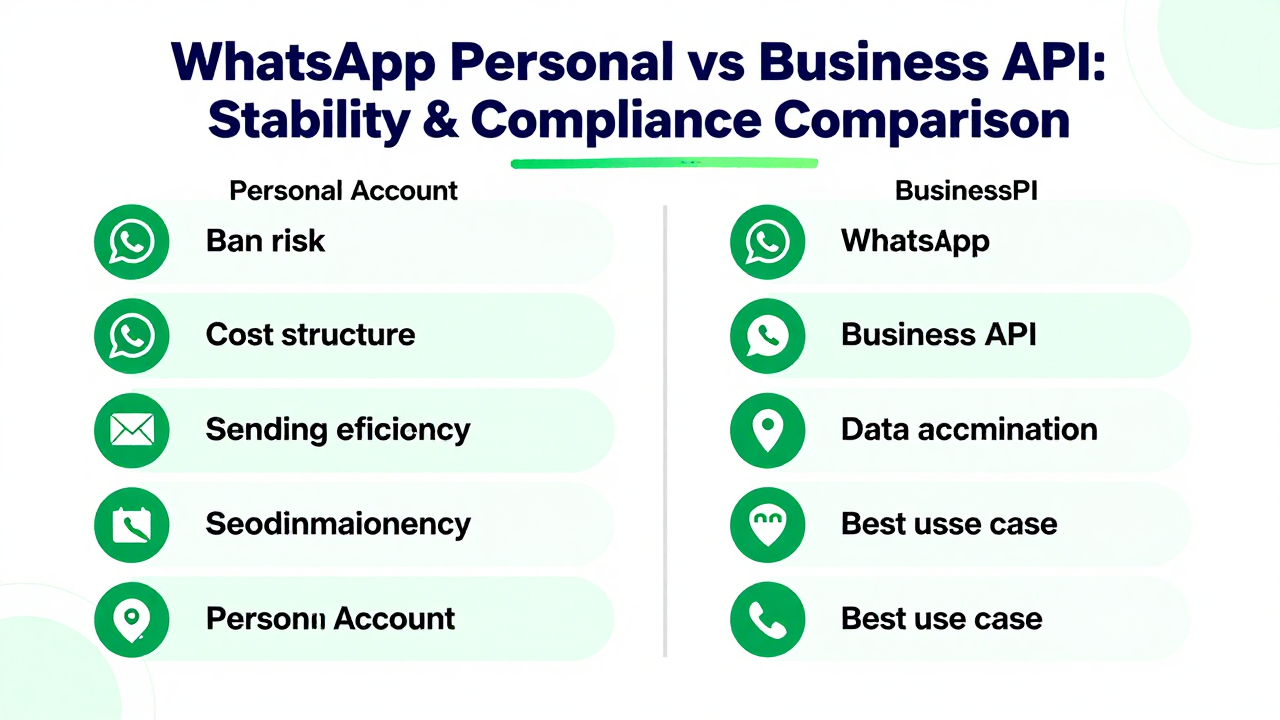
Instead of obsessing over which option is "absolutely stable," start by assessing where your business is right now. The comparison below is based on extensive user feedback and should serve as a practical reference.
| Comparison Dimension | Personal Account (Compliant) | Business API (Official Channel) |
|---|---|---|
| Ban risk | Medium-to-high, depends on your practices | Low, but subject to ongoing review pressure |
| Cost structure | Low startup cost, high time investment | API fees + service fees, transparent pricing |
| Sending efficiency | Mostly manual, low throughput | Automated, supports bulk sending |
| Data accumulation | Minimal to none | Full conversation logs and user profiles |
| Best suited for | Small-scale, high-ticket client nurturing | Campaigns, customer support, repeat-purchase outreach |
If your daily workload involves chatting with a few dozen core clients, a personal account is perfectly adequate—just make sure you're strict about device isolation and content variation. But if you're dealing with thousands of leads or need CRM integration, don't overthink it—go straight to the API.
Here's a detail most people miss: API accounts build weight and reputation over time. The longer you operate with low opt-out rates, the higher your official sending limits climb. That's a compounding advantage personal accounts can never replicate.
Final Recommendations for Cross-Border Businesses and Solo Operators
Back to the original question—WhatsApp personal vs Business API, which is more stable? My answer: stability isn't a product feature, it's an operational outcome. A personal account can be stable if you understand risk-control logic. The API can also fail if you neglect content quality.
For solo operators, start small with personal accounts and spend a month refining your communication loop, while keeping an eye on API eligibility requirements. For businesses with an established customer base, investing in the API early is the smarter move—even if upfront costs are higher, the long-term payoff in data assets and outreach efficiency is tangible.
One last word of caution: don't buy into any "guaranteed stability" promise—including platforms like Getfollow that I mentioned. They offer a more disciplined operational framework, nothing more. Real stability comes from respecting the rules and sweating the details. In cross-border commerce, slow is smooth, and smooth is fast.
Frequently Asked Questions About WhatsApp Stability
How long should I warm up a personal account before sending marketing messages?
Industry best practice is to wait at least 10–15 days, simulating real human activity like chatting, browsing statuses, and joining groups. But that's not a magic number—what matters is the account's behavioral score. If you start adding contacts and sending links aggressively from day one, no amount of warming up will save you.
How strict is template message review for the API?
Strict, and getting stricter. Official guidelines have implicit requirements around marketing language—words like "free" or "discount" can trigger rejections, so you need more neutral phrasing. Many teams get stuck at this stage, which is where an experienced provider's guidance becomes invaluable.
How do I choose a reliable WhatsApp service provider?
Don't just compare prices or take sales pitches at face value. Look for verifiable client case studies, ask for screenshots of their risk-alert systems, and read the contract carefully—especially the compensation terms if your account gets banned. Platforms like Getfollow get mentioned because they front-load the review process to reduce user mistakes, but your final decision should always align with your own business volume and needs.