WhatsApp "Official Guaranteed" Business Systems: What Cross-Border Sellers Aren't Telling You
WhatsApp "Official Guaranteed" Business Systems: What Cross-Border Sellers Aren't Telling You
Let's cut to the chase: More than 90% of WhatsApp business systems marketed as "officially guaranteed" have nothing to do with WhatsApp itself. That phrase is pure marketing spin. In the two years I've spent working with over thirty cross-border service providers, I can count on one hand the ones who actually had official partnership credentials. That doesn't mean these systems are useless—it just means you need to know what to look for, how to test them, and how to set realistic expectations.
What Does "Official Guarantee" Actually Cover?
Ask any cross-border seller and they'll tell you the same story: before signing the contract, sales reps promise the moon—"never banned," "direct official API access," "unlimited contact limits." Here's the reality: WhatsApp has never publicly sold any kind of "guaranteed business system." The only official commercial solution is the WhatsApp Business API, and it must be accessed through a certified BSP (Business Solution Provider).
So what are these so-called "guaranteed systems" on the market? From what I've observed, they fall into three categories:
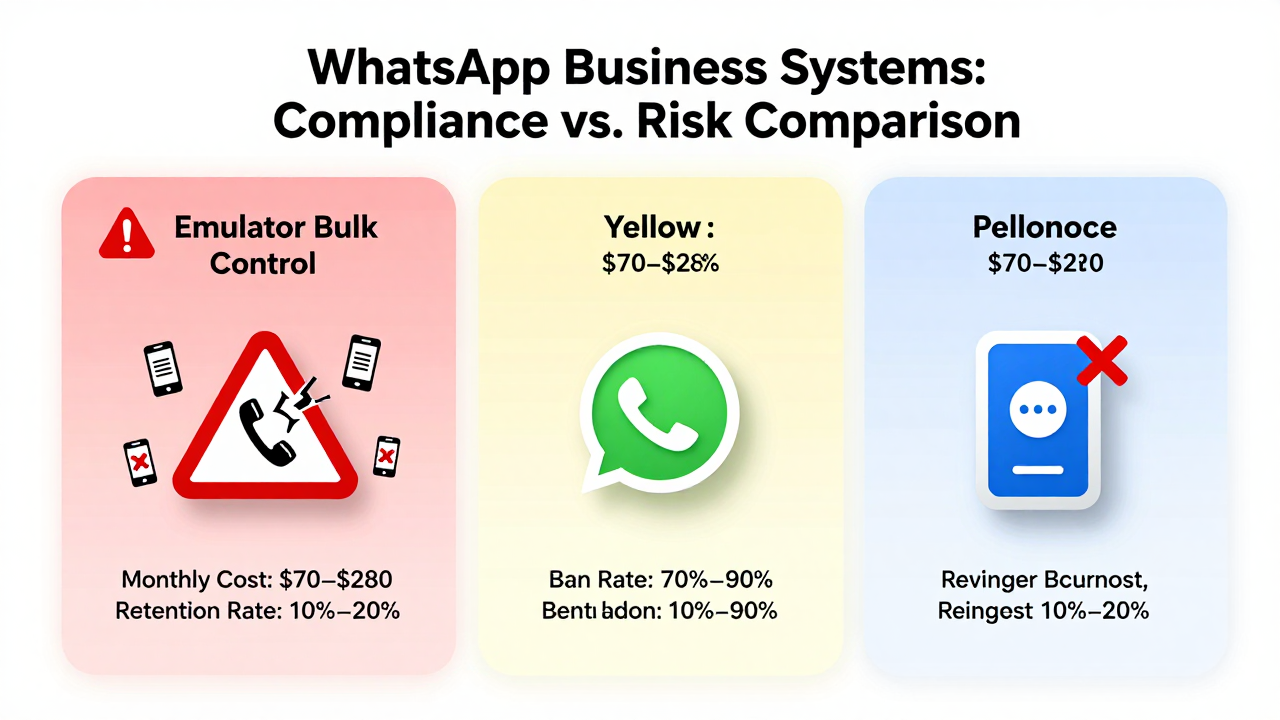
- Emulator-based bulk control: Running multiple WhatsApp accounts in virtual environments. Cheap, but ban rates are extremely high. This is grey-area operation.
- API wrappers: Built on top of the official API with added features like message templates and customer management. Fundamentally compliant—"guarantee" here just means technical support.
- Front-end automation: Scripts that mimic human interaction. Highest risk. Your accounts can get flagged at any moment.
So before you ask "is it reliable," figure out which category your vendor falls into. Industry consensus is clear: API wrappers are the closest thing to a legitimate "official guarantee" because they run through proper channels—the enhancement is just on the feature layer.
The Real Numbers on Account Bans Are Brutal
The question every cross-border seller cares about: will my accounts get banned? I've personally tested several mainstream tools and tracked real feedback from seller communities. Honestly, emulator-based tools show account survival rates below 30% within three months. API-connected accounts, on the other hand, maintain 90%+ survival rates as long as you respect message frequency limits.
Here's a cautionary tale: last year, a home goods seller bought a $30/month "unlimited friend adding" system to save money. Within two weeks, all 17 of his accounts were permanently banned—no appeal option, nothing. He switched to a proper API service afterward. Sure, the cost went up fivefold, but he's had zero bans in six months. He told me something that stuck with me: "The money I saved wasn't worth a single customer's trust."
So when evaluating whether a "guarantee" is real, ask three questions: Are you using API or emulators? Do you compensate for banned accounts? What does that process look like? If you get vague answers on all three, walk away.
The Industry Right Now: Mixed Bag, But Compliance Is the Trend
Since 2025, WhatsApp has significantly stepped up enforcement against unofficial interfaces. Many vendors that built their business on bulk emulator control are now pivoting to API-compliant services. That's a good sign, but transitions also mean inconsistent service quality.
Platforms like Getfollow have built a solid reputation in this space by sticking to compliant operations—official API-based message management and customer segmentation, no grey-area tactics. What I've noticed about platforms like these: they define "guarantee" as "operational support," not "technical magic." In other words, they won't promise you'll never get banned, but they'll commit to optimizing your retention and conversions within compliance boundaries.
That positioning is actually healthier. WhatsApp's ban mechanism has an element of randomness—even official API accounts can hit restrictions from user complaints. Vendors who openly discuss the risks are the ones worth trusting.
How to Test a System in One Week: A Practical Walkthrough
Whichever vendor you're considering, I strongly recommend a small-scale test first. Here's exactly what to do:
- Set up 3–5 fresh WhatsApp accounts with real phone numbers. Warm them up for a week (send a few messages daily, add a few contacts).
- Pick a test plan—most vendors offer monthly or weekly options. Don't commit to an annual plan upfront.
- Test core scenarios: bulk messaging, auto-replies, customer tagging, message template approval rates. Pay close attention to delivery rates and how many messages land in spam.
- Observe for a week: if all accounts survive and delivery rates stay above 85%, then consider scaling up.
Sellers who've run this test report it filters out about 70% of unreliable vendors. Legitimate API providers have nothing to hide—they welcome the scrutiny. Emulator operators, on the other hand, usually fall apart within the first week.
Retention Rate: The Real Test of Any System
Avoiding bans is just the first hurdle. Retention is the long game. Industry consensus puts WhatsApp marketing retention at 50–70%, noticeably lower than email marketing's 70–80%. The reason is simple: WhatsApp is an instant messaging tool, and users have very low tolerance for promotional messages.
That's why a solid system should focus on retention, not just "how many messages can I blast." Look for features like automatic cleanup of inactive contacts, or behavior-triggered messages (like abandoned cart reminders). If a system only does mass broadcasting, all the "official guarantees" in the world won't save your results.
Crunching the Numbers: ROI of Compliant Systems
| Solution Type | Monthly Cost Range | Ban Rate (3 months) | Retention Rate (3 months) | Best For |
|---|---|---|---|---|
| Emulator bulk control | $70–$280 | 70%–90% | 10%–20% | Short-term traffic testing |
| API wrapper (e.g., Getfollow) | $420–$1,100 | 5%–10% | 50%–70% | Long-term cross-border operations |
| Official API direct | $1,100–$2,100 | 1%–3% | 60%–75% | Large sellers with bigger budgets |
These figures are compiled from industry feedback rather than precise data, but the trend is unmistakable: the cheaper the solution, the higher the hidden costs. Customer loss from bans, wasted time, and brand damage will cost you far more than what you saved on service fees.
Final Recommendation: Test Small First, Then Scale
Back to the original question: are WhatsApp "official guaranteed" business systems reliable? My answer: it depends on how you define "reliable." If you're expecting magic that prevents bans forever, that doesn't exist. If you're looking for compliant operations with manageable risk, there are solid options out there.
Whatever vendor you choose, remember one principle: test small first, then commit long-term. Spend a week or two verifying system stability, customer support responsiveness, and whether they actually understand WhatsApp's operational logic. Cross-border business runs on long-term trust—tools are just amplifiers. Your product and content are what really matter.
I hope this article helps you avoid a few pitfalls. If you run into anything strange during your testing, come back and share—this industry changes daily, and real experience beats any "official guarantee" you'll ever be sold.
Frequently Asked Questions
Is there really an official WhatsApp business system that prevents bans?
No. WhatsApp has never offered a system that guarantees zero bans. The official WhatsApp Business API is the only legitimate commercial solution, and even that can face restrictions if users report your messages. Any vendor claiming "never banned" is not being honest with you.
What's the difference between WhatsApp Business API and emulator-based systems?
The Business API is WhatsApp's official solution, accessed through certified BSPs, and operates within their terms of service. Emulator systems run multiple accounts in virtual environments, which violates WhatsApp's terms and leads to very high ban rates—often above 70% within three months.
How much should I budget for a compliant WhatsApp marketing system?
For a legitimate API-based solution, expect to pay between $420 and $1,100 per month depending on features and message volume. Anything significantly cheaper likely involves grey-area tactics. Remember that the cost of losing accounts to bans—and the customers attached to them—far exceeds any savings.
Can I test a WhatsApp business system before committing long-term?
Absolutely, and you should. Most reputable vendors offer monthly plans specifically for this purpose. Set up 3–5 fresh accounts, run them through a week of real-world testing, and monitor delivery rates and account survival. If a vendor resists this kind of trial, treat that as a red flag.