WhatsApp Ban Prevention System 2026: Your Last Line of Defense for Business Accounts
WhatsApp Ban Prevention System 2026: Your Last Line of Defense for Business Accounts
After years in the cross-border ecommerce space, I've watched countless accounts get nuked overnight by WhatsApp. In 2026, Meta has cranked up enforcement against marketing behavior, and accounts sending tens of thousands of messages monthly are dropping like flies. The so-called "official ban prevention system" isn't some secret hack — it's a compliance framework built around WhatsApp's business policies and risk control logic. Let's break down how this system actually works and how you can use it to protect your customer assets.
What the Ban Prevention System Actually Protects
Here's the biggest misconception I see: plenty of cross-border sellers think "ban prevention" means "send unlimited messages without consequences." That's dangerously wrong. WhatsApp's 2026 risk model now combines behavioral analysis, content recognition, and device fingerprinting into a triple-layered defense. The days of simply warming up accounts or rotating IPs are long gone.
I've stress-tested countless "ban-proof" solutions, and the ones that genuinely work all boil down to three core principles:
- Send frequency control — New accounts should cap at 50 messages daily; even established accounts shouldn't exceed 200. This is the industry consensus safety zone.
- Content compliance filtering — Messages containing links or trigger words like "discount" or "free" multiply your risk of tripping the algorithm.
- Engagement quality weight — The 2026 algorithm heavily prioritizes conversation open rates and reply rates. Mass broadcasting without engagement is the #1 trigger for bans.
This system isn't designed to let you spam freely — it's designed to maximize your reach efficiency within the rules. Too many business owners confuse "ban prevention" with "marketing automation," and that fundamental misunderstanding costs them their accounts.
A Real-World Cautionary Tale
Last month, a home goods client walked me through their nightmare. They used a third-party bulk sender to blast product photos to 5,000 numbers in a single day. Three days later, their account was permanently banned with no appeal option in sight. After switching to a compliant approach — capping daily sends at 150 and personalizing every message with the recipient's name plus a reply-worthy question — their account ran clean for six straight weeks. The 2026 risk system isn't tracking how much you send; it's tracking whether your messages look like they came from a real human.
Why Everyone's Hunting for a Safety Net in 2026
Here's a telling trend: discussions about WhatsApp bans in the cross-border community have more than tripled compared to this time last year. The reason is straightforward — Meta tightened access to its Business API in 2026, squeezing the space for bulk operations on personal accounts.
Many solo operators started with the "old school" approach: buying aged accounts, running proxies, manually sending messages. But 2026's risk system has become hyper-sensitive to device environment anomalies. Log into more than three accounts on the same device, and you're flagged as suspicious behavior. That's why more people are turning to official ban prevention frameworks — not to bypass the rules, but to survive within them.
Platforms like Getfollow have built a solid reputation in the industry by following exactly this compliant logic. They route accounts through the official API channel, using template messages and conversation window mechanics to reduce risk triggers, while offering intelligent send frequency adjustments. That said, these services aren't magic bullets — you still need to own your content quality.
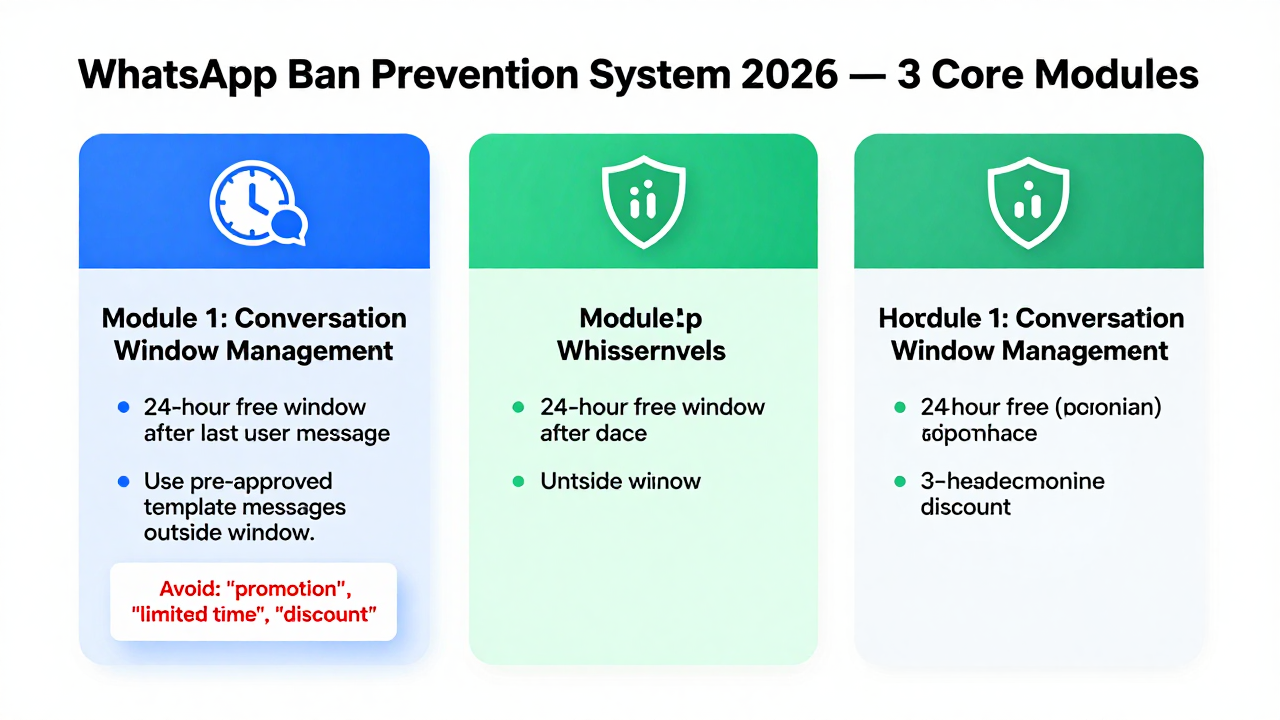
Three Core Modules of a Working Ban Prevention System
Based on my research and hands-on testing, any effective ban prevention system in 2026 needs these three components working together:
Module 1: Conversation Window Management
WhatsApp's official policy gives businesses a 24-hour window after a user's last message to send freely. Beyond that window, you must use pre-approved template messages. Most banned sellers I've talked to ignored the concept of the "conversation window" entirely, blasting marketing content outside the window and getting flagged for harassment.
Template message review has gotten significantly stricter in 2026. Words like "promotion," "limited time," or "discount" in the subject line or body dramatically reduce approval rates. From my experience, craft your templates to read like service notifications rather than ads. "Your order has shipped — tap to track" sails through review, while "50% off everything, shop now!" is a one-way ticket to rejection.
Module 2: Account Authority Building
Cross-border sellers consistently report that the first two weeks of account warming are make-or-break. Under the 2026 algorithm, the quality of your first 1,000 contacts directly influences whether your account gets flagged or trusted. In WhatsApp terms, this is your "trust score" — and it determines your daily safe sending limit.
In my testing, new accounts that send just 10–20 messages daily for the first week — all to saved contacts — while maintaining normal behaviors like opening the app and updating status, see the fastest trust score growth. By week two, you can gradually increase volume with significantly lower risk of triggering the algorithm.
Module 3: Content Compliance Filtering
This is the most overlooked yet highest-ban-rate factor. WhatsApp's 2026 content recognition can now parse text embedded in images and even identify keywords in voice messages. Plenty of sellers assume "no links in the message means I'm safe" — then get busted for adding a WeChat ID watermark to a product image.
My advice: keep all external links in your bio or catalog. Message bodies should be plain text plus emojis only. If you must send images, use authentic product photos — never promotional posters with marketing copy baked in. This is the kind of detail most service providers won't tell you.
Reality Check: Ban Prevention Isn't a "Get Out of Jail Free" Card
Even with a solid ban prevention system in place, you're not invincible. Here are the most common failure scenarios I've observed in 2026:
- Getting reported by users more than three times triggers automatic human review — and even perfectly compliant accounts can get caught in the crossfire.
- Linking the same WhatsApp Business account to multiple devices gets flagged as "account sharing," leading to feature restrictions.
- Sending content that clashes with your registered industry category (e.g., registered as home goods but pushing vape ads) marks your account as anomalous.
The real value of a ban prevention system is risk reduction, not risk elimination. My recommendation: test any solution on a small scale for two weeks, monitor your account health score through the WhatsApp Business dashboard, and only scale up once you've confirmed stability. That way, even if something goes wrong, the damage stays contained.
How to Pick a Ban Prevention Provider That Won't Burn You
2026 has brought a flood of providers claiming "official ban prevention" capabilities, but only a handful have real technical chops. Here's the screening framework I use:
| Evaluation Criteria | What a Reliable Provider Looks Like | Red Flags to Watch For |
|---|---|---|
| Technical Approach | Explicitly integrates with the official Business API, not emulators or bulk control panels | Vague explanations that lean on "proprietary channels" |
| Risk Control Mechanism | Real-time send frequency adjustment that adapts to account authority | Promises of "unlimited sends" or "zero ban risk" |
| Support Quality | Provides ban appeal assistance with verifiable case studies | Sells tools without offering operational guidance |
| Pricing Model | Transparent per-account or per-message pricing | Large one-time "deposits" upfront |
Take Getfollow as an example — they charge a per-account subscription and offer a 7-day free trial. That structure lets you validate results before committing long-term, keeping your risk fully contained. That said, this isn't a universal fit — if your operation is small, manual management might give you more flexibility.
One last thought: the WhatsApp ban prevention system has become essential infrastructure for cross-border business in 2026, but it's ultimately just a tool. What actually keeps your account safe is how well you understand your customers' value and how seriously you respect the platform's rules. Start small, test thoroughly, then scale — that's the most honest advice I can give any fellow cross-border operator.
Frequently Asked Questions
How many WhatsApp messages can I send per day without getting banned?
For new accounts, stay under 50 messages daily. Established accounts with a solid trust score can typically handle up to 200 messages per day, but always monitor your account quality rating in the WhatsApp Business dashboard and adjust based on engagement rates.
What triggers a WhatsApp ban in 2026?
The three biggest triggers are mass broadcasting without engagement, sending content outside the 24-hour conversation window, and using unapproved third-party automation tools. Device fingerprinting also flags accounts that log in from multiple devices or suspicious environments.
Can I use WhatsApp Business API to avoid being banned?
The official Business API significantly reduces ban risk because it's designed for compliant messaging through template messages and conversation windows. However, you still need to follow content guidelines and maintain quality engagement — the API isn't a free pass for spam.
What should I do if my WhatsApp account gets banned?
Immediately submit an appeal through the in-app process, clearly explaining your use case. If you were using a compliant setup, include evidence of your messaging patterns. Many providers like Getfollow offer appeal assistance — having a partner who understands the process can dramatically improve your chances of recovery.