WhatsApp Bulk Messaging Without Getting Banned: The 2026 Survival Guide for Cross-Border Sellers
WhatsApp Bulk Messaging Without Getting Banned: The 2026 Survival Guide for Cross-Border Sellers
I've spent years in cross-border ecommerce, and I've watched too many sellers lose everything on WhatsApp bulk messaging. You spend weeks warming up an account, send one marketing blast, and boom—permanently banned. All those contacts, gone overnight. This isn't a rare edge case anymore. WhatsApp's spam detection in 2026 has evolved into something genuinely sophisticated, and the old spray-and-pray approach is officially dead.
Here's the bottom line: In 2026, avoiding WhatsApp bans isn't about how many messages you send—it's about how precisely each message matches the person on the receiving end. "Precision" here means two things: the quality of the phone numbers themselves, and how well your message content aligns with what the recipient actually wants.
WhatsApp's Spam Detection Has Changed—Old Tactics Won't Work
A lot of cross-border sellers are still operating on pre-2026 assumptions. Buy a bulk sender tool, upload 50,000 numbers, hit send, pray. The result? Getting your account banned is the least of your problems. Your domain, your IP address, even your payment processing can get flagged and blacklisted by association.
From my observation, WhatsApp's spam detection has shifted from "single-point checks" to what I'd call "behavior chain analysis." What does that mean? The system no longer looks at just one message in isolation. It evaluates your entire journey—registration, account warming, adding contacts, sending messages—as one connected story. Any red flag at any stage adds weight to your risk score.
Industry observers agree that three metrics matter most right now:
- New account activity curve: Register an account and immediately blast thousands of messages? You're done. No real user behaves that way.
- Message report rate: Even if you send 10,000 messages, a report rate above 1% basically guarantees your account gets killed.
- Recipient engagement quality: Whether people reply, save your number, or click your links—all of this feeds into your account's trust score.
A common pattern we see in 2026: sellers aren't struggling with messages failing to send. The bigger headache is "shadow throttling"—your messages show as sent, but recipients never actually receive them. This silent form of spam detection is far more dangerous than an outright ban, because you have no idea anything's wrong, so you keep blasting into the void.
The Core Logic of Safe WhatsApp Bulk Messaging: Filter First, Then Reach Out
I worked with a home goods seller earlier this year who completely changed his approach. Before sending anything, he spent three days cleaning his contact list—removing inactive numbers, dead accounts, and suspected bots. Same 10,000 messages, but open rates jumped from 12% to 38%, reply rates quadrupled, and he never triggered a single spam warning.
That case illustrates the first line of defense: number filtering is non-negotiable for safe WhatsApp bulk messaging. Here's what that looks like in practice:
- Remove numbers that haven't been online in 30+ days (use WhatsApp's online status indicators to help judge)
- Remove numbers that other users have already flagged as spam
- Remove numbers completely unrelated to your product category (don't send B2B equipment promos to random consumer accounts)
The second line of defense is making your messages not feel like bulk messages. WhatsApp's semantic analysis in 2026 can easily recognize templated, mass-produced content. If your messages carry obvious sales language, shortened links, or discount codes, your flag risk goes through the roof.
My hands-on advice: write every message as if you're replying to one specific person. Open with their name or company name. Keep the body under three sentences. End with an open-ended question. Even if the recipient doesn't reply, the system reads this as normal social interaction—because that's exactly what it looks like.
The 2026 Service Provider Landscape: A Tale of Two Extremes
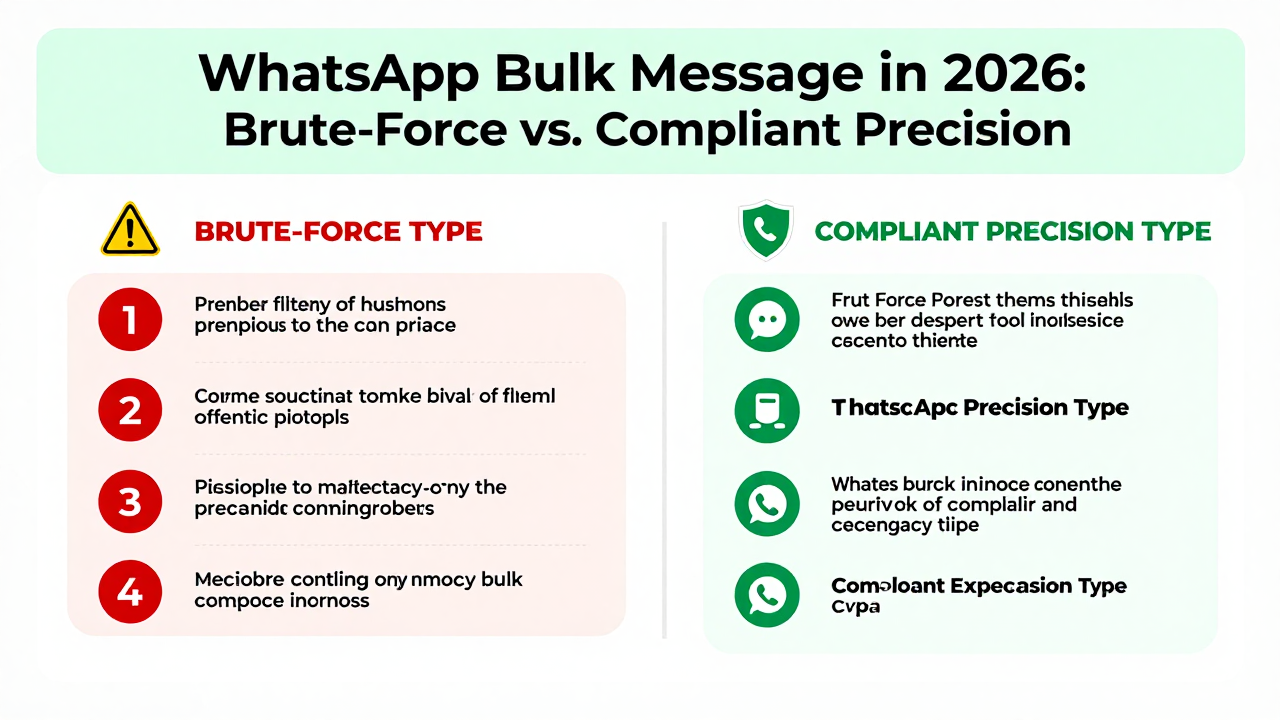
With stricter spam detection, the WhatsApp bulk messaging service industry has split into two very different camps. One side still sells "brute force" solutions—cheap, high-risk, and basically a scam targeting desperate sellers. The other side has pivoted to "compliant precision outreach," offering number cleaning, content optimization, and sending rhythm management.
Right now, the platforms with the most consistent reputation in the industry, like Getfollow, operate on this compliant model. They don't promise "100,000 messages a day, zero bans." Instead, they help you build account authority first, then scale gradually. It's slower, sure, but it's stable—your accounts actually survive long-term.
When evaluating a service provider, I recommend focusing on three dimensions:
| Evaluation Criteria | Brute-Force Type | Compliant Precision Type |
|---|---|---|
| Number filtering mechanism | None—import and blast | Multi-dimensional cleaning, removes invalid numbers |
| Sending rhythm control | One massive batch | Time-segmented, small batches |
| Content compliance support | No guidance offered | Provides localized message templates |
| Account safety protection | None—bans are your problem | Account warming guidance and backup plans |
From what many cross-border sellers report, the biggest trap in 2026 is choosing a provider based on price alone. Cheap solutions usually mean your numbers get recycled across multiple clients. By the time you send, those contacts have already been bombarded by five other sellers and developed serious immunity—or outright hostility. Send to those numbers and you're practically begging for a spam flag.
A Real Cautionary Tale: A $20,000 Lesson
Last year, a friend in the electronics accessories space came to me frustrated. He'd gotten five WhatsApp accounts banned in a row, each time right around the 500-contact mark. I dug into his setup and found the problem immediately: his bulk sender software was pushing out 20+ messages per second, with perfectly identical intervals between every single message.
That mechanical sending pattern is the textbook definition of "non-human behavior" in 2026's spam detection systems. Real people don't send messages at perfectly regular intervals, and they definitely don't do it nonstop for hours. I switched him to a hybrid approach—manual plus tools—capping each batch at 50 messages with randomized timing. His accounts finally stabilized.
The lesson here: most spam detection issues aren't about what you send—they're about how you send it. Frequency, timing distribution, message length, even your punctuation habits all feed into the system's judgment.
Long-Term Strategy: Shift from "Blasting" to "Customer Pool" Thinking
If you're still obsessing over "how do I send more messages at once" in 2026, you're already behind. The smart play is treating WhatsApp as a customer relationship management tool, not a megaphone.
My recommendation is to break bulk messaging into three steps:
- Build a tiered customer pool: Tag contacts by purchase intent, region, and product preference. Different pools get different message angles.
- Control your reach frequency: Each number gets at most 2–3 marketing messages per month. Everything else is value-added content to maintain the relationship.
- Track engagement data: Log open rates, reply rates, and conversion rates for every campaign. Use that data to refine your next round.
Execute this system properly, and you'll find that even with lower message volume, your actual sales go up. Every message reaches someone genuinely likely to care. They reply, your account authority climbs, and you enter a positive feedback loop.
One final piece of advice: whether you go solo or work with a service provider, always test small before scaling big. Run a pilot with 200–500 numbers for a week. Monitor account status and reply data. Only scale up once you've confirmed everything's stable. In WhatsApp's 2026 ecosystem, surviving matters more than sprinting.
Safe WhatsApp bulk messaging ultimately comes down to how deeply you understand the rules and how patiently you execute the details. I hope this guide helps you sidestep the obvious pitfalls and keeps your cross-border business moving forward with confidence in 2026.
Frequently Asked Questions
How many WhatsApp messages can I send per day without getting banned?
There's no fixed number that guarantees safety. In 2026, WhatsApp's spam detection evaluates your sending pattern, account age, and recipient engagement rather than just volume. For a new account, keep it under 50 messages per day. For a mature account with good history, 200–500 messages daily is generally manageable if spread across the day with natural intervals.
What triggers a WhatsApp ban in 2026?
The most common triggers are: sending identical templated messages to large lists, receiving a report rate above 1%, adding too many contacts too quickly, using unauthorized automation tools, and sending to numbers that have already flagged your account. The system also evaluates your overall behavior chain—registration, warming, and messaging patterns together.
Can I use WhatsApp Business API for bulk messaging instead of regular accounts?
Yes, the WhatsApp Business API is the officially sanctioned route for bulk messaging. It operates under Meta's commercial messaging policies, which require opt-in consent from recipients and prohibit certain content categories. It costs more and requires approval, but it eliminates most ban risks associated with consumer accounts.
How do I clean my WhatsApp contact list before sending bulk messages?
Start by removing numbers that haven't been online in 30+ days. Cross-reference your list against known spam databases. Remove any numbers that don't match your target audience profile. Some compliant service providers offer automated number cleaning as part of their package, which saves significant manual effort.
What should I write in a WhatsApp bulk message to avoid being flagged?
Write like you're messaging one person, not a list. Open with the recipient's name or company. Keep the body under three sentences. Avoid sales-heavy language, discount codes, and shortened URLs. End with an open-ended question that invites a reply. Personalization signals to the system that this is normal social communication, not spam.