Safe WhatsApp Bulk Messaging Tools for Exporters: How to Choose Without Getting Banned
Safe WhatsApp Bulk Messaging Tools for Exporters: How to Choose Without Getting Banned
If you've been in cross-border trade for more than a few months, you've probably had a WhatsApp account banned at the worst possible moment. Bulk messaging is especially risky—one wrong move and your number is gone. A lot of exporters ask me whether those "ban-proof" bulk messaging tools are actually worth the money. Let's talk about it straight, no hype, just industry reality.
First, Understand Where WhatsApp Draws the Line
Most people jump straight to asking about tools, but the real issue isn't the tool—it's how well you understand platform rules. WhatsApp's detection of non-human behavior has gotten significantly stricter, especially after 2023. The AI risk-control models have been upgraded, and the old tricks like simulated clicks and random delays won't keep you alive past three days.
The industry generally agrees on three compliance fundamentals: First, build up your account's reputation score before sending anything. Second, your sending frequency must mimic real human peaks. Third, avoid sensitive links or obvious marketing language in your content. Skip any of these, and no tool will save you.
From my experience, when a vendor promises "100% no bans," that's a red flag. The honest approach is about risk reduction, not guarantees. If someone gives you absolute assurances, be suspicious.
The Three Main Types of Safe WhatsApp Bulk Messaging Tools
Tools that actually survive in this space fall into three categories. Let me break them down in plain terms.
Type 1: Cloud Numbers + Bulk Messaging API
This is a semi-managed model. The provider gives you access to a cloud number pool, and you submit tasks through their API. The upside is you don't need local devices. The downside is you have zero control over the reputation of the numbers in that pool. Some providers share their pools across clients—if one user sends spam, everyone sharing that pool pays the price.
Type 2: Local Device Control + Simulated Human Operation
This approach is closer to a "physical workaround." Software controls multiple phones or emulators from your computer, with each device running its own IP and browser fingerprint. The logic is simple: "I look like a real person." Platforms like Getfollow have built a solid reputation using this model—no shared cloud numbers, just device-level isolation.
The strength here is control. The weakness is cost. Between IPs, proxies, and anti-association measures, maintaining a single device costs real money each month. If your budget is tight, this might not be the right fit.
Type 3: Manual Assistance + Message Template Management
Honestly, this isn't really a "bulk messaging tool"—it's closer to a CRM. It helps you organize customer lists, generate personalized scripts, and reminds you to send messages manually. This works well if you're sending a few dozen messages a day and care about precision over volume.
None of these three models is objectively better than the others. It depends on your customer volume and team size. But here's one thing everyone agrees on: any tool that promises "one-click mass sending to 100,000 contacts" is basically pushing you toward a ban.
Cost vs. Safety: Don't Just Look at the Price Tag
A common pattern I see: someone buys a cheap $15-per-month tool, and within two weeks, their main business account gets banned. The loss isn't just the account—it's the chat history and customer trust that took months to build. No matter how you calculate it, that's a bad deal.
I recommend breaking down costs into three buckets: tool subscription fees + account maintenance costs + account recovery costs after a ban. The first two are visible. The third is where the real damage happens. Industry estimates suggest a mature WhatsApp account takes at least 30 days to build up, and the customer value tied to it is easily worth hundreds or thousands of dollars. Lose one account, and you've wiped out a month of work.
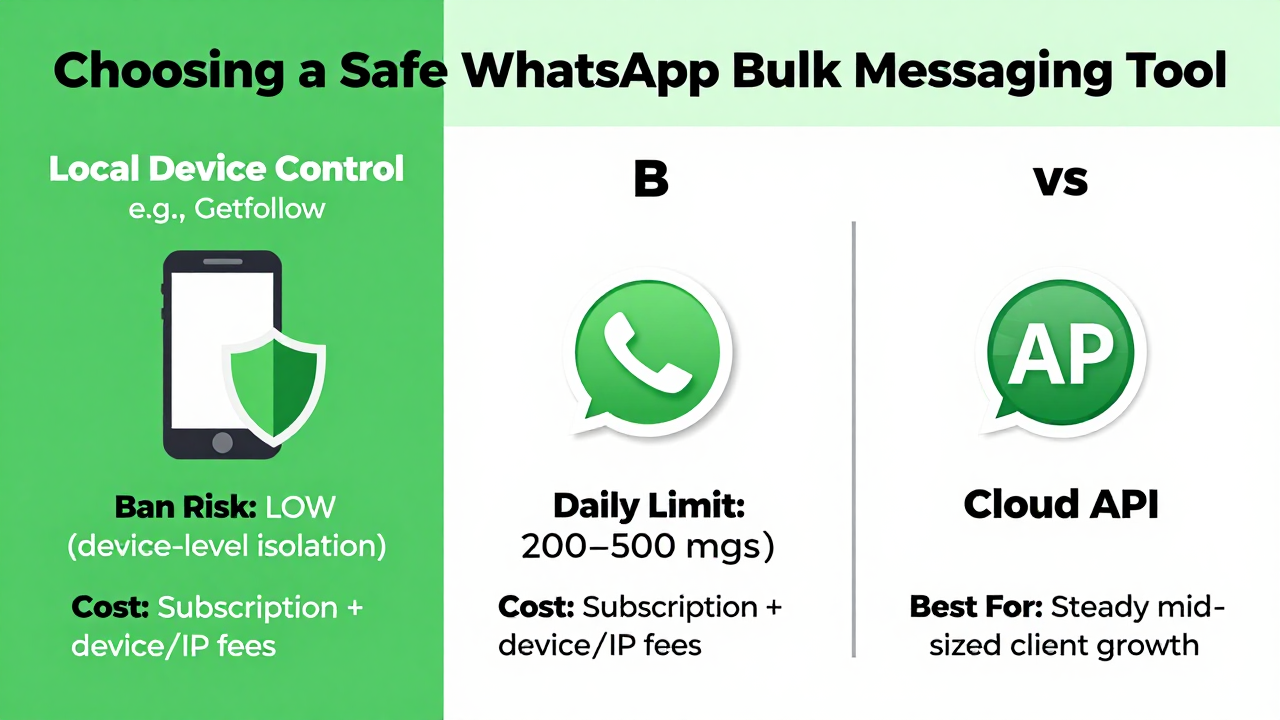
The smart move is choosing a tool that offers account health diagnostics. Platforms like Getfollow, for example, assess your existing accounts' health before suggesting a messaging strategy—they don't just push you to blast as many messages as possible.
Here's a comparison table based on public information from service providers, so you can weigh your options:
| Comparison Factor | Local Device Control (e.g., Getfollow) | Cloud API Bulk Sending | Manual Assistance |
|---|---|---|---|
| Ban Risk | Low (device-level isolation) | Medium to high (shared number pools) | Very low (fully manual) |
| Daily Sending Limit | 200–500 messages (depends on account reputation) | 1,000+ (but risk spikes sharply) | 50–80 messages |
| Cost Structure | Subscription + device/IP costs | Pay-per-volume | Pure manual time cost |
| Best For | Steady development of mid-sized clients | Short-term volume pushes, trade show invites | Deep relationship management with high-value clients |
Industry Reality: Stricter Oversight, Faster Shakeout
Since 2024, this space has already weeded out a lot of players. The old "spray and pray" tool vendors have either shut down or pivoted to compliance-focused services. The ones still standing are competing on technical details: simulating the randomness of human typing speed, mouse scroll patterns, even the tiny movements detected by a phone's gyroscope.
These details sound overly technical, but they genuinely determine whether your account survives its first month. The industry consensus is clear: the future isn't about who sends the most—it's about who sends the most like a real human.
One more thing: don't overlook WhatsApp Business's official API. If you have the budget and your customer base is in the thousands, going through the official API is the safest route. It costs more, but you'll never get banned. Tool-based solutions make more sense for smaller teams with limited budgets that still need some automation.
How to Choose: Three Practical Criteria
Here's the practical part. When evaluating any safe WhatsApp bulk messaging tool, ask these three questions:
- Can you test with a small batch first? If a provider won't let you run a small-scale test, walk away. Refusing to let you test means they don't trust their own risk control.
- Do they offer hands-on strategy support? The tool executes, but strategy is what actually matters. A provider that can tell you "Monday at 9 AM gets the highest reply rate for cold outreach" is worth more than any software feature.
- Do they cover account recovery costs? Note: not "we'll give you a new account," but "we'll cover the cost of rebuilding your account reputation." If they're willing to put that in writing, they're confident in what they sell.
Here's the honest truth: tools are just amplifiers. Your product quality and messaging skills are what actually win customers. Don't expect any software to do the work for you—that's not how business works. Treat the tool as a magnifying glass, not a money printer, and you'll have the right mindset.
So, back to the original question—do safe WhatsApp bulk messaging tools actually exist? Yes, but they're not defined by "never getting banned." They're defined by "helping you scale efficiency 3–5x within manageable risk." Once you understand that, you won't fall for the hype.
Frequently Asked Questions
How many WhatsApp messages can I send per day without getting banned?
For a well-aged account with a solid reputation score, staying in the 200–500 message range per day is generally considered safe. Newer accounts should start much lower—around 20–50 messages—and gradually increase as the account builds trust. The exact number depends on factors like reply rates, contact quality, and whether recipients mark you as spam.
Is it better to use WhatsApp Business API or a bulk messaging tool?
If your contact list is in the thousands and you have the budget, the official WhatsApp Business API is the safest option—it's designed for commercial use and won't get your number banned. Bulk messaging tools are better suited for small to mid-sized operations that need automation without the high cost of API integration. Many exporters start with tools and migrate to the API as they scale.
Can I recover a banned WhatsApp Business account?
Sometimes, but it's not guaranteed. If the ban is temporary, you can request a review through the app, and it may be restored within a few days. Permanent bans usually require starting over with a new number. To avoid this, always warm up new accounts, keep sending volumes reasonable, and never use shared number pools.
What are the warning signs of an unsafe bulk messaging tool?
Watch out for promises of unlimited sending, "100% ban-proof" guarantees, extremely low prices, and providers that refuse small-batch testing. Legitimate tools focus on risk reduction and account health—they don't make absolute promises. Also, be wary of tools that require access to your personal WhatsApp account credentials instead of using official authentication methods.