WhatsApp Business for Export Factories: Think Through These 3 Things Before Buying Numbers
WhatsApp Business for Export Factories: Think Through These 3 Things Before Buying Numbers
When export factory owners bring up WhatsApp Business with me, the first question is almost always, "Can you get me numbers?" But honestly, I've watched too many factories stumble at that very first step—shelling out serious money for accounts that get banned within two weeks, taking every hard-earned customer lead down with them. So let's skip the fluff and talk straight about WhatsApp Business for export factories: which pitfalls you absolutely need to dodge, and where your money is actually well spent.
First, Figure Out: Do You Need "Numbers" or a "Channel"?
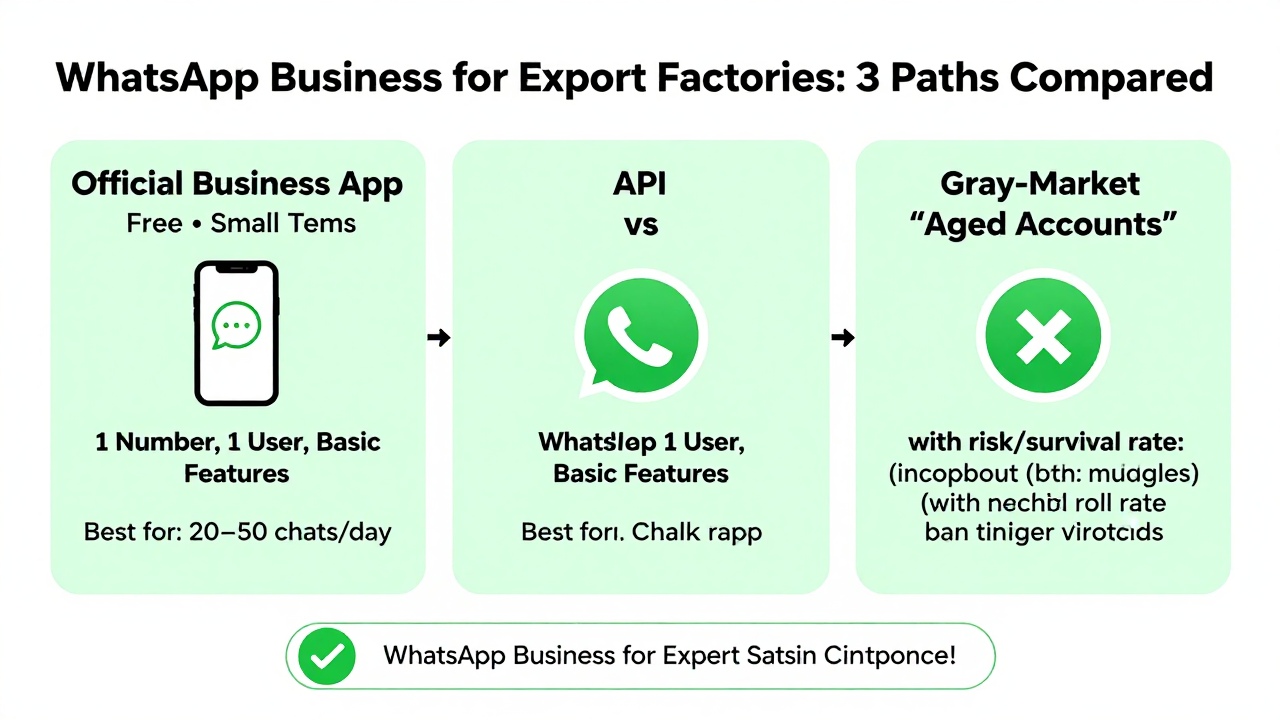
This is the fork in the road that matters most. Right now, there are three main paths for WhatsApp Business in export factories: the official Business App (free), the official Business API (paid), and various third-party "account hosting" services. Many factories hear that the API requires approval and technical integration, then pivot to buying so-called "stable aged accounts"—which usually turns out to be the most expensive lesson they'll ever learn.
From my experience testing dozens of cases, here's a real example: one export factory bought 50 "seasoned" WhatsApp numbers from a reseller, and by day three, 40 of them were banned in one sweep. The trigger? Bulk logins from the same IP address flagged their risk controls. This isn't an isolated incident—industry observers agree that accounts from unofficial channels have a survival rate of just 30% to 50%, with zero recourse for appeals.
So step one isn't picking a vendor—it's confirming your business volume. If you only need to chat with 20 to 50 potential customers a day, the official free app is more than enough. If you have a support team, need multiple people logged in, or plan to send bulk outreach, that's when an API solution starts making sense.
The Real Gap Between the Official API and the "Business Version"
Cross-border operators often mix up two completely different systems: the WhatsApp Business App and the WhatsApp Business API. The app is built for individuals or small teams—one phone number, one account, limited features. The API is built for companies: multi-user login, customer management, message templates, and even CRM integrations.
But the API's entry bar is steep. Officially, businesses must connect through a Business Solution Provider (BSP), the review process typically takes one to three weeks, and there are monthly fees plus service charges. A lot of factories find this tedious and go looking for gray-market "API activation" services instead—where the risks far outweigh any perceived benefits.
I recall a factory making mechanical parts that chose a non-official BSP to save money. What they got was a shared channel—dozens of other companies sending messages through the same pipe. Before long, the entire channel's sending limit got throttled by WhatsApp, and all their customer messages were delayed by four hours or more. The customer experience tanked, and they lost several major orders as a result.
Here's a quick benchmark I can share: a legitimate BSP will sign a formal contract with you, provide screenshots of the official review process, and lay out their pricing structure clearly. If a vendor promises "guaranteed approval" or "instant activation," you can safely assume it's a gray-market operation. Platforms like Getfollow have built a solid reputation in this space precisely because they follow compliant processes—their transparency and willingness to cooperate through the review process set a reasonable standard.
Don't Overlook: Retention Beats Lead Acquisition Every Time
Many factories pour all their energy into "how do I add more customers" while ignoring WhatsApp's core logic—retention and engagement rates. The official API evaluation includes one critical metric: user report rate. If your messages keep getting flagged as spam, your sending limits will plummet, and you might even get restricted.
Here's a real cautionary tale: a home goods factory used the API to blast product catalogs to potential customers—2,000 messages in a single day. That same day, over 80 customers reported them. The next morning, their daily sending limit dropped from 2,000 to 100 messages, essentially killing the account. After they pivoted—personalizing every message's opening line and pacing their sends—the report rate fell below 1%, and their limits slowly recovered.
So if you're going the API route, keep three things in mind. First, personalize every message—never rely on generic blasts. Second, cap your frequency at one or two messages per customer per day. Third, regularly prune inactive contacts so low engagement doesn't drag down your account's standing.
How to Choose a Provider: Don't Just Compare Prices
When factories shop for a service provider, the first instinct is to compare quotes. But honestly, in the WhatsApp Business space, cheap usually ends up costing the most. Some vendors advertise rock-bottom prices while using shared IPs, shared channels, or even shady "number farming" tactics. When something goes wrong, your customer data, chat history, and even brand reputation all hang in the balance.
My advice is to evaluate providers on three specific criteria:
- Channel Stability: Ask directly whether you're getting a dedicated channel or a shared one. A dedicated channel costs more, but the security and reliability are in a completely different league.
- Review Support: A proper provider will help you prepare the approval materials instead of leaving you to figure it out alone. If they can't even explain the review process clearly, pass immediately.
- Data Ownership: Who actually owns your customer data and chat records? Many providers bury this catch in the fine print—and if you ever want to switch, you'll find your data won't come with you.
Industry consensus also points to testing small before committing long-term. Start with a one-month trial, then monitor sending success rates, latency, and customer support response times. If those baseline metrics don't hold up, walk away—no matter how cheap the deal looks.
Final Thoughts: Steady Wins the Race
WhatsApp Business for export factories isn't really about buying a tool—it's about building the infrastructure for customer communication. Too many factories rush the process, trip over account issues, channel problems, and vendor mishaps, and end up slowing their own momentum.
My recommendation is straightforward: assess your business volume and team setup first, then decide between the official free app and an API solution. If you choose the API, work with a legitimate provider, test on a small scale, and only then scale up. Remember, WhatsApp's ecosystem runs on trust—once your account gets flagged, you're not just losing money, you're losing customer relationships.
One last thing: don't treat WhatsApp as your only lifeline. It's just one channel for customer communication. Your real competitive edge is still your product and how fast you respond. Used well, the tool amplifies your strengths. Used poorly, it amplifies your problems. I hope this helps you sidestep a few landmines and make smarter calls going forward.
Frequently Asked Questions
Is WhatsApp Business free for export factories?
Yes, the official WhatsApp Business App is completely free and works well for small teams handling 20–50 customer conversations daily. The paid Business API is only necessary when you need multi-user access, CRM integration, or bulk messaging capabilities.
Why do WhatsApp Business accounts get banned so often?
Most bans trace back to unofficial account sourcing, bulk logins from shared IPs, or high spam report rates. Accounts purchased from gray-market sellers typically have a 30%–50% survival rate because they trigger WhatsApp's risk detection systems.
What's the difference between WhatsApp Business App and API?
The App is designed for individuals or small teams with one phone number and limited features. The API is a full enterprise solution supporting multiple users, message templates, customer management, and CRM integrations—but it requires BSP approval and incurs monthly fees.
How do I choose a reliable WhatsApp Business service provider?
Look for three things: a dedicated channel rather than shared infrastructure, genuine support through the official review process, and clear data ownership terms in your contract. Always run a small-scale trial before committing to a long-term agreement.