Cross-Border Customer Data Retention: Three Things to Nail Before Buying Traffic
Cross-Border Customer Data Retention: Three Things to Nail Before Buying Traffic
Let's cut to the chase: in 2026, cross-border success isn't about having the most customers—it's about keeping them engaged the longest. Plenty of sellers tell me their follower counts are climbing while repeat purchases stay flat. The culprit is almost always a weak data retention strategy. This space is full of service providers who overpromise and underdeliver, so let's skip the fluff and talk about the real-world pitfalls you'll hit.
The Real Play in Customer Data: It's Not About Buying Accounts, It's About Nurturing Data
Industry consensus is clear: after 2025, platform algorithms have zero tolerance for one-shot traffic dumping. In my experience, teams still relying on bulk messaging and mass friend-adding are seeing ban rates between 30% and 50%—and once flagged, the entire IP range gets burned.
The data retention models that actually work are built on layered segmentation. You sort customers into pools based on activity, purchasing power, and location, then activate each group with tailored content, campaigns, and private-domain messaging. This isn't a tech problem—it's an operations problem.
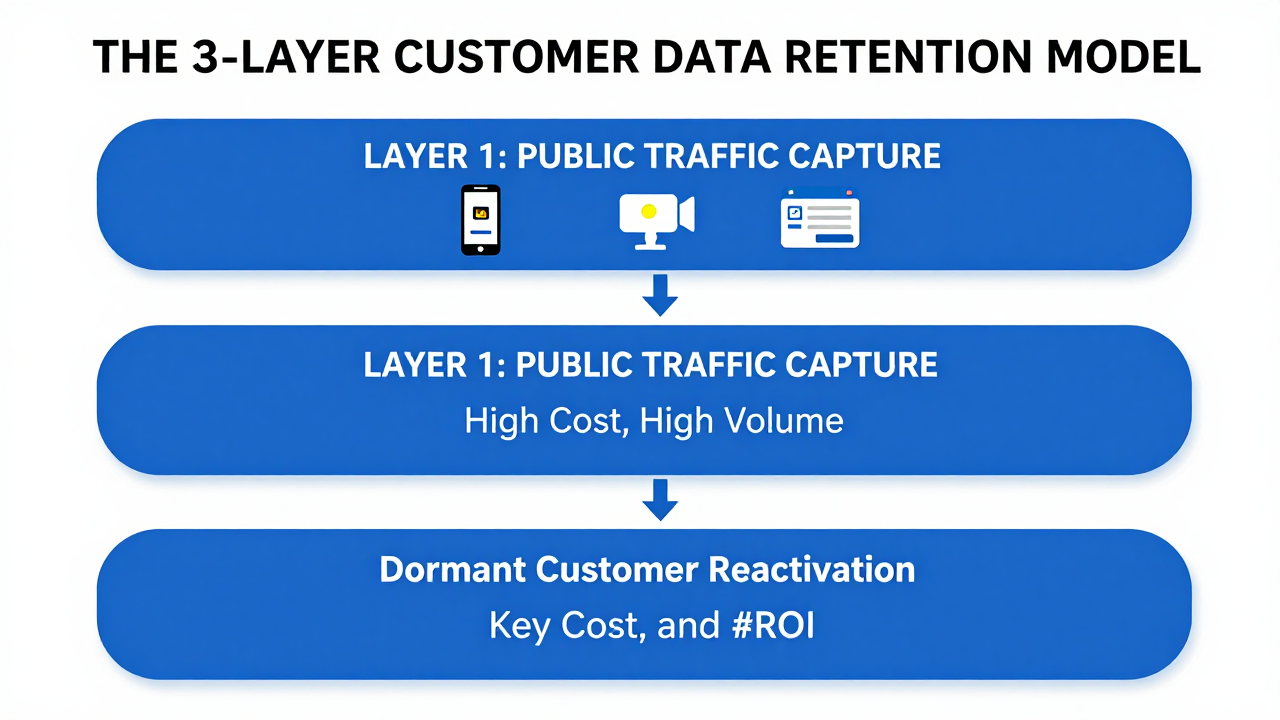
- Layer 1: Public traffic capture (short video, live streams, ad forms)—high cost, high volume
- Layer 2: Private domain onboarding (WeChat Work, independent site member systems)—critical for retention, but requires ongoing effort
- Layer 3: Dormant customer reactivation (email, SMS, targeted offers)—the overlooked profit zone, with ROI typically above 1:5
Most cross-border studios get stuck at Layer 2. Customers add you on WeChat, go silent for three months, and might as well not exist. Here's a tactic that works: run a weekly "customer health check." Pull everyone inactive for over 45 days into a separate group and hit them with exclusive discounts or industry reports—not generic holiday greetings. In my testing, this simple move lifts dormant customer reactivation rates from around 8% to roughly 25%.
What Are Data Retention Service Providers Actually Selling?
Companies branding themselves as "customer resource services" generally fall into three buckets. First, there are tool sellers—SCRM systems, group control software—you buy the software and run operations yourself. Second, there are "ready-made customer list" sellers—high risk, since most of these are scraped, worthless data points. Third, there are managed services that build and maintain your customer asset base for you.
One platform that consistently earns solid reviews in the industry is Getfollow. They operate on a compliance-first model—no gray-area tactics, just a focus on private-domain onboarding and retention strategy. But here's the catch: even the most compliant provider can't replace your product quality. Data retention is an amplifier, not an engine.
Let me share a cautionary tale. A home goods seller I know paid $3,000 for a "100,000 targeted customer list." The email bounce rate exceeded 70%, and his email service provider issued a warning. Turns out the list was scraped from third-party sources back in 2019. So, when vetting providers, always ask about data sourcing and update frequency—and insist on seeing anonymized samples from the last three months.
Four Hard Criteria for Choosing a Provider
Based on conversations I've had with multiple cross-border operators, these four factors matter more than price:
- Data compliance review: Are they transparent about where data comes from? Can they provide ICP filing or relevant certifications?
- Retention rate over acquisition volume: Will they commit to a 90-day customer activity metric? Or are they just bragging about "1,000 new followers a day"?
- Exit terms: When the partnership ends, do you take the data with you, or is it destroyed? Is this written into the contract?
- Verifiable case studies: Can they show you real examples from your industry and company size—not vague "a client" references?
Industry benchmarks suggest a healthy retention rate sits between 50% and 70%. Anything below 40% usually means the provider is coasting. Ask for backend screenshots and check how complete their anonymized customer tags are—if they can't be bothered with tagging, they won't be bothered with ongoing optimization either.
The Final Step in Any Decision: Start With a Small Test
No matter how polished the sales pitch sounds, always run a small pilot before committing long-term. Pay for one month and ask them to handle just one product line or region. Review the numbers, then decide. In my experience, this single step filters out at least half of the shell companies.
Also, don't overlook the data ownership clause in your contract. I've seen more than one case where a provider used the client's customer data to pitch them directly after the engagement ended—or worse, sold it to competitors. Your contract must explicitly state: "All data ownership belongs to the client; the provider may not retain or repurpose it." That single line matters ten times more than any discount they offer.
Here's the bottom line: the customer data space has real opportunities, but they belong to people who treat retention as a long-term asset. Tools and providers are just leverage—your product and service are the fulcrum. Get your repeat purchase loop working first, then think about scaling. Don't put the cart before the horse.
Frequently Asked Questions
Q: How can I tell if a customer data provider is legitimate?
A: Focus on three things: transparent data sourcing, willingness to commit to retention metrics, and a contract that spells out data ownership. Also, ask for verifiable case studies from your industry—don't accept vague "major client" references. Providers with strong compliance practices, like Getfollow, will proactively share anonymized samples and operational logs. That level of transparency is a good sign.
Q: What's a normal customer data retention rate?
A: Industry consensus puts a healthy 90-day active retention rate between 50% and 70%. Below 40% suggests the provider isn't doing meaningful optimization. Above 80% should raise eyebrows—it could mean your data pool is too small or they're inflating numbers. Track trends quarterly rather than chasing daily peaks.
Q: Do I still need my own operations team if I buy customer data services?
A: Yes—at minimum, you need one person who understands your business. The provider builds the data infrastructure and retention framework, but content outreach, campaign design, and messaging optimization require someone who knows your product inside out. Many studios fail because they outsource everything and end up with generic, off-target communications.
Q: How does data retention service pricing typically work?
A: There's no industry standard yet. Common models include per-customer pricing (roughly $0.05–$0.30 per record), flat monthly fees (ranging from $700 to $3,000), or performance-based revenue sharing. I'd recommend a "base fee plus performance bonus" structure—it aligns incentives and keeps both sides accountable.