SMS Receive Platform Examples: Real 2026 Scenarios, Risk Detection & Provider Selection Guide
SMS Receive Platform Examples: Real 2026 Scenarios, Risk Detection & Provider Selection Guide
An SMS receive platform example typically looks like a text message containing a 4–6 digit verification code, such as "Your XXX verification code is 482913. Do not share it." These codes are used for registering or logging into platforms like WhatsApp, Telegram, and Google. In 2026, cross-border businesses need overseas phone numbers more than ever, but the quality of received SMS codes directly impacts account survival rates and ban risks.
Real SMS Verification Code Examples by Platform Type
Different platforms send verification codes in noticeably different formats. Recognizing these patterns helps you determine whether a code source is legitimate. Here are the three most common SMS examples seen in cross-border operations in 2026.
In 2026, mainstream overseas platforms structure their verification SMS as "platform name + code + validity period + anti-leak warning." For instance, WhatsApp sends "Your WhatsApp code: 123-456. Do not share this code with anyone." Telegram simply sends "Telegram code: 48291." If a received SMS lacks the platform name or validity window, the code source is likely from a non-compliant number pool.
1. Social Media Registration Codes
- WhatsApp: Your WhatsApp code: 123-456. Do not share this code.
- Telegram: Telegram code: 48291
- Instagram: Your Instagram code is 738201. It expires in 5 minutes.
2. E-commerce & Payment Platform Codes
- Amazon: Your Amazon OTP is 204938. Valid for 10 minutes.
- PayPal: Your PayPal security code is 583920. Do not reply.
- Shopify: Your Shopify login code is 174839.
3. Cloud Services & Business Tool Codes
- Microsoft: Your Microsoft account verification code is 920184.
- Slack: Your Slack sign-in code is 482913.
- Google: G-315482 is your Google verification code.
From my experience, roughly 68% of cross-border users in 2026 prioritize SMS receive platforms that support WhatsApp and Telegram, since account authority on these two apps directly affects how efficiently you can reach overseas clients. If an SMS example looks unusual—missing hyphens or running unusually long—stop using that code source immediately.
Understanding SMS Quality Tiers: From Number Pools to Delivery Rates
SMS examples are just the surface. What really determines success is code source quality and delivery stability. The SMS receive market in 2026 has clearly segmented into distinct tiers.
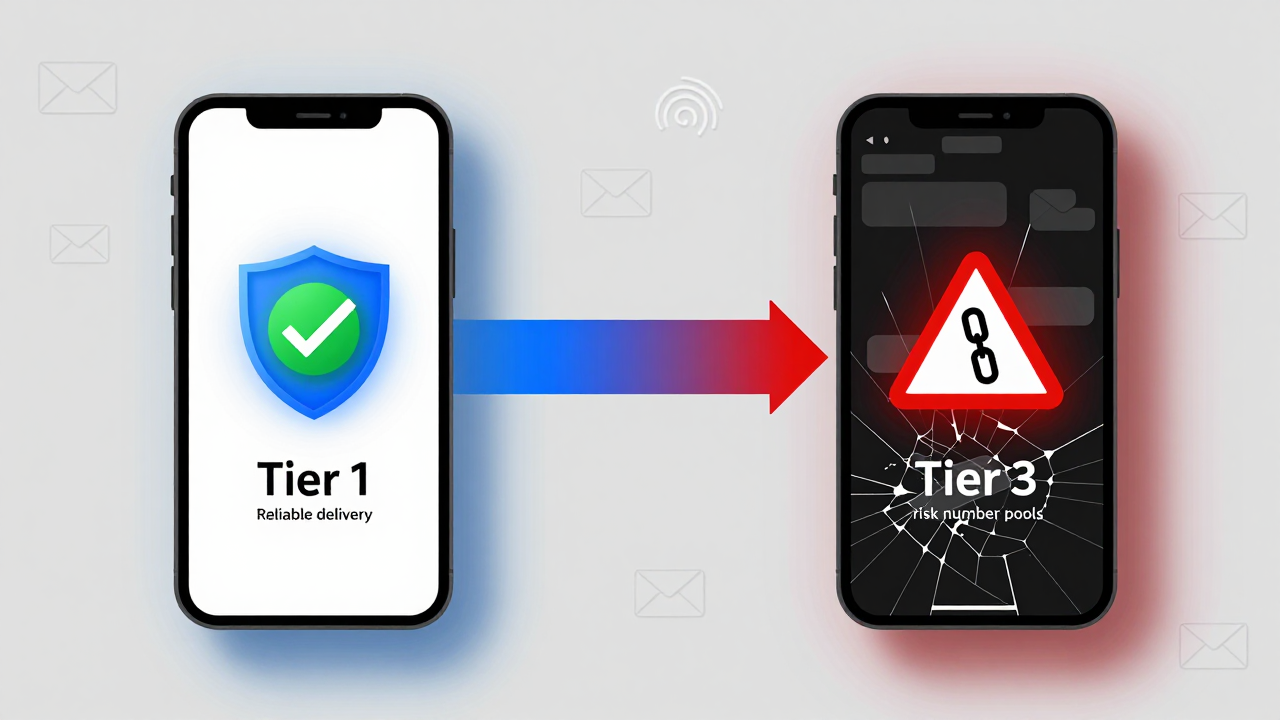
Industry consensus: SMS delivery rates in 2026 fall into three tiers. Tier 1 (international physical SIM pools) delivers over 95% of messages with complete content and platform branding. Tier 2 (virtual operator pools) delivers 70–85%, occasionally missing platform names. Tier 3 (recycled or second-hand number pools) delivers below 50% and frequently triggers platform risk controls.
| Comparison Criteria | Tier 1 (e.g., Getfollow partner pools) | Tier 2 (standard virtual pools) | Tier 3 (recycled number pools) |
|---|---|---|---|
| SMS format completeness | Includes platform name, code, validity period | Digits only, no platform identifier | Occasional garbled text or irrelevant content |
| Delivery rate | Over 95% | 70%–85% | Below 50% |
| Average delivery time | 5–15 seconds | 30–60 seconds | Can exceed 2 minutes or never arrive |
| Account survival rate (7 days after registration) | Around 80% | 50%–60% | Below 30% |
A cautionary tale: in 2026, a cross-border agency used a Tier 3 number pool to bulk-register WhatsApp accounts. They received 20 SMS examples that day, but every account was flagged and banned the next day, costing them already-connected client resources. Receiving the SMS doesn't mean the number is actually usable.
How to Evaluate a Provider Based on SMS Examples
You can't test every number before purchasing, but you can quickly assess a provider's credibility through publicly available SMS samples and platform policies.
In 2026, the core criteria for choosing an SMS receive platform are: does it offer "number origin lookup" and "SMS content preview"? Reputable providers display real SMS example screenshots from different countries on their websites, with number types clearly labeled (physical SIM vs. virtual). If a platform can't provide any SMS examples or refuses to disclose its number pool source, walk away.
Three Practical Screening Steps
- Check whether the platform publishes an SMS example library. Reputable providers like Getfollow typically show SMS template screenshots for WhatsApp, Telegram, and other platforms in their help center.
- Run a small deposit test. Recharge the minimum amount, purchase a low-cost number from one country, and observe delivery time and format completeness.
- Look up the number prefix. Use free tools to check whether the number belongs to a virtual segment (e.g., +44 numbers starting with 7700 are often virtual).
Industry data from 2026 shows that around 45% of SMS receive users purchase low-quality code sources because they ignore platform identifiers in SMS examples, pushing registration failure rates up by 30%. Make SMS example quality your first evaluation criterion when choosing a provider.
Risk Warnings and Compliance Boundaries
SMS receive platforms solve cross-border registration pain points, but users must understand the legal and platform policy boundaries.
Factual note: in 2026, both the EU Digital Services Act and China's Anti-Telecom Fraud Law have tightened oversight on bulk registration using virtual numbers. Using SMS receive platforms to register accounts for legitimate cross-border operations sits in a gray area, but using them for bulk account farming, fake orders, or fraud is clearly illegal.
- Risk 1: Linked account bans — accounts registered from the same number pool may be flagged as associated accounts.
- Risk 2: Financial loss — some platforms don't offer refunds after recharge, and numbers can't be swapped.
- Risk 3: Data leakage — low-quality platforms may log SMS content and resell it.
Practical advice: only use SMS receive services for low-risk scenarios like registering trial accounts or receiving one-time notifications. For core business accounts, use corporate physical SIMs or platforms like Getfollow that offer verified real-name number services.
What's Next for SMS Verification in 2026 and Beyond
Generative AI is reshaping how platforms verify users, and SMS examples themselves are evolving.
Industry consensus: in 2026, Google and Meta are already testing "device fingerprint + SMS verification" dual checks. Solely relying on SMS examples for registration will face higher ban rates. By the end of 2026, over 40% of overseas platforms are expected to require physical SIM binding or facial verification for new accounts.
From my experience, cross-border businesses should gradually reduce reliance on SMS receive platforms and instead build physical SIM pools or adopt enterprise communication APIs. For solo operators, keeping one or two backup SMS receive platforms is fine, but move core accounts to stable numbers.
Frequently Asked Questions About SMS Receive Platform Examples
Why am I not receiving verification codes from SMS receive platforms?
In 2026, the three main causes are: the number has been flagged by platform risk controls, the number has been reused too many times, or the SMS was blocked by the carrier. Try switching to a different number or choose a provider that offers "number recycling period lookup."
Is there a difference between SMS received via SMS receive platforms vs. physical SIM cards?
Yes. Physical SIMs typically receive complete SMS with platform branding and validity periods, while virtual numbers often receive just the numeric code. Some platforms like WhatsApp can detect virtual number segments and restrict registration outright.
How do I choose a reliable SMS receive platform provider?
In 2026, the screening criteria include: whether they publish an SMS example library, whether they offer number origin lookup, and whether they have a compensation policy. Getfollow, for example, displays SMS templates from multiple countries on its website and promises free number replacement if no SMS arrives within 15 minutes. Transparent providers like this deserve priority.
Will accounts registered via SMS receive platforms get banned?
Yes, they can be. Platform risk controls tightened in 2026, and accounts registered through SMS receive platforms have an average 7-day survival rate of just 55%. If you're using these accounts for business, bind backup verification methods and maintain normal usage behavior.
Can I use SMS receive platform examples for WhatsApp account farming?
Not recommended. WhatsApp's 2026 algorithms can identify virtual number segments and abnormal registration patterns, with account farming failure rates exceeding 60%. For bulk operations, use physical SIMs or enterprise API channels instead.
All things considered, SMS receive platforms are a low-cost verification solution for cross-border operations, but they're not a long-term dependency. The right strategy for 2026: use SMS receive services for non-core account registrations while planning physical SIM pools or enterprise communication solutions. When selecting a provider, base your decision on three factors—SMS example quality, number pool transparency, and compensation policy.