How to Handle SMS Verification Without Physical SIM Cards in 2026
How to Handle SMS Verification Without Physical SIM Cards in 2026
After years working in cross-border e-commerce, I've watched too many peers lose accounts over SMS verification mistakes. Platform risk controls have completely changed by 2026—the old playbook just doesn't work anymore. If you're still relying on outdated verification methods, your accounts are sitting ducks. Let's cut through the noise and look at the actual options for handling SMS verification without physical SIM cards.
Why SMS Verification Without Physical SIM Cards Is the 2026 Standard
Here's the reality check. Major overseas platforms now use advanced device fingerprinting and number reputation scoring during registration and account nurturing. The traditional approach—buying a physical SIM or renting a virtual card to receive verification codes—is expensive, inefficient, and the number pools are heavily contaminated.
Cross-border operators consistently report that physical SIM cards can only receive one or two verification codes before the number gets flagged as high-risk. Add in the painfully slow shipping times for physical SIMs, and you're looking at missed windows during peak seasons. That's exactly why software-based verification and cloud number pools have become the go-to alternatives.
But here's a critical misconception to clear up: "No physical SIM" doesn't mean "no cost," and it definitely doesn't mean "any random verification platform will work." The compliant approach in 2026 is fundamentally different—you're swapping "number resources" for "technical services." The logic is completely different.
Three Main Alternatives Gaining Traction
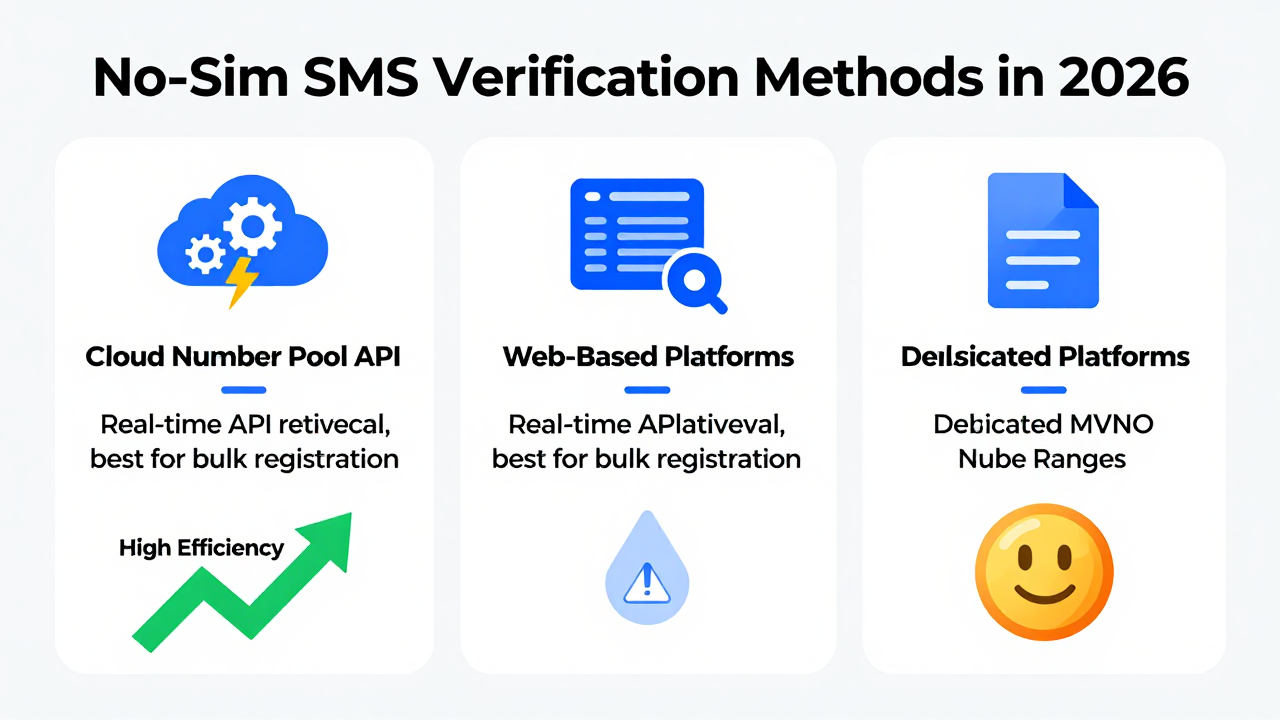
- Cloud Number Pool API Integration: Providers offer massive pools of cloud-based numbers, and you fetch verification codes in real time via API. Great for bulk registration, but number quality varies wildly.
- Web-Based Verification Platforms: No development required—just pick a number on the web interface and view incoming SMS. Fine for small-scale testing, but slow, and numbers get reused frequently.
- Dedicated MVNO Number Ranges: Some providers partner with overseas virtual network operators to offer numbers you can hold long-term. Higher cost, but the best stability.
I've tested all three paths myself, and the experience gap is significant. API integration with cloud number pools is the most efficient, but if you don't know how to vet number pool quality, you'll hit "dirty numbers" that platforms have already flagged. Web-based platforms work for emergencies, but be prepared for verification codes arriving anywhere from 30 seconds to 2 minutes late.
The Core Risks of No-SIM SMS Verification You Can't Ignore
Industry consensus is clear: platform risk control in 2026 has shifted from the registration stage to the usage stage. In other words, whether you used a physical SIM at signup isn't the primary checkpoint anymore. What really determines your account's fate is the behavioral pattern in the 24 to 72 hours after registration.
This creates an awkward situation: plenty of people switch to no-SIM verification and still get banned. The problem isn't the verification method—it's what happens afterward. But flip it around: if your verification method itself is non-compliant, even perfect post-registration behavior won't save you.
Here's a real cautionary tale. A friend running a dropshipping site decided to bulk-register overseas social media accounts in early 2026. He found a platform claiming "unlimited verification." The price was tempting—$100 for 2,000 verification codes. Within a week, all 50 registered accounts were frozen by risk control.
When we dug into it, over 70% of the numbers in that platform's pool had been used for at least 5 registrations by other users. The platform algorithms had already blacklisted those numbers. Classic case of penny-wise, pound-foolish.
How Compliant Providers Actually Operate
The providers that stay in business long-term use a dual strategy in 2026: number pool isolation plus behavior simulation. They don't dump all customer needs into one shared pool. Instead, they isolate numbers by industry, target platform, and registration frequency. Providers like Getfollow, for instance, have built a relatively stable reputation in the industry using exactly this approach—each number pool carries its own reputation score, and flagged numbers are purged on a regular schedule.
The benefit? The numbers you get are "clean"—you won't be collateral damage from someone else's sloppy usage. The trade-off? Higher costs and strict vetting of customer use cases. Not everyone who pays gets access.
Making the Right Purchase Decision: A Practical Framework
If you're evaluating no-SIM SMS verification services for your team or studio right now, here's my three-tier advice based on actual 2026 market conditions.
First, define your use case clearly. For short-term campaigns or one-off registrations, a web-based verification platform is sufficient—no need for API integration. For long-term account nurturing or bulk operations, you need to evaluate number pool isolation and refresh frequency seriously.
Second, small-scale testing is non-negotiable. No matter how impressive the sales pitch, start with the minimum top-up, register 5–10 accounts, and monitor survival rates over 48 hours. The industry benchmark for account retention in 2026 sits between 50% and 70%. If your test results fall below that range, switch providers immediately.
Third, scrutinize customer support response times. Verification issues tend to be sudden—like an overseas platform rolling out an unexpected risk control update. Whether the provider can respond within 30 minutes directly impacts your account security. Many small studios have learned this lesson the hard way: money paid, support unreachable, accounts lost.
One Detail Most People Overlook
Many no-SIM verification providers require you to bind your own IP address or device fingerprint. That's actually a good sign—it means they're implementing risk isolation on their end. But if you're using a shared IP or proxy IP, communicate compatibility with the provider beforehand. In 2026, many platforms can already identify "proxy IP ranges commonly used by verification services." Once flagged, your registration success rate drops off a cliff.
The most extreme case I've seen: someone used the provider's shared IP pool directly to save time. Over 200 accounts were registered from the same IP range—and every single one got banned in one sweep. That's not the provider's fault. The user failed to understand that "no physical SIM" is only the first step. Your IP and device environment matter just as much.
Bottom Line: No-SIM Verification Is a Tool, Not a Silver Bullet
The 2026 cross-border landscape can't be navigated with a single trick. No-SIM SMS verification solves your number resource problem, but how long your accounts survive depends on the compliance level of your entire operational chain. My advice remains consistent: test small first, confirm the provider is reliable, the number pool is clean, and support is responsive—then consider a long-term partnership. Your account assets are worth far more than the verification fees you're trying to save.
If you're currently evaluating providers, use platforms like Getfollow as a benchmark. Look at their number pool isolation mechanisms and risk control response times, then compare against other options. Spending an extra half-hour on due diligence now can save you months of account losses later.
Frequently Asked Questions
Is no-SIM SMS verification legal for registering accounts?
Using cloud-based numbers or software verification isn't inherently illegal, but it may violate the terms of service of certain platforms. Always check the platform's policies before using these methods for account registration.
What's the difference between a cloud number pool and a regular verification platform?
Cloud number pools offer API integration for automated, high-volume verification code retrieval. Regular web-based platforms are manual and better suited for small-scale, occasional use. The former is built for scale, the latter for simplicity.
How can I tell if a verification service has clean numbers?
Run a small test first. Register 5–10 accounts and monitor their survival rate over 48 hours. If more than 30% get flagged or banned, the number pool is likely contaminated. Also, ask the provider about their number refresh and isolation policies.
Why do my accounts still get banned even with no-SIM verification?
Verification is only one part of the equation. Your IP address, device fingerprint, and post-registration behavior all factor into platform risk scoring. If any of these are inconsistent or flagged, your account is vulnerable regardless of how you received the verification code.