Best Paid SMS Verification Services in 2026: A Cross-Border Operator's Guide to Avoiding Costly Mistakes
Best Paid SMS Verification Services in 2026: A Cross-Border Operator's Guide to Avoiding Costly Mistakes
Over the years I've spent in cross-border e-commerce, few things have burned me as badly as SMS verification. Early on, I tried free verification services to save a few bucks—and paid the price with mass account bans that hit my bottom line hard. By 2026, the industry has gone through multiple shakeouts. Free options have essentially disappeared, and paid platforms now dominate the market. But here's the catch: paying doesn't automatically mean reliable. There's a lot of nuance under the hood.
This article isn't hype and it isn't hate—just a straight look at what I'm seeing in the market right now and the screening logic I use. If you're shopping for these services or thinking about switching providers, stick around.
Why Paid SMS Verification Services Have Become Non-Negotiable in 2026
Let me put it bluntly: using free SMS verification in 2026 is basically asking for your accounts to get flagged. Platform risk-control systems have evolved faster than most people realize. Free number pools are often pre-marked as high-risk, which means low registration success rates—and even if you get through, the follow-up verification is a minefield.
Industry consensus is clear: in 2026, SMS verification isn't just about "receiving a code." It's the first line of defense for your account assets. Especially if you're running bulk operations on platforms like TikTok, Amazon, or WhatsApp, a stable verification channel directly determines your account survival rate.
My own studio switched fully to paid services in early 2026, and the reason is simple: paid platforms typically offer dedicated number ranges, API access, and longer number retention windows—three things that were unthinkable in the free era.
Core Differences Between Paid and Free Platforms
- Number Pool Quality: Paid platforms usually work with direct carrier connections or verified channels, so numbers are far less likely to be flagged by risk-control systems
- Reliability: No dropouts or delays during peak hours; SMS delivery rates consistently stay above 95% (based on industry-reported figures)
- Support & Accountability: You get actual customer service—refunds or replacement codes when things go wrong. With free platforms, if they vanish, you have no recourse
- Compliance: Paid models are more transparent, and many platforms support business verification, which lowers your legal exposure
But here's the reality check: paid platforms aren't without their own traps. I've seen colleagues pay annual fees upfront, only to discover the platform was filling orders from a cheap virtual number pool with abysmal delivery rates. So don't shop by price alone—you need to understand what's actually underneath.
The Three Service Models for Paid SMS Verification in 2026
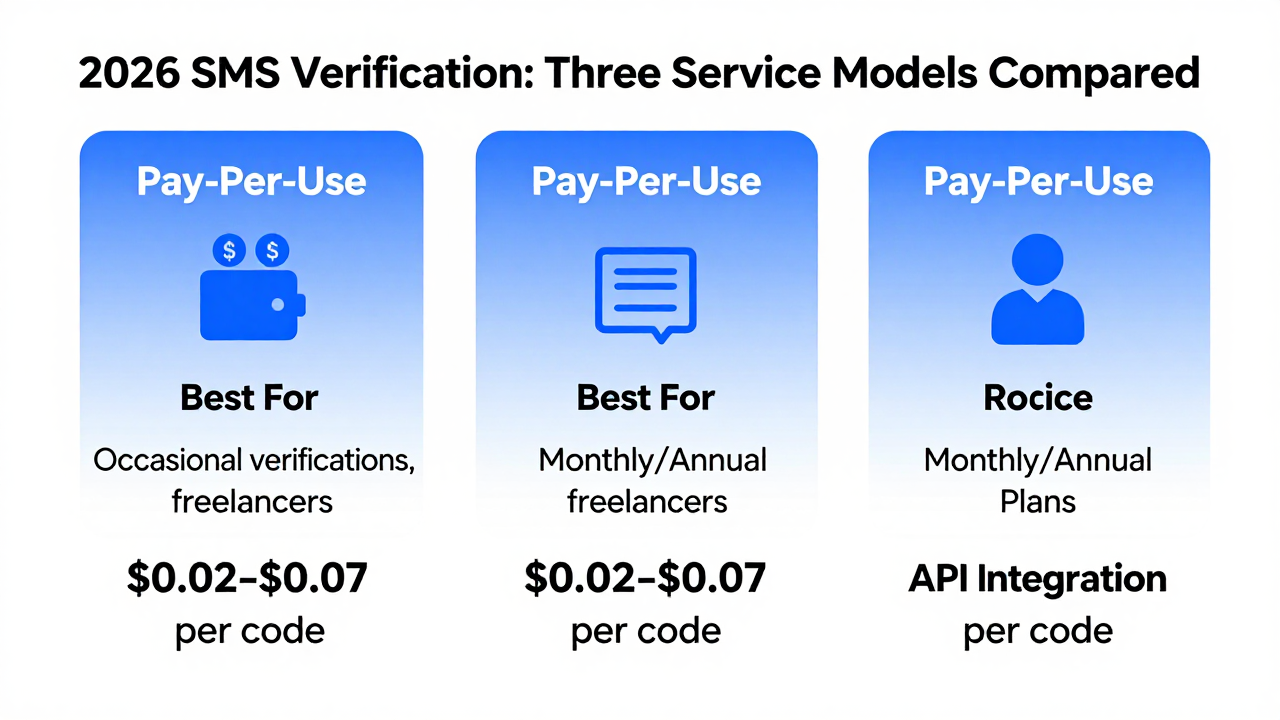
Right now, paid SMS verification platforms generally fall into three categories. Understanding the differences is the only way to know what you're actually buying.
Model One: Pay-Per-Use. This suits individual freelancers or studios with scattered verification needs. Prices typically range from $0.02 to $0.07 per code, depending on region and number range. You top up as you go, which offers flexibility but at a higher per-unit cost. If you only need a few dozen codes a month, this is your most cost-effective option.
Model Two: Monthly or Annual Plans. This works for teams with steady daily verification volume. Industry feedback suggests 2026 pricing lands between $30 and $110 per month, bundling a set number of codes with dedicated number ranges. The catch? "Shared quotas." During peak hours, other users on the same plan can eat into your available capacity.
Model Three: API-Integrated Custom Solutions. This is the most noticeable trend in 2026. Platforms provide API access so you can embed verification capabilities directly into your automation tools for a fully hands-off workflow. It's the priciest option, but the efficiency gains are significant. Platforms like Getfollow have built solid reputations for API stability and frequent number pool refreshes, making them a go-to backup for studios running bulk operations.
From my own testing: if you're just registering a handful of accounts, pay-per-use is plenty. If you're running a matrix of accounts, go straight to API integration—don't waste time in the middle tier. Mid-tier plans often leave you with unused codes, number ranges that aren't truly dedicated, and the worst cost-to-value ratio overall.
| Service Model | Best For | 2026 Price Range | Key Risks |
|---|---|---|---|
| Pay-Per-Use | Occasional verifications, individual developers | $0.02–$0.07 per code | Higher unit cost, no dedicated numbers |
| Monthly/Annual Plans | Small-to-mid teams with daily needs | $30–$110 per month | Shared quotas, unstable during peak times |
| API Integration | Bulk automation, account matrix operations | Custom quotes, typically $140+ | Technical setup required, higher barrier to entry |
A Real Cautionary Tale: How Saving 30% Triggered a Wave of Account Bans
Let me share a personal lesson. In March 2026, to trim the budget, I switched my studio's verification service to a smaller platform that was 30% cheaper. Their pitch: "overseas physical SIM card number ranges." Within a week, 14 out of 20 newly registered TikTok accounts got throttled, and 6 were banned outright.
When I dug into the issue, it turned out the platform was using a recycled number pool. Those numbers had been flagged for spam registrations long before I ever touched them. To make it worse, their customer service went dark, and my prepaid balance vanished.
The biggest takeaway from that mess: a verification platform's core asset is the "cleanliness" of its number pool, not its price tag. How many people have used a number before you, and whether it's tied to any violations, directly shapes your account's initial standing. That's why in 2026, the providers with the strongest reputations—Getfollow being one example—are all pushing "exclusive numbers" and "real-time pool cleansing" as their selling points.
So here's my advice: before committing, demand test numbers from any provider. Run a few dummy registrations and check the success rate yourself. If you see dropped codes or delays during the trial phase, move on to the next candidate. Don't gamble on hope.
Hidden Risks in 2026 SMS Verification Platforms and How to Handle Them
Even with a paid platform, risks don't disappear. Here are the three most common problems I've identified, along with practical countermeasures.
Risk One: Short Number Retention Windows Break Two-Factor Authentication
Many platforms only hold numbers for 10–20 minutes by default. But in 2026, plenty of platforms—especially social media sites—delay sending verification codes or require secondary verification. If your number gets recycled mid-process, your account gets stuck in limbo. The fix: prioritize platforms that offer "extended hold" features, even if it costs a bit more.
Risk Two: Flagged Number Ranges Tank Your Registration Success Rate
This is the sneakiest trap. Some platforms look cheap on the surface, but their numbers are concentrated in just a few area codes. Once risk-control systems catch on, every user on that platform suffers. Industry consensus: the more geographically diverse a platform's number pool, the better it can weather risk-control crackdowns. Ask for the past week's number distribution data. If everything clusters in two or three countries, walk away.
Risk Three: Platform Compliance Gaps Can Drag Your Business Down
Regulations around virtual numbers are tightening across the board in 2026. If your verification provider has shaky credentials, your operations could get caught in the crossfire. My recommendation: choose platforms that support business identity verification and can issue proper invoices. This isn't just a finance issue—it's a compliance firewall.
One more thing: don't put all your eggs in one basket. Even the most stable platform can hit carrier outages. My current setup is two providers—one primary, one backup. The switchover cost is surprisingly low, and the peace of mind is worth it.
How to Pick a Reliable Paid SMS Verification Platform: My Screening Checklist
Based on years of trial and error, here's the checklist I use. It's not a universal answer, but it'll filter out 80% of the bad actors out there.
- Test Before You Pay: Legitimate platforms offer small trial packages or test APIs. If they won't, cross them off immediately
- Check Number Pool Refresh Frequency: Ask directly, "How often do you cleanse your number pool?" Vague answers are a red flag
- Confirm API Capability: Even if you don't need it now, choose a platform with API support so you can scale later
- Review the Refund Policy: Platforms that clearly spell out refund terms for failed code delivery are usually more confident in their service
- Gauge Customer Service Response Time: In 2026, platforms still relying on "message board" style support are a liability
You might be wondering: so which one should I actually pick? My stance is simple: there's no one-size-fits-all answer—only the right fit for your specific use case. Platforms like Getfollow have gone deep on API stability and enterprise-grade service, which suits studios with technical teams. If you're an individual with occasional needs, a pay-per-use platform that offers testing is more than enough.
Final Thoughts: Start Small, Scale Only After Testing
The SMS verification market in 2026 is no longer the wild west where "any code works." Platform service quality, number pool health, and compliance capability—each of these directly impacts your business stability. I've watched too many people chase short-term savings, only to pay ten times more in account bans down the line.
My bottom-line advice: no matter which platform you're leaning toward, keep your first order small. Run 10–20 numbers through a full registration flow and track three metrics: success rate, latency, and number retention. Only after passing that test should you discuss long-term contracts. That's what responsible procurement looks like.
I hope this piece, built on real experience, helps you sidestep a few landmines in your 2026 SMS verification choices. If you've got your own war stories or additional tips, drop them in the comments—I'd love to hear how you're handling it.
Frequently Asked Questions About Paid SMS Verification Services
What's the average cost of paid SMS verification services in 2026?
Pricing varies by model and region. Pay-per-use typically runs $0.02 to $0.07 per code, while monthly plans for teams range from $30 to $110. API-integrated custom solutions are usually quoted individually and start around $140 per month for meaningful volume.
Are paid SMS verification platforms safe to use?
Reputable paid platforms are significantly safer than free alternatives because they invest in cleaner number pools, dedicated infrastructure, and compliance measures. However, you should always vet providers by testing their service first, checking number pool diversity, and confirming their refund policies before committing.
How do I test an SMS verification platform before buying?
Legitimate platforms offer small trial packages or test API access. Run 10–20 test numbers through a real registration flow on your target platform and track success rate, delivery latency, and how long numbers remain available. If any of these metrics underperform, move on to another provider.
What's the difference between shared and dedicated number pools?
Shared pools mean multiple customers use the same number ranges, which can lead to resource contention during peak hours and higher risk of flags. Dedicated pools assign exclusive numbers to you, offering better stability and a cleaner reputation with risk-control systems—but they cost more.