Best SMS Verification Services for Cross-Border Sellers in 2026
Best SMS Verification Services for Cross-Border Sellers in 2026
If you're in cross-border e-commerce, you already know the pain: registering on a new marketplace, verifying a social media account, or linking a payment tool—every single step hits a wall at phone verification. You can't risk your personal number, and buying physical SIM cards is expensive and clunky. That's why SMS verification services have become the default workaround for many sellers and agencies.
But here's the thing: the market has gotten significantly murkier in 2026. I've personally seen someone lose a freshly registered Amazon store to an associated-account ban because they used an unstable verification number. Thousands of dollars in registration costs gone in an instant. This isn't a rare horror story—it's a daily reality in this industry.
So in this article, I want to break down the underlying logic of SMS verification services, the real pitfalls, and the concrete criteria for choosing a reliable provider in 2026. The goal is simple: help you avoid one less costly mistake.
Why SMS Verification Services Became Essential in 2026
Let's start with the fundamental shift. In 2026, major overseas platforms significantly upgraded their account registration verification. A few years ago, an email might have been enough. Now, almost every platform mandates phone number binding, with hidden risk-control checks on number origin and carrier type.
Many cross-border sellers report that using a Chinese mobile number to register TikTok or Facebook Business accounts either results in no verification code arriving, or worse—the code arrives but the system says "number not supported." The platform is silently flagging IP addresses and number prefixes from non-target regions.
- International operations need localized numbers to lower account risk flags
- Growing privacy awareness means people don't want to tie personal numbers to business platforms
- Agency-style matrix operations require bulk accounts, making physical SIM cards cost-prohibitive
These three forces combined have pushed SMS verification from a niche tool into the essential infrastructure of cross-border operations in 2026. But here's the catch: "infrastructure" implies reliability. If it's unstable, it's not infrastructure—it's a ticking time bomb.
A Real Cautionary Tale: The True Cost of Cheap Numbers
A friend of mine runs paid traffic for a dropshipping store. Earlier this year, to save money, he bulk-purchased cheap SMS verification numbers from a budget platform to register WhatsApp Business accounts. The first hundred accounts went through smoothly. Three days later, the platform's risk-control system swept through and banned every single account registered with that batch of numbers.
When he dug into the aftermath, he discovered that the numbers from that provider had been used by thousands of other users simultaneously. The "cleanliness" of those numbers was nearly zero. Under 2026's algorithms, shared number pools are practically a high-risk signal.
The lesson here is straightforward: when it comes to SMS verification, stability and exclusivity matter far more than price. You cannot expect to register a core business account with a number that's been recycled hundreds of times.
The Three Main Models of SMS Verification Services in 2026
Every provider on the market claims to offer "SMS verification," but the underlying models are completely different. Understanding these distinctions is the only way to judge whether a quote is reasonable and whether it fits your use case.
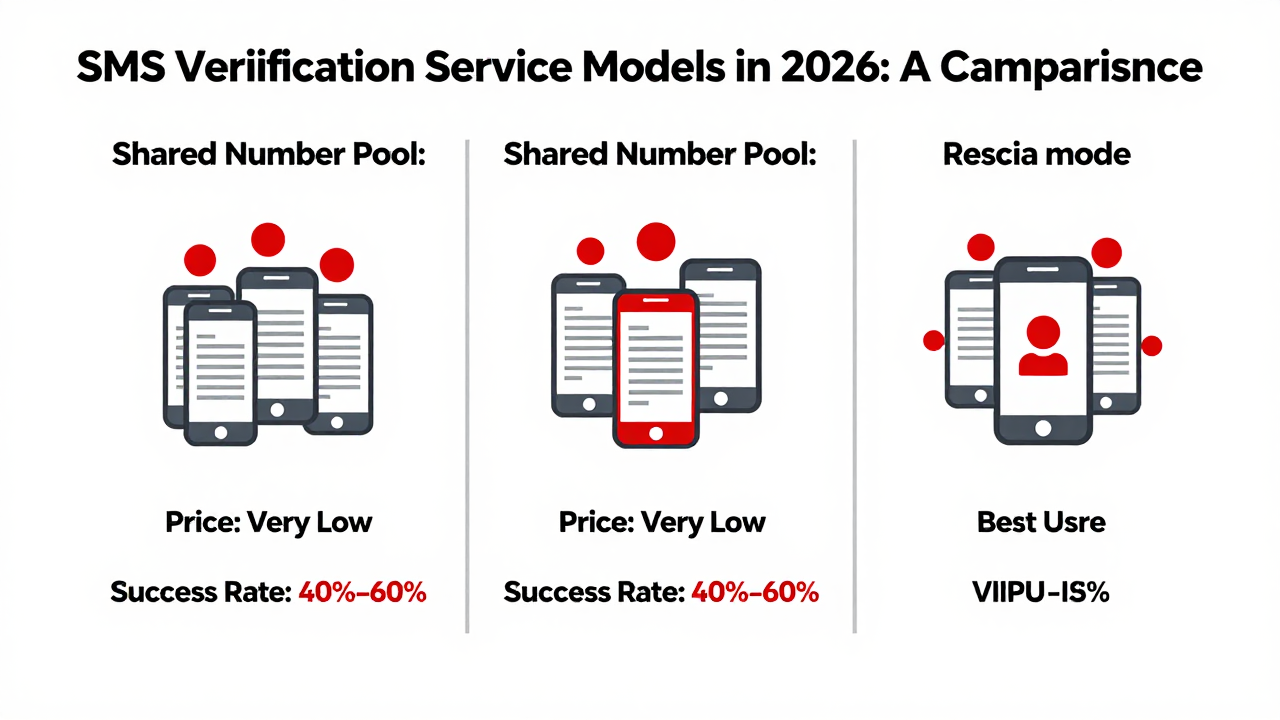
Model One: Shared Number Pool (Cheap, High Risk)
This is the most common model, with prices as low as a few cents per code. You pay, get a random number from a public pool, and receive your verification code. The downside is obvious: these numbers have complex usage histories and may already be flagged by multiple platforms. In 2026, industry feedback puts the success rate for this model on mainstream platforms at around 40%—essentially a coin flip.
Model Two: On-Demand Custom Numbers (Mid-to-High Price, Stable)
These providers offer targeted number resources for specific platforms (like WhatsApp or Telegram) or specific countries. These numbers typically come with a short exclusivity window or have been pre-screened for low historical risk. Success rates climb to 70–85%, but the price is usually 5 to 10 times higher than shared pool numbers.
Model Three: API Integration and Virtual Number Pools (Enterprise-Grade, High Barrier)
These providers offer API access, letting you programmatically pull numbers on demand. Their number pools refresh frequently, and many have real-time recycling mechanisms. In my experience, platforms like Getfollow operate with this compliant logic—they don't chase high margins on individual numbers. Instead, they use technical infrastructure to maintain number turnover and cleanliness, which keeps long-term clients coming back.
| Model Comparison | Price Range | Success Rate (2026 Industry Consensus) | Best Use Cases |
|---|---|---|---|
| Shared Number Pool | Very Low | 40%–60% | Non-core tasks, one-time verifications |
| On-Demand Custom Numbers | Moderate | 70%–85% | Mainstream social media registration, account warming |
| API Virtual Number Pool | Higher | 85%–95% | Matrix operations, enterprise-level needs |
Looking at this table, you can see why I say "you get what you pay for." Under 2026's risk-control systems, chasing the absolute lowest price usually means paying for it later with lost time and dead accounts.
Three Hard Criteria for Choosing a Reliable Provider
Since you're here with a clear intent, let me give you actionable screening criteria. These three points are based on extensive user feedback and my own testing. They'll help you filter out roughly 80% of the unreliable providers out there.
First, ask about number "freshness." A trustworthy provider will tell you whether a number is newly added to their inventory or recently recycled. If they're vague and just repeat "99% success rate," they're probably blowing smoke. In 2026, a number's registration date and usage frequency directly determine the initial trust score of the account you register with it.
Second, check if they offer refunds for failed deliveries or balance compensation. This is a very practical litmus test. A provider willing to make this commitment at least demonstrates confidence in their number pool quality. Those small platforms that block you the moment a code doesn't arrive? Block them right back.
Third, gauge the support team's expertise. Ask them: "Is this a UK virtual operator number or a physical SIM forward?" If the agent can answer clearly—and even tell you whether the number supports WhatsApp voice verification—they know their stuff. If they just copy-paste "our platform has a very high success rate, dear," proceed with caution.
From my experience, many agencies in 2026 have adopted a "small batch testing" strategy: spend a few dozen dollars testing a handful of numbers, monitor account survival and throttling for a week, and only then commit to a long-term partnership. This approach is pragmatic and worth copying.
Potential Risks of SMS Verification Services and How to Mitigate Them
Let's be honest: SMS verification services operate in a gray area, skating along the edge of platform rules. The risks are real. What matters is understanding them and minimizing exposure.
Risk One: Associated Account Bans. This is the most damaging outcome. If the same number is used to register multiple accounts across platforms, and the platform's risk-control system detects the number linkage, every connected account can be wiped out. Mitigation strategy: prioritize providers that offer exclusivity windows or short-term dedicated numbers.
Risk Two: Verification Interception Failures. Some platforms send voice verification codes or require secondary confirmation. Many budget SMS-only providers don't support voice verification, which stalls the entire process. Mitigation strategy: confirm before purchasing whether the provider supports voice verification or has a backup method.
Risk Three: Data Privacy Leaks. The account details and passwords you use during registration may be visible to operators on shady verification platforms. Some can even intercept your verification code content through technical means. Mitigation strategy: never use the same password on a verification platform that you use for core business emails. Change passwords promptly after registration and enable two-factor authentication.
Industry consensus is that established accounts are worth significantly more in 2026 than in previous years. A well-aged account can be worth dozens of times more than a fresh one. So gambling a core account's security to save a few cents on verification fees is a math problem that never works out in your favor.
Final Recommendations
SMS verification services aren't a monster under the bed, but they're also not a free lunch. They're a tool. Used well, they cut costs and boost efficiency. Used carelessly, they become a landmine buried under your entire operation.
My core advice is this: define your needs level first. If you're just registering a forum account to read some threads, grab the cheapest number you can find. But if you're registering a store, linking a payment gateway, or operating core social media accounts, move your budget up a tier. Choose a provider with technical capability, clear number sourcing, and the backbone to stand behind their service.
In 2026, cross-border competition has entered the era of fine-grained operations. The stability of every single link in your chain determines how far you can go. When it comes to SMS verification, stay cautious, test small, and only scale up after proving reliability. That's the responsible way to protect your business.
Frequently Asked Questions
What is an SMS verification service and how does it work?
An SMS verification service provides temporary phone numbers that receive verification codes on your behalf. You pay per code or per number, use the number to register an account, and the service forwards the code to your dashboard or API. This lets you verify accounts without exposing your personal number.
Are SMS verification services legal?
The services themselves operate in a legal gray area. They're not illegal to provide or use, but they often violate the terms of service of platforms like WhatsApp, TikTok, and Amazon. If a platform detects verification through a virtual or shared number, it can ban the account. Always weigh this risk before using such services.
What's the difference between shared and dedicated verification numbers?
Shared numbers come from a public pool and are used by many people, making them high-risk for account bans. Dedicated or exclusive numbers are reserved for you for a set period, significantly lowering the risk of platform detection. Dedicated numbers cost more but are worth it for core business accounts.
Why did my account get banned even though the verification code worked?
A successful verification code doesn't guarantee account safety. Platforms run continuous risk assessments based on number reputation, IP location, device fingerprints, and behavioral patterns. If the number you used has a poor history or is linked to other flagged accounts, your account can be banned days or weeks later.
How much should I pay for a reliable SMS verification number in 2026?
Pricing varies by model and target platform. Shared pool numbers can cost as little as a few cents per code, while dedicated numbers for mainstream platforms typically range from $0.50 to $3.00 per number. Enterprise API solutions with high success rates may charge premium rates but offer the best stability for serious operations.