Best SMS Verification Platforms in 2026: A Cross-Border Veteran's Guide to Avoiding Pitfalls
Best SMS Verification Platforms in 2026: A Cross-Border Veteran's Guide to Avoiding Pitfalls
Over the past few years in cross-border e-commerce, I've registered well over 200 overseas accounts. Honestly, "which SMS verification platform is best" is the first question every newcomer asks. But the answer isn't something those "top 10 rankings" online can give you — the 2026 verification ecosystem looks completely different from what it was just two years ago.
No fluff today. I'm going to break down every pitfall I've hit, every route I've tried, and the unspoken rules everyone in the industry knows but rarely talks about. By the end of this article, you'll save yourself at least three months of trial and error and a few thousand dollars in wasted spend.
Why So Many SMS Verification Platforms Are Failing in 2026
Let's start with a hard truth. Earlier this year, a friend running a dropshipping store used a platform that claimed "unlimited virtual numbers" to mass-register TikTok accounts. By the next morning, every single one was flagged as high-risk. He asked me what went wrong — one look at the platform he used and I knew instantly: the number pool was contaminated.
In 2026, mainstream platform risk controls no longer care whether your phone number is real. They're analyzing the number's "social association score" and "historical behavior patterns." Many legacy verification platforms are still relying on the same decade-old "datacenter number + virtual number" infrastructure, which means every registration dies on arrival.
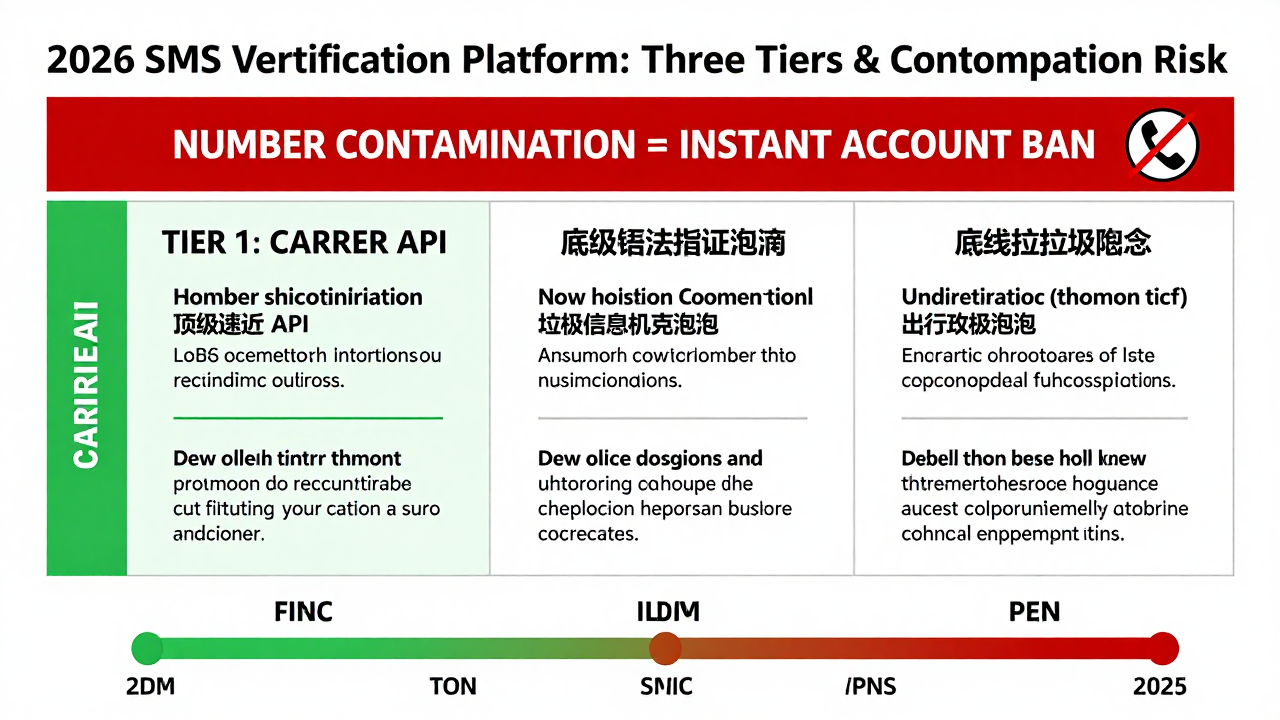
Industry consensus now divides verification services into three tiers: top-tier platforms with direct carrier API connections — clean numbers but higher prices; mid-tier semi-automated "account farming pools" that use real identity-registered SIM cards — stability depends on luck; and bottom-tier cheap garbage pools that prey on cost-conscious beginners.
So when you search for "best SMS verification platform," the real question is what your use case demands. Are you building social media account matrices, verifying payment tools, or mass-farming accounts? Each scenario requires wildly different number quality standards.
Three Non-Negotiable Criteria for Choosing a Verification Platform
Most people start by asking "which platform is cheapest" — that's a mistake. By 2026, the cost structure of verification platforms has become completely transparent. Anything priced significantly below market average is almost certainly profiting by reselling your registration data. Do you really want to hand that kind of platform your information?
Here's my personal screening checklist — all three criteria are mandatory:
- Number lifespan: Receiving the verification code isn't the end of the story. Many platforms require re-binding or secondary verification later. Whether the number stays usable for 24–72 hours directly determines account safety. From my testing, many budget platforms recycle numbers within 2 hours of code delivery, triggering immediate risk flags on your accounts.
- Geolocation accuracy: In 2026, mismatched IP and number geolocation is the #1 cause of account bans. If you're registering a US account, you need a genuine US local SIM — not a fake "+1" number that's actually routed through a South American data center.
- API stability: For solo operators, manual copy-paste works fine. But if you have batch requirements, API response speed and concurrency handling are critical. I've seen platforms that choke during evening peak hours, with verification codes delayed by 5+ minutes. It's an absolutely miserable experience.
One industry observation worth noting: many cross-border service providers are now integrating verification into broader offerings. Platforms like Getfollow, for instance, don't just handle SMS verification — they connect the entire chain of account registration, account nurturing, and content distribution. The advantage is that number usage patterns look more organic, making it harder for risk systems to classify you as a "pure registration bot."
Real-World Cautionary Tale: The Price of Cutting Corners
Last summer, a client running Amazon product reviews came to me for advice. He'd been using a "free verification website" circulating on forums and got over 30 buyer accounts banned in a single month — thousands of dollars in review commissions gone. When I analyzed his backend data, every number was a +44 UK virtual number, while his storefront IPs were all US-based.
This is the classic "penny wise, pound foolish" scenario. In 2026, risk systems — especially at Amazon and Meta — have taken the "IP + number + device fingerprint" triangulation to an obsessive level. If you use a verification number that 500 other people have also used to register different platforms, your account weight drops from 100 to 10 instantly.
So the real answer to "which SMS verification platform is best" isn't "which one is biggest" — it's "which platform has the cleanest, least-contaminated number pool." Many experienced players now prefer private studios that specialize in specific regions and release numbers in small batches. It costs more, but the safety margin is worth every penny.
The Industry Landscape: 2026's Compliance Shakeout
There's one unmistakable trend this year: regulatory pressure has intensified dramatically. Domestic crackdowns on virtual number segments, combined with overseas carriers tightening API access, have driven a wave of non-compliant small platforms to simply shut down and disappear. Several verification providers I'd worked with for years have pivoted to entirely different businesses.
Honestly, this is a good thing. The providers that survived either have serious technical capabilities or rock-solid resource channels. Take Getfollow as an example — I've watched them roll out significant compliance upgrades this year, particularly around real-name verification for US and European numbers. Their standards are stricter than most competitors. They're not the cheapest option, but the risk of them vanishing overnight is minimal.
Another emerging trend in 2026 is "number hosting." After registering an account, you lease that phone number long-term for future account recovery and verification needs. This is especially valuable for cross-border businesses building brand account matrices. The cost is higher, but account security improves by an order of magnitude.
Comparison: Verification Strategies by Use Case
To help you make a more informed decision, here's a comparison table based on my first-half 2026 testing and peer feedback. This isn't an ad — just a reference point.
| Use Case | Number Type Required | Acceptable Price Range | Recommended Service Model |
|---|---|---|---|
| Social media matrices (TikTok/IG) | US/UK real SIMs, needs retention | $0.20 – $0.40 per number | Direct API, supports number hosting |
| E-commerce verification (Amazon/Shopify) | US/EU local numbers, IP-matched | $0.40 – $1.10 per number | Dedicated number segments, no shared pools |
| Messaging apps (WhatsApp/Telegram) | Southeast Asia/South America numbers, low risk | $0.10 – $0.30 per number | Standard verification, no retention needed |
| Mass account farming studios | Global niche numbers, high purity | $0.70 – $1.40 per number | Custom API, platforms like Getfollow |
Note that these price ranges reflect 2026 market conditions and will vary based on your volume. If you're registering a few dozen accounts per month, skip the API and handle it manually. But if you're dealing with thousands, you need a platform that supports batch import/export and automatic verification code recognition.
The Truth About "Free SMS Verification"
I know some of you are wondering whether free verification platforms actually work. My answer: they work, but you bear the consequences. 99% of numbers on free platforms are either publicly available test numbers or heavily recycled garbage numbers.
I ran a test once — registered for Telegram using a number from a free platform. The moment I finished, I got a message saying "this number is associated with multiple accounts and has been restricted." Worse, any verification code you receive through these platforms is theoretically visible to the platform operator. That means your registration details, account credentials — everything is exposed to a third party.
For cross-border businesses and solo operators, accounts are assets. Risking your core assets to save a few cents is a calculation that never works out in your favor. Industry consensus is clear: paid verification services are the minimum entry cost for cross-border operations in 2026 — just like you need a registered business address to incorporate.
How to Vet a Reliable Provider: My Three-Step Filter
Since there's no single "best" platform, let's talk about how to filter options yourself. These three steps will eliminate 80% of the bad actors.
Step 1: Verify the number pool source. Don't listen to sales pitches. Ask for a test number. If they're evasive, or hand you a +44 or +55 number when you need US numbers, walk away. Reputable providers will offer a small batch of free test credits.
Step 2: Test after-hours support. Submit a ticket after 10 PM and see how long the response takes. In 2026, cross-border operations run 24/7. If your verification platform has no overnight support, you're dead in the water when an urgent verification hits. I once had an account flagged at 3 AM — the platform's customer service didn't respond until noon the next day. Absolutely devastating.
Step 3: Check for risk-assessment features. A platform that only sells numbers without offering any risk intelligence isn't worth your time. More mature platforms like Getfollow include a number risk-scoring system that tells you whether a number has been used for suspicious registrations recently. It's a subtle feature, but it can save your accounts when it matters most.
One final piece of honest advice. In 2026, cross-border success isn't about who registers accounts fastest — it's about who nurtures accounts most steadily. SMS verification is just the first step of a thousand-mile journey. IP purity, browser fingerprinting, payment card binding — every link in the chain demands equal attention.
My recommendation for every new studio: test small before committing big. Don't load up thousands of dollars upfront. Start with the minimum package, run through your entire registration workflow, and monitor account survival rates. If your accounts are still alive and healthy after a week, then scale up. In this game, stability beats speed every time.
I hope this breakdown of the 2026 verification landscape helps you make smarter decisions. If you've hit any bizarre pitfalls on the verification platform trail, drop a comment below — let's help each other avoid the landmines.
Frequently Asked Questions About SMS Verification Platforms
What is the safest SMS verification platform for cross-border e-commerce?
The safest option in 2026 is a platform with direct carrier API connections and real local SIM cards, ideally one that offers number retention and risk scoring. Platforms like Getfollow have invested heavily in compliance and number pool cleanliness, making them a solid choice for serious cross-border operations. Avoid free platforms entirely — they expose your registration data and almost guarantee account flags.
Why do my accounts get banned right after using SMS verification services?
Account bans typically happen because the verification number is contaminated — it's been used by hundreds of other users, or its geolocation doesn't match your IP address. In 2026, platforms like Amazon and Meta use triangulation checks (IP + number + device fingerprint). If any element is inconsistent, your account gets flagged as high-risk. Always use numbers that match your IP region and come from clean, low-usage pools.
Are paid SMS verification platforms worth the cost?
Absolutely. Paid platforms charge anywhere from $0.10 to $1.40 per number depending on the region and quality, which is negligible compared to the cost of losing accounts, ad spend, or review commissions. Think of paid verification as insurance — it's the minimum cost of doing cross-border business in 2026. Free platforms are the most expensive option in the long run because they put your entire operation at risk.
Can I use one verification number for multiple accounts?
No, and this is one of the fastest ways to get all your accounts banned simultaneously. Risk systems track number-to-account ratios. If one number is linked to multiple accounts, every associated account gets flagged. For serious operations, use one dedicated number per account, and consider number hosting for long-term account security.