Free SMS Verification Platforms in 2026: How to Choose Without Getting Burned
Free SMS Verification Platforms in 2026: How to Choose Without Getting Burned
If you run a cross-border operation—whether you're registering social media profiles, verifying payment tools, or testing features on your independent site—you deal with SMS verification codes almost daily. By 2026, overseas platforms have sharpened their risk-control algorithms significantly, and they're scrutinizing phone number sources more closely than ever. Many people take the shortcut, searching for "free SMS verification platforms" online, only to find their accounts blocked shortly after.
This article isn't another "top 10 platforms" list. Instead, I'm sharing an industry insider's perspective on how free SMS verification really works behind the scenes. You'll quickly realize that the cheapest option often costs you the most—but that doesn't mean paid services are automatically reliable either. The key is understanding how this ecosystem operates.
What "Free" Actually Means on SMS Verification Platforms in 2026
Here's the industry consensus: truly "free and stable" SMS verification platforms have practically disappeared by 2026. Those sites still advertising free services typically run on one of several hidden business models you should know about.
The first model is the "fishing trap." These platforms display every verification code they receive on a public page where anyone can see it. Think about what that means: the code used to verify your account is simultaneously visible to dozens of strangers. If someone decides to misuse it, your account security is compromised from day one.
The second model is data monetization. The phone numbers you input and the verification codes you receive get packaged into data streams, often sold for bulk account registration, account farming, or even shadier operations. By 2026, overseas platform risk-control systems have become highly effective at flagging these "public number pools." Cross-border professionals consistently report that accounts registered through such platforms rarely survive the day before getting flagged.
The third model is the upgrade bait. Free access means shared public number ranges—slow delivery, low success rates, and constant "number already in use" errors. When you're stuck mid-registration, a popup appears: "Unlock a dedicated number for just $X." It's a classic bait-and-switch: free access lures you in, then frustration pushes you to pay.
From my own testing across numerous platforms, one common thread stands out: free number ranges have wildly inconsistent geolocation. You might be trying to register a US TikTok account and get assigned a Nigerian number instead—which obviously fails the location consistency checks that major platforms now enforce. The success rate for such registrations is virtually zero.
Why Cross-Border Businesses Should Avoid Public SMS Reception
Individual operators often think, "I'm just testing a feature with a throwaway account—public SMS reception is fine." But here's the reality in 2026: overseas platforms now use a three-dimensional risk-control system combining device fingerprinting, IP quality scoring, and number source verification.
Here's how it plays out. If you register multiple accounts using numbers from the same public pool, and other users have previously registered banned accounts with those same numbers, your new accounts are born with a "bad credit history." This invisible penalty is more dangerous than an outright ban—it doesn't trigger immediately but permanently suppresses your account's reach and visibility.
Many cross-border sellers report mysterious issues: email verification never arriving, social media posts getting zero impressions. After extensive troubleshooting, they discover the root cause traces back to the SMS verification number used during initial registration. It's like trying to open a bank account with a contaminated ID—every downstream operation gets affected.
So here's my hard rule: never use public free SMS reception platforms for accounts tied to real business operations, paid advertising, or long-term brand building. In 2026, this mistake still costs countless operators their accounts.
Different Service Models in the 2026 SMS Verification Market
If free platforms are unreliable, does that mean you're stuck with expensive physical SIM cards from overseas? Not necessarily. The 2026 SMS verification market has evolved into several distinct service models, each suited to different needs.
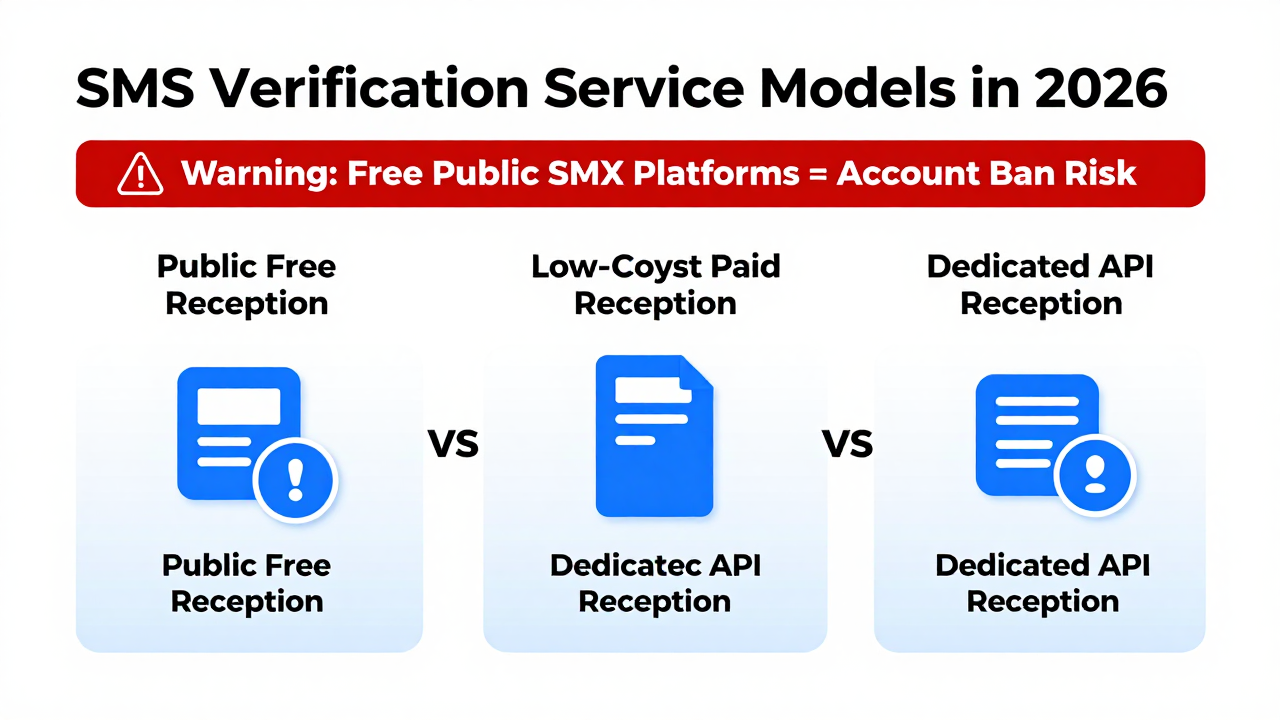
| Service Model | Number Source | Stability | Best For |
|---|---|---|---|
| Public Free Reception | Shared public web pages | Very low, expires anytime | One-off tests, non-critical accounts |
| Low-Cost Paid Reception | Bulk virtual SIM pools | Moderate, concurrency limits | Bulk registration of non-core accounts |
| Dedicated API Reception | Carrier partnership channels | High, independent number resources | E-commerce, ad campaigns, account matrix operations |
As the table shows, these models serve very different purposes. Industry feedback consistently points to the third model as the only viable option for long-term business use. These platforms provide independent, private numbers that never appear on public pages, and they support API integration for automated management workflows.
In the 2026 ecosystem, platforms like Getfollow exemplify this more compliant approach—they integrate carrier resources to deliver stable verification services for businesses with genuine needs. Their revenue comes from service fees rather than data sales, which means number privacy and stability are structurally guaranteed.
Details Most People Overlook When Choosing a Provider
Most people evaluate SMS verification platforms based on just two metrics: price and success rate. But from my observations, serious operators in 2026 pay attention to several less obvious factors that matter far more.
First, the number's "purity history." What was this number previously used to register? Has it ever been banned? If a number carries a dirty history, your new account will likely receive extra scrutiny from platform algorithms. Reputable providers periodically clean their number pools, but smaller platforms rarely maintain this discipline.
Second, whether "number retention" is supported. Some business operations require you to hold the same number long-term for ongoing two-factor authentication. If your provider only offers one-time reception, you'll face major headaches with password recovery and security verification later. By 2026, many cross-border service providers offer monthly number retention plans—slightly pricier, but dramatically more convenient.
Third, customer support responsiveness. This sounds basic, but it's precisely where most free platforms fail. If you're stuck at 3 AM with a verification code that never arrives, and your provider has no 24/7 support, your business just sits idle. Industry consensus: a reliable provider should respond within 5 minutes, no exceptions.
A Real-World Cautionary Tale
A friend running an independent e-commerce site decided to cut costs in early 2026. He used a free SMS verification platform to register three overseas social media accounts for content distribution. All three accounts were immediately flagged for secondary verification, requiring photo ID uploads.
He casually snapped a photo and uploaded it. The next day, all three accounts were permanently banned with no appeal path. Upon investigation, he discovered the free platform's numbers had been blacklisted as a "high-risk number range" by the target platform due to massive abuse from other users. After switching to a dedicated number provider and re-registering, his accounts finally stabilized.
This story plays out constantly in 2026. Individual operators save a few dollars on SMS verification fees, only to lose hundreds in domain and server costs—not to mention precious time. SMS verification is your account security's first line of defense. It's not where you cut corners.
How to Test a Provider's Reliability on a Minimal Budget
Since you can't choose blindly, how do you evaluate whether an SMS verification provider actually works? My recommendation: use a "small-scale testing" strategy.
Don't buy a large package upfront. Instead, spend the minimum amount to purchase one or two numbers and register your most frequently used, most critical overseas platform account. Evaluate three dimensions:
- Reception speed: Does the verification code arrive within 10 seconds?
- Number quality: Is the registered account immediately flagged or asked for extra verification?
- Post-registration stability: Within 24 hours, does the account show any suspicious login alerts?
If all three dimensions pass, consider scaling up your investment. If even small-scale testing reveals problems, walk away immediately. From my experience, this testing method filters out over 80% of low-quality providers in the market.
During testing, you'll encounter different provider styles. Some platforms use aggressive sales tactics, promising "100% success." That's actually a red flag. Overseas platform risk controls change dynamically in 2026—no provider can guarantee 100% success. Providers who honestly explain the risks and tell you which platforms have lower success rates are the ones worth trusting.
The Bottom Line: SMS Reception Is Just the Starting Point
One final reminder: regardless of which free SMS verification platform or paid provider you choose, understand this fundamental truth: SMS reception is only the beginning of your account's lifecycle.
In 2026's algorithmic environment, your account's behavior during the first 72 hours after registration determines whether it enters the normal recommendation pool. If you register and abandon the account, or immediately bombard it with high-frequency marketing actions, even the best number won't save you. Treat SMS reception as a basic utility and invest your real energy into content operations and brand building—that's the sustainable strategy.
For cross-border businesses and individual operators, the smart approach is to start with small-scale testing, then decide on long-term partnerships based on actual business needs. The best choice isn't the cheapest or the most premium—it's the one that fits your specific requirements.
Frequently Asked Questions About SMS Verification Platforms
Are free SMS verification platforms safe to use in 2026?
Generally, no. Free platforms typically expose your verification codes publicly, monetize your data, or use aggressive upselling tactics. Accounts registered through them face high risk of being flagged or banned by overseas platforms due to shared number pools with poor reputation histories.
What's the difference between free and paid SMS verification services?
Free services use shared public number pools that are unstable, slow, and often blacklisted. Paid services—especially dedicated API-based providers—offer private numbers with better reputation, higher success rates, and features like number retention for ongoing verification needs.
How can I test if an SMS verification provider is reliable?
Start with a minimal purchase of one or two numbers and register your most critical account. Evaluate reception speed (under 10 seconds is ideal), whether the account gets immediately flagged, and whether any suspicious activity appears within 24 hours. This small-scale test filters out most low-quality providers.
Why does my account get banned even after successful SMS verification?
Successful SMS reception doesn't guarantee account safety. Platforms now assess device fingerprints, IP quality, and number source history. If your number was previously used for abusive activities, your account inherits that negative reputation. Additionally, your behavior in the first 72 hours after registration significantly impacts your account's fate.