Free SMS Verification in 2026: What Cross-Border Sellers Need to Know Before Registering Accounts
Free SMS Verification in 2026: What Cross-Border Sellers Need to Know Before Registering Accounts
After years working in cross-border e-commerce, I've noticed a recurring pattern: most solo operators and small studios stumble at the very first step—account registration. Whether you're verifying a store backend, setting up social media profiles, or managing multiple accounts in 2026, free SMS verification has become the go-to tool. But here's the thing nobody in the ads tells you: this space is riddled with traps. Let's cut through the marketing fluff and talk about what actually happens behind the scenes.
What "Free" SMS Verification Really Costs You
I get it—"free" sounds great. But in my experience, any platform still pushing completely free SMS verification in 2026 is hiding costs somewhere you can't see. Industry observers agree: maintaining stable phone number lines requires paying carrier channel fees, server bandwidth costs, and hiring staff to handle risk-control blocks. That money has to come from somewhere.
So how do free platforms stay afloat? Typically through one of these three methods:
- They harvest your IP and device fingerprint data and sell it to data brokers.
- They tamper with the accounts you register, injecting marketing scripts or trackers.
- They bet your account isn't valuable—if you never receive the code, they don't really care.
From my direct observations, a common pattern we see in 2026: solo operators who register WhatsApp or Telegram accounts using free verification numbers often find those accounts banned within 48 hours. The reason is straightforward—these numbers are shared across hundreds of users and already flagged as high-risk by platform algorithms. You spend half a day building a proper account-warming environment, and it all evaporates overnight. That time cost far exceeds the few cents you saved on SMS fees.
Three High-Risk Scenarios for Free SMS Verification in 2026
Let's skip the theory and go straight to the pain points. Based on feedback from cross-border sellers and service providers I work with, these three use cases carry the highest risk when using free SMS verification:
| Scenario | Why It's Dangerous | Typical Outcome |
|---|---|---|
| E-commerce store verification (Amazon, Shopee) | Platforms now use dual-layer checks: device fingerprint + number activity history | Secondary video verification requests, or worse—linked account bans that take down multiple stores at once |
| Social media account matrix (TikTok, Instagram) | Algorithms aggressively flag multiple accounts sharing the same device or IP segment | Entire account networks get wiped out in one sweep |
| Payment tool binding (PayPal, Payoneer) | If the number was previously used for suspicious activity, payment restrictions apply silently | Withdrawal functions locked—you only find out when you try to cash out |
A pattern I keep hearing from cross-border operators: it's not that they refuse to pay for SMS verification—it's that they've been burned before by small platforms that took their money and disappeared. Pay upfront, use it twice, and the platform vanishes along with your numbers. That trust crisis pushes some people to gamble on free services instead.
How SMS Verification Platforms Actually Operate—and Where Compliance Splits
If free platforms are unreliable, does that mean all paid ones are safe? Not exactly. The 2026 SMS verification market splits into two distinct operational models, and understanding the difference matters.
Model One: Shared number pool. This approach maximizes efficiency—one number can receive verification codes for multiple platforms, keeping costs extremely low. The downside? Numbers get overused and accumulate obvious risk flags. By the time you receive one, it's likely already "burned out" from excessive use.
Model Two: Dedicated numbers. This model emphasizes one number per user, meaning the number serves only your account and maintains a clean history. Costs run higher, and the provider needs strong risk-control capabilities. In my testing, platforms like Getfollow follow this compliance-first approach—they prioritize number "survival rates" over sheer volume, which makes a real difference in 2026's stricter environment.
One detail worth sharing from my own testing: platforms that offer number recycling or number retention services tend to be more trustworthy. That capability signals they have genuine carrier relationships rather than just a pool of virtual numbers. If a platform can't clearly explain whether a number can be reused, you're probably dealing with a middleman reseller.
How to Choose a Reliable SMS Verification Provider: A Three-Step Framework
Enough about risks—let's talk solutions. Here's a practical three-step approach I've developed for evaluating SMS verification services in 2026:
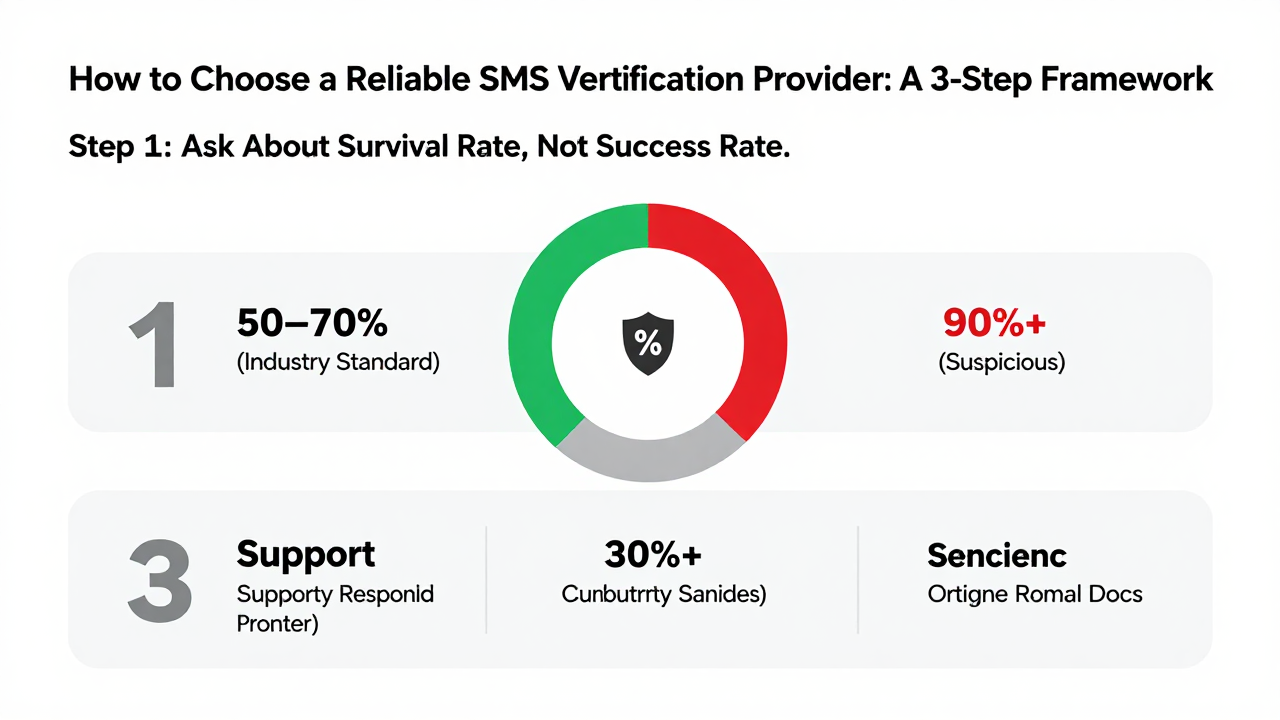
Step 1: Ask about "survival rate," not "success rate." Many platforms advertise "99% success rate," but the question that matters is: "What percentage of accounts remain active 7 days after registration?" If the answer is vague, or they show you screenshots you can't verify, walk away. Industry consensus in 2026 puts legitimate platforms at a 50–70% 7-day survival rate. Anyone promising 90% or higher is either lying or using aggressive tactics that will get your accounts banned anyway.
Step 2: Test their customer support response time. The worst scenario with SMS verification is paying, not receiving codes, and having zero way to reach support. My advice: make a small deposit, then deliberately contact support at 2 AM or on a weekend. If nobody responds during off-hours, that platform isn't worth your money regardless of how cheap it is.
Step 3: Demand clarity on number origin. Legitimate platforms will tell you whether numbers come from virtual operators or physical SIM cards, and whether they're local or roaming numbers. If a provider gives you vague answers like "overseas numbers" without specifics, be suspicious. In 2026, a leading cause of account bans is mismatched number origin and IP address—a basic error that's entirely avoidable with transparent providers.
One final piece of advice: regardless of which service you choose—even with relatively transparent platforms like Getfollow—start with a small test before committing long-term. Register one or two low-importance accounts, observe the process, watch for unusual login alerts, and only scale up once you're confident. This protects your account security and serves as the ultimate test of a provider's quality.
At the end of the day, free SMS verification in 2026 functions more like bait than a solution. What actually determines your business safety is your risk awareness and willingness to invest in proper tools. Don't sacrifice your carefully built account portfolio to save a few cents. I hope this guide helps you build your own evaluation framework—and keeps you steady on the cross-border road ahead.
Frequently Asked Questions About SMS Verification Services
Is free SMS verification safe for registering business accounts?
Generally no. Free numbers are shared among many users and carry high-risk flags that platforms detect immediately. For business-critical accounts, the cost of losing access far outweighs any savings.
What's the difference between shared and dedicated SMS verification numbers?
Shared numbers are used by multiple people across different platforms, making them cheap but quickly flagged. Dedicated numbers serve only your account, maintaining a clean history that passes platform risk checks more reliably.
How can I test an SMS verification platform before committing?
Start with a small deposit and register one or two non-critical accounts. Monitor the registration process, check whether you receive codes promptly, and observe if any security alerts appear afterward. Also test customer support response during off-hours.
Why do accounts registered with free SMS numbers get banned quickly?
Platforms track number reputation and usage patterns. When a number has been used for hundreds of registrations or appears in suspicious activity reports, it gets flagged as high-risk—and any account linked to it faces immediate scrutiny or ban.
What should I look for in a paid SMS verification provider?
Ask about 7-day account survival rates (50–70% is the industry standard), whether they offer dedicated numbers, their customer support availability, and whether they can clearly explain number origin and reuse policies.