Best SMS Verification Services for Cross-Border Business in 2026
Best SMS Verification Services for Cross-Border Business in 2026
If you run an e-commerce operation or manage overseas social media accounts, you've probably noticed something frustrating: phone verification keeps getting harder. By 2026, platform risk-control algorithms are updating almost monthly, and many SMS verification services that used to work fine now either fail to deliver codes or get your accounts flagged within hours. Let's skip the fluff and get into what's actually happening in the industry right now, based on real testing and hands-on experience over the past couple of years.
The Real Problem in 2026 Isn't Receiving Codes Anymore
Most people start by asking which platform is cheapest or has the highest success rate. But honestly, by 2026, "just receiving a verification code" is no longer the benchmark. The industry-wide consensus is that the biggest risk now is getting the code and losing the account anyway—usually due to linked account bans.
How does that happen? Platforms like Google, Meta, and TikTok have upgraded their risk-control systems to detect numbers that come from SMS verification services. They're not just checking whether you used a verification service—they're analyzing the number's "birth certificate" and its social graph. If a number has never appeared in normal telecom traffic and only receives verification codes, algorithms flag it as high-risk almost immediately.
From my experience, there's a clear pattern in 2026: the SMS verification services that are still active have shifted to a hybrid model combining virtual operators with real SIM card pools. They use algorithms to randomly assign numbers and simulate real user behavior patterns. This approach produces much "healthier" numbers, but it also drives up costs.
So if you're still using those dirt-cheap platforms that charge a few cents per code, stop now. In 2026, those number ranges are almost entirely blacklisted by major platforms. You're not buying a verification code—you're buying a short lifespan for your account.
What Cross-Border Businesses vs. Solo Operators Should Prioritize
These two groups need completely different things from an SMS verification service, so let's break it down.
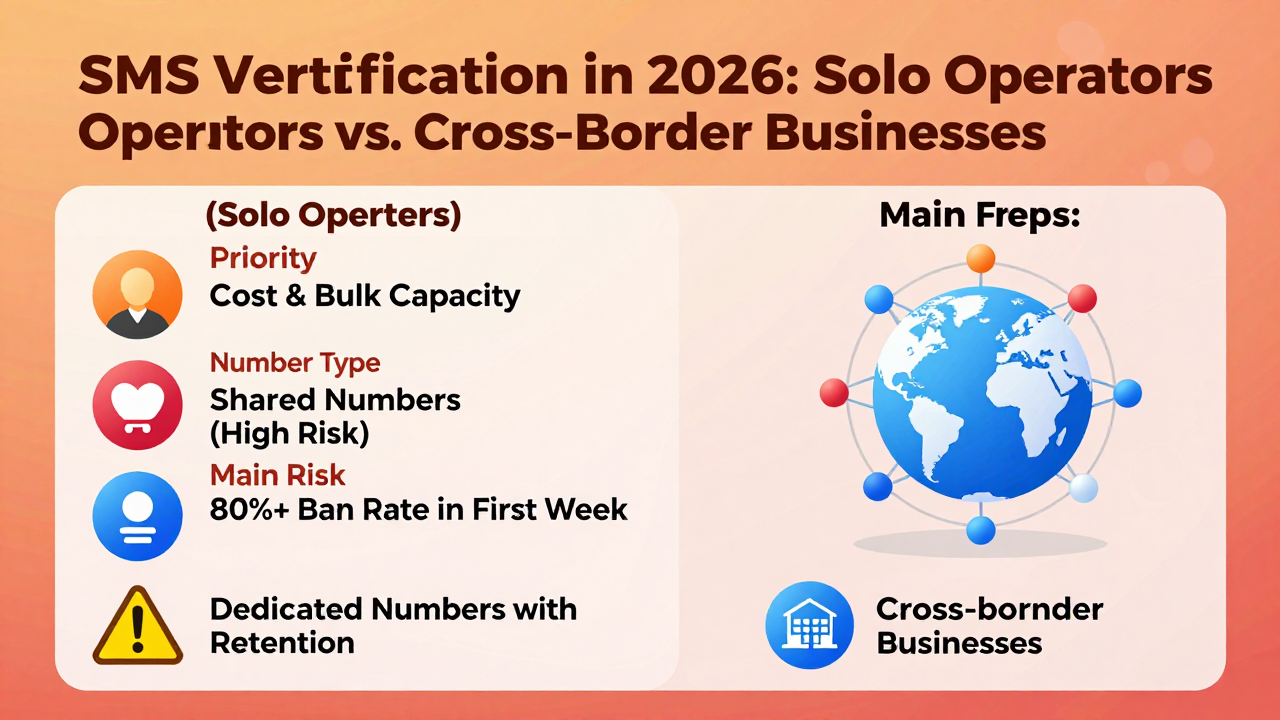
If you're a solo operator—running a dropshipping store or managing multiple social media accounts—your priorities are cost, flexibility, and bulk capacity. But here's the trap: many individual users go for shared-number services because they're cheap. One number gets sold to a dozen people at once, and when someone else registers a spam account with it, you're collateral damage. In 2026, the ban rate on shared number ranges is extremely high—industry observers estimate over 80% of accounts created this way don't survive the first week.
If you're a cross-border business—registering enterprise-level accounts with legitimate overseas operations—your priorities are stability, traceability, and reliable support. When an enterprise account gets banned, the appeal process is painfully complicated. If your SMS verification provider doesn't offer a number retention period or secondary verification code forwarding, you won't even have the materials needed to file an appeal.
One service that has built a solid reputation in this space is Getfollow. In 2026, their focus isn't on being the cheapest—it's on what they call "number lifecycle management." Simply put, they keep the same number assigned to you for a set period, so if the platform requests secondary verification, you can receive the code on the same number. That sounds basic, but surprisingly few providers actually offer it. Many smaller platforms collect your payment, recycle the number immediately, and leave you stranded when follow-up verification is required.
To be clear, Getfollow isn't perfect—their coverage in some less common country codes is limited. But their product design follows the logic of 2026 platform risk-control rules, and that's a direction worth paying attention to.
A Four-Step Checklist for Choosing a Service in 2026
Step one: Check the number source. Legitimate providers will clearly tell you whether numbers are virtual or physical SIM cards and which carrier they come from. If customer support can't give you a straight answer, walk away.
Step two: Test the secondary verification capability. Register a throwaway account, deliberately trigger platform risk controls, and see if you can complete secondary verification with the same number. This single test will filter out more than half of the unreliable providers.
Step three: Evaluate support response time. Cross-border work means time zone differences—if you hit an issue at 2 AM, is anyone actually available? Many platforms in 2026 have introduced AI chatbots, but AI can't solve complex problems like a number being flagged. You need access to a real human.
Step four: Don't buy an annual plan right away. There's an unwritten rule in the industry: start with the smallest test package, run a complete flow (register—verify—use—secondary verify), and only then consider a long-term commitment. Many providers offer pay-per-use pricing. It's slightly more expensive per code, but the risk is manageable.
Three Major Risks in 2026 You Need to Know About
Risk one: "Code received" doesn't equal "registration successful." Some platforms show that a code was sent, you receive it, but when you submit it, the system says the number is already in use or the operation is too frequent. This is common in 2026 because platform risk controls track the number of concurrent requests on a single number. If your provider sells the same number to too many people at once, this mechanism kicks in.
Risk two: "Registration successful" doesn't equal "account safe." In 2026, platforms have strengthened login environment detection. Even if you registered with a clean number, mismatched IP addresses, device fingerprints, or browser language settings can still put your account in a "suspicious" state. This isn't actually the SMS verification service's fault, but many users mistakenly blame the number and make the wrong judgment.
Risk three: "Cheap packages" are often bait. I've seen numerous cases where users bought budget packages, registered a few accounts, and then the verification platform suddenly disappeared. Worse, when those accounts later needed verification, the original numbers were gone—all that upfront work was wasted. In 2026, there are already gray-market platforms using low prices to attract users and harvest account information. Be very careful.
Here's a practical tip to mitigate these risks: don't tie all your accounts to a single SMS verification platform. Even if you've found a provider you trust, keep at least one backup option ready. That way, if one service fails, your business doesn't grind to a halt.
Where the Industry Is Headed: Compliance and Precision
Let's be honest—the SMS verification industry in 2026 has moved past its "wild growth" phase. The old model of cheap prices and massive number pools simply doesn't work under current risk-control systems. The industry consensus is that going forward, verification services must offer traceable numbers, simulated user behavior, and complete after-sales support.
This trend is driving a clear split in the market. Top-tier platforms are becoming more like virtual operators, offering services that closely mimic real user behavior. Meanwhile, smaller players are getting pushed out. For users, this is actually good news—your money now buys a reliable registration solution rather than a lottery ticket disguised as a verification code.
One last piece of advice: regardless of which provider you choose, test with a small volume before committing long-term. Cross-border business is already challenging enough—don't let something as basic as phone verification hold you back. Hopefully, this guide helps you avoid some common pitfalls and makes your 2026 expansion smoother.
Frequently Asked Questions
What is the best SMS verification service for international accounts in 2026?
The best choice depends on your use case. For solo operators managing multiple social media accounts, look for providers offering dedicated numbers with retention periods. For businesses registering enterprise accounts, prioritize providers with reliable support and secondary verification capabilities. Always test with a small package before committing.
Why do my accounts get banned even when I receive the verification code?
Receiving a code doesn't guarantee account safety. Platforms analyze the number's history, your IP address, device fingerprint, and browser settings. If your number comes from a shared pool or your login environment looks inconsistent, your account can still be flagged as suspicious.
Are cheap SMS verification services worth it in 2026?
Generally, no. Budget services often use shared number ranges that are already blacklisted by major platforms. You might save money upfront, but the high ban rate means you'll spend more time and resources re-registering accounts. A mid-tier provider with clean numbers is usually the better investment.
How can I test if an SMS verification platform is reliable?
Run a complete test flow: register an account, trigger secondary verification, and confirm you can receive codes on the same number. Also, check whether customer support responds quickly during your time zone's off-hours. These two tests will reveal most unreliable providers.