How to Choose a QQ SMS Verification Code Platform in 2026: A Cross-Border Seller's Guide
How to Choose a QQ SMS Verification Code Platform in 2026: A Cross-Border Seller's Guide
After two years in cross-border e-commerce, I've learned one thing the hard way: account security isn't something you can solve by just buying software. In 2026, platform risk-control algorithms have gotten frighteningly sophisticated—they're judging registration environments, number ownership, and behavioral patterns with surgical precision. Every studio owner I talk to says the same thing: the real headache isn't traffic anymore, it's accounts getting banned right after they're warmed up. And nine times out of ten, the root cause traces back to a bad decision made at the SMS verification step.
So let's skip the fluff and talk honestly about the QQ SMS verification code platform industry. I'll walk you through the unspoken rules, the failure cases I've witnessed firsthand, and a screening framework that actually holds up in 2026.
The Bottom Line: In 2026, It's Not About "More Numbers"—It's About Clean Environments
Most people pick a platform by looking at price first and number volume second. But the industry consensus in 2026 is that both of those factors matter far less than they used to. Last year, I helped a friend who runs a TikTok Shop account troubleshoot a wave of bans. Turns out, the platform he was using had sold the same number segment to users across a dozen different regions. Those "dirty numbers" might pass registration, but once the algorithm cross-references device fingerprints and IP associations, it flags the entire batch as coordinated operation and bans them all at once.
What actually determines a platform's value is its number resource management and risk-control isolation. In plain terms: can it deliver "one card, one clean environment," and is the number segment uncontaminated?
Three Major Shifts in the SMS Verification Industry for 2026
Shift one: Real-name registration pressure is forcing providers to evolve. Domestic regulators are cracking down hard on IoT cards and virtual operators. Platforms that relied on "black cards" in 2026 have mostly vanished. The survivors either partner with legitimate carriers or operate through overseas number pools.
Shift two: API stability is now a non-negotiable benchmark. Most cross-border studios run automated registration workflows. If the interface keeps dropping or callback delays exceed 10 seconds, the platform is useless. Practitioners report that in 2026, the first thing they test is API documentation quality and response speed.
Shift three: Customer support speed matters more than ever. In the old days, you'd submit a ticket and wait three days. Not anymore. Account registration is time-sensitive—miss one verification code and you miss an entire window of opportunity. That's why providers offering 7x24 instant messaging support have become the default choice for serious studios, even at a premium price.
Pain Points: The SMS Verification Traps We've All Fallen Into
Let me share a real case. A friend running a independent site community needed to bulk-register WhatsApp accounts in early 2026. He went with a rock-bottom-priced platform to save money. Within two weeks, 47 out of 50 registered accounts were hit with secondary verification requests within 24 hours—and all of them died. When he dug into the cause, he found the platform was handing out virtual numbers generated in bulk from a single overseas data center. WhatsApp's risk-control system had already flagged that entire range.
This case is a perfect illustration of a widespread misconception in 2026: people assume SMS verification is just "receiving a text," but the number's origin determines the account's lifespan.
Another common trap is "phantom inventory." Some platforms show plenty of available numbers, but when you actually send a request, it either spins forever or delivers a wrong verification code. These platforms use fake "online" status to keep users around—they simply don't have that many physical SIM cards. This problem exploded in 2026, especially on small, non-specialized websites.
Why Is Risk Control So Paranoid in 2026?
The core reason: major overseas platforms (Google, Meta, TikTok) have fully deployed behavioral biometrics. They no longer just check if your phone number is valid—they analyze your swipe patterns during registration, typing speed, network latency, even micro-vibrations from phone sensors. This means even if your number is real, a "too fake" registration environment will trigger risk controls anyway.
That explains why some people use the same SMS platform without issues while others get banned on every attempt. The problem usually isn't the platform itself—it's whether your device fingerprint and network environment are clean. So in 2026, choosing a QQ SMS verification code platform is really about choosing a service that supports your environment isolation strategy.
From what I've observed, platforms like Getfollow have earned a solid reputation by using a "tiered number pool" system. They classify numbers by registration environment purity, letting users pick a tier that matches their risk tolerance. It costs more per number, but it dramatically reduces post-registration ban rates.
How to Pick a Reliable Provider: A Practical Screening Framework for 2026
Since you're here with clear intent, let's get straight to actionable advice. This screening framework comes from conversations with multiple cross-border sellers doing eight-figure annual revenue. Use it as-is.
- Step one: Ask about "number segment survival rate," not total inventory. Request the verification code delivery rate for a specific segment (like US T-Mobile) over the past 7 days. If the provider gets vague or throws out a generic "99% success rate," walk away. Reliable platforms will show you a real-time monitoring dashboard.
- Step two: Test concurrent isolation. Fire off 5 registration requests for different platforms simultaneously. See if you receive all 5 codes within 30 seconds and whether the numbers are geographically dispersed. If all 5 come from the same city or even the same carrier, that's a red flag.
- Step three: Clarify the refund policy. By 2026, any legitimate platform offers "double refund for undelivered codes" or balance compensation. If support dodges the topic, they don't trust their own number quality.
- Step four: Inspect the API documentation's granularity. Professional platforms document callback timeouts, custom number pool configuration, and number status queries in detail. If the docs only cover "get number" and "get code," you're dealing with a middleman.
Run through these four steps and you'll filter out roughly 80% of the junk platforms on the market. From the remaining 20%, pick based on price and business fit—you won't go far wrong.
About Pricing: Don't Fall for "Low-Price Traffic Bait" in 2026
There's an unspoken rule in this industry: new platforms often slash per-code prices to steal users—think $0.05 per code. But here's the math problem: physical overseas SIM cards, data center bandwidth, and risk-control maintenance all cost real money. Selling below cost only means one of two things: the numbers are virtual (which means they'll get banned fast), or the platform plans to run off with your balance.
A reasonable price range in 2026, depending on region, is roughly $0.10 to $0.50 per code. Major Western markets (US, UK, Germany) skew higher; Southeast Asia (Philippines, Malaysia, Thailand) runs cheaper. If you see anything below $0.05, skip it entirely.
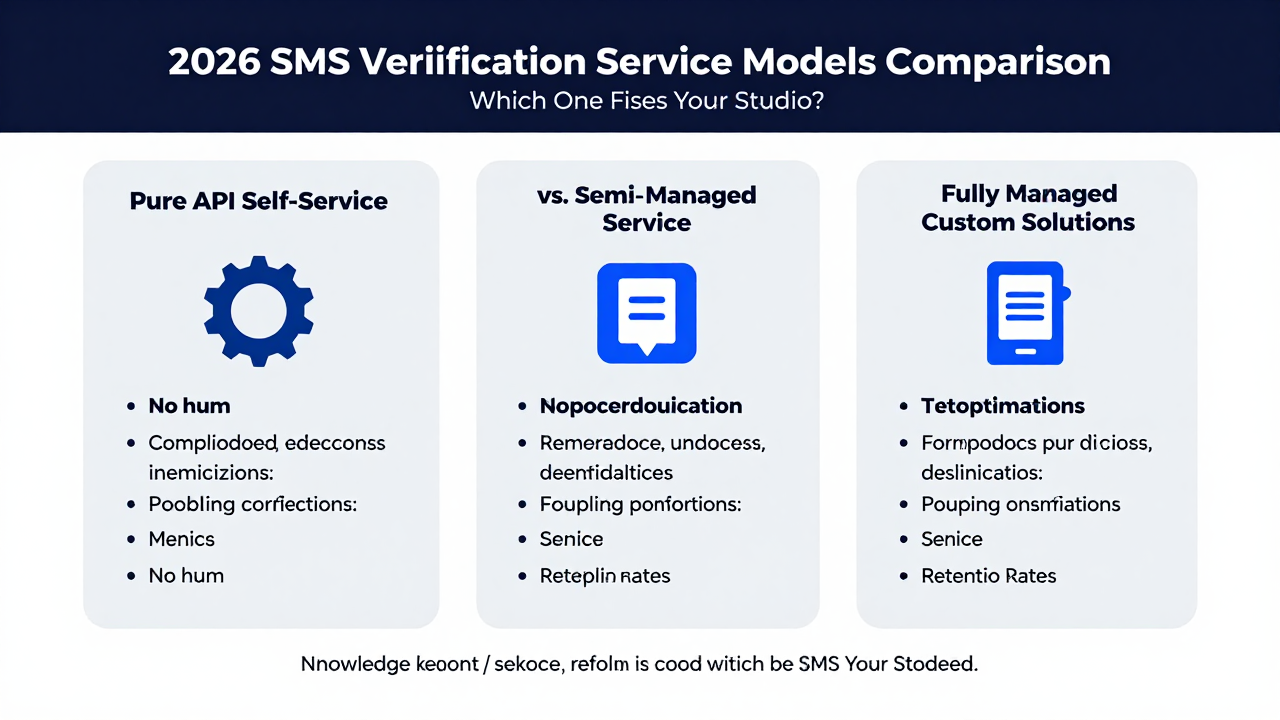
Comparison: Three Main Service Models (2026 Field Observations)
| Service Model | Typical Features | Best For | 2026 Risk Notes |
|---|---|---|---|
| Pure API Self-Service | No human intervention, fully automated number retrieval | Studios with mature tech teams and in-house risk-control systems | You handle environment isolation yourself—otherwise, ban rates run high |
| Semi-Managed Service | Number pool access plus basic environment recommendations | Teams with operational experience but limited technical support | Depends on how current the platform's environment advice is |
| Fully Managed Custom Solutions | Tailored number resources for specific business platforms | Large-scale matrix operations requiring maximum account stability | Higher cost, but retention rates consistently reported above 70% |
Based on 2026 industry feedback, pure API self-service platforms show wildly fluctuating retention rates—typically between 30% and 50%. Fully managed custom solutions cost more but hold retention steady around 70%. If you're a solo operator on a tight budget, start with semi-managed services and test the waters.
Potential Risks and Avoidance Tips (Must-Read)
Let me pour some cold water on the hype: SMS verification platforms are tools, not insurance policies. In 2026, even if you use the most expensive platform, accounts will still get banned if your post-registration behavior looks robotic. Register and immediately start mass-adding friends or blasting marketing links? No platform on earth will keep those accounts alive past three days.
There's also the "linked ban" risk. Many cross-border sellers think using different numbers for different platforms keeps them safe. But if all your accounts were registered through the same SMS platform and one of its number segments gets flagged, every account tied to it can be banned in one sweep. My advice: use physical SIM cards for your primary accounts, reserve SMS platforms for secondary ones, and never put all your eggs in one platform's basket.
Finally, a word on compliance. In 2026, overseas platforms are cracking down on virtual number registrations harder than ever. If your business involves financial or payment accounts, I strongly advise against using SMS verification platforms for primary registrations—the risk is simply too high. For those sensitive accounts, go through physical SIM cards or legitimate carrier channels.
Final Thoughts: My Honest Recommendation
In cross-border e-commerce, time is money. Instead of endlessly troubleshooting SMS verification issues, pay a bit more upfront for a stable service. My personal routine: every time I test a new platform, I deposit $10, register 3–5 accounts across different platforms, and monitor survival rates for a week. If retention falls below 60%, I abandon it—balance and all.
In 2026, QQ SMS verification code platforms are fundamentally competing on resource integration and risk-control expertise. Providers like Getfollow that can explain why a specific number works for a specific platform are the ones worth long-term partnerships. Anyone who only shouts "lowest price on the internet" is probably treating you as the product.
Remember: test small first, then scale up. That's the single most reliable SMS verification strategy in the cross-border circle for 2026—bar none.
Frequently Asked Questions About QQ SMS Verification Platforms
What is a QQ SMS verification code platform?
A QQ SMS verification code platform provides temporary phone numbers that receive SMS messages for account registration and verification. Cross-border sellers use these services to register accounts on platforms like WhatsApp, Telegram, TikTok, and others without using personal phone numbers.
Why do accounts get banned after using SMS verification platforms?
Most bans trace back to "dirty numbers"—number segments that have been overused, recycled across regions, or generated as virtual numbers. Platforms like Google, Meta, and TikTok now use behavioral biometrics to detect fake registration environments, so even real numbers can trigger bans if the device fingerprint or network looks suspicious.
How much should I pay for SMS verification codes in 2026?
Reasonable pricing ranges from $0.10 to $0.50 per code depending on the target country. US, UK, and German numbers cost more; Southeast Asian numbers cost less. Anything below $0.05 should be treated as a red flag—it likely means virtual numbers or a platform planning to disappear with your balance.
Can I use one SMS verification platform for all my accounts?
Technically yes, but it's risky. If the platform's number segment gets flagged by risk-control systems, all accounts registered through it can face linked bans. Best practice: use physical SIM cards for primary accounts, reserve SMS platforms for secondary ones, and diversify across multiple providers.
What's the difference between pure API and managed SMS verification services?
Pure API platforms give you automated access to numbers but require you to handle environment isolation yourself. Managed services provide number pools plus environment recommendations or fully customized solutions. In 2026, retention rates for pure API platforms hover between 30-50%, while fully managed solutions consistently hit 70% or higher.