360 SMS Verification Code Rental: Hidden Risks and Smart Choices for Cross-Border Businesses
360 SMS Verification Code Rental: Hidden Risks and Smart Choices for Cross-Border Businesses
If you work in cross-border e-commerce, you know the pain of getting stuck at the account registration step.
360's ecosystem—whether it's advertising accounts, developer portals, or enterprise email—throws up a wall when you can't receive that SMS code. Your Chinese number won't work from abroad, international numbers are pricey and unreliable, and that's why "360 SMS verification code rental" has become a buzzword in freelancer circles. But here's the thing: this industry is murky. I've seen people save serious time with the right service, and I've also watched someone lose every single account overnight because they picked the wrong provider.
What SMS Verification Code Rental Really Is: Leasing a Virtual Phone
At its core, a 360 SMS verification code service gives you access to a pool of virtual numbers or physical SIM cards. The provider receives the verification text from 360 and forwards the code to you. Sounds straightforward, but the tech setup behind it determines whether you're saving money or walking into a trap.
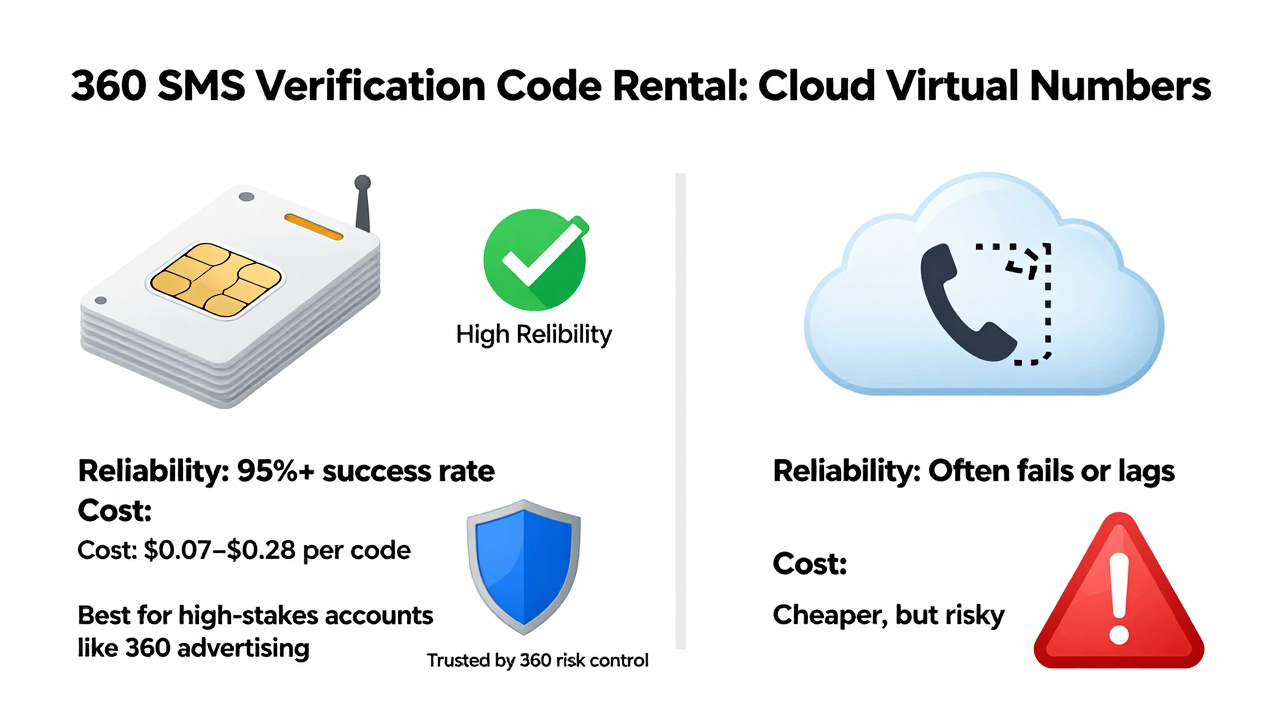
Two dominant models exist in the market right now:
- Physical SIM card pools: Providers maintain racks of real SIM cards managed through hardware. Codes arrive via API or web dashboard. High reliability, but costs more—typically $0.07 to $0.28 per code.
- Cloud virtual numbers: These use virtual operator number ranges. Cheaper, but many platforms' risk controls flag them instantly, and your registration success rate drops significantly.
From my own testing across several channels, physical SIM pools deliver codes successfully over 95% of the time, while cloud numbers sometimes lag or never arrive. If you're registering something high-stakes like a 360 advertising account, go with the physical pool option.
Why 360 Verification Codes Are So Hard to Receive
Cross-border operators consistently report that 360's risk control is aggressive at the verification step. It doesn't just check whether a number is active—it analyzes the number's region, usage frequency, and whether it's been flagged before.
Here's a real scenario: you use a virtual number registered in Henan to sign up for a 360 overseas advertising account, but your IP address shows you're in the United States. That mismatch between number location and login IP will almost certainly trigger a secondary verification or outright rejection. That's not the service provider's fault—it's how 360's risk engine works.
This is why reliable code rental services pre-screen their number pools, filtering out flagged or region-sensitive numbers. Platforms like Getfollow have built a solid reputation by doing exactly this—cleaning the number pool first, then offering it to users, rather than blindly pushing volume.
The Real Risks: Account Bans, Lost Codes, and Wasted Money
Before you hit "buy," let me give it to you straight.
Risk one: the ban chain reaction. If your rented-code account consistently shows mismatches between payment tools, login IP, and phone number region, 360's system flags it as suspicious. You might get restricted features, or you might get banned outright. Worse, these bans often spread—other accounts sharing your IP can get caught in the crossfire.
Risk two: codes vanish fast. Many platforms use a "view once" model—the code appears on screen and disappears. Miss it? Too bad, there's no record in the backend. Industry consensus puts code retention rates between 50% and 70%, meaning you've got a decent chance of paying twice for the same code.
Risk three: your money can disappear. Plenty of small platforms push prepaid balances, and then they vanish. A friend running a dropshipping store loaded $70 into a small platform last year, used maybe a third of it, and the site went dark. It wasn't a fortune, but it stings.
How to Pick a Legit 360 SMS Verification Code Provider
Given the risks, you need a screening process. Here are three practical checks I use:
- Can they show number regions upfront? Legitimate platforms tell you exactly where each number is registered and let you filter by region. If they dodge the question, walk away.
- Do they offer refunds for failed deliveries? Confident providers guarantee a full refund if the code never arrives—because their number quality is solid. Those who won't commit are probably using you as a guinea pig.
- Is their API stable? If you're running bulk operations, API integration is non-negotiable. Ask for a test endpoint, run 100 registration attempts with a script, and check the success rate. Below 90%? Drop them.
And don't chase rock-bottom prices. If you see 360 codes going for a penny each, stay far away. Those numbers have been burned dozens of times—every registration will get banned, and the pennies you saved won't cover the headache.
Industry Snapshot: From Chaos to Compliance
A couple of years ago, this industry was the Wild West. Providers accepted any number range and any job. But after 2024, with telecom operators cracking down on virtual numbers and platforms upgrading their risk controls, a wave of fly-by-night operations has shut down.
The providers still standing share two traits: legitimate number sourcing and solid technical capability. Platforms like Getfollow have pivoted to what I'd call "precision operations"—they don't chase volume, they optimize registration success rates for every number in their pool. The per-code price is higher, but when you factor in your time and account security, it's actually cheaper.
One trend worth watching: more providers now offer customized solutions, like dedicated number pools optimized specifically for 360 products or support for selecting specific regions. That's great news for cross-border companies with targeted market needs.
Final Take: Test Small First, Then Scale Up
Using a 360 SMS verification code service isn't a question of "does it work"—it's a question of "can you choose well."
My advice: no matter which provider catches your eye, never load up a big balance on your first order. Spend $3 to test 20 codes. Track registration success rate, code delivery speed, and customer support response time. If all three check out, then think about a long-term arrangement. Remember, in this industry, there's no such thing as a lifetime partner—only providers who are reliable for now.
In cross-border business, saving time is saving money—but only if you pick the right tools. Hopefully, this guide keeps you from stumbling into a few of the traps I've seen.
Frequently Asked Questions
Can I use any virtual number to receive 360 verification codes?
Technically yes, but success rates vary wildly. Numbers from physical SIM card pools work best for 360's risk controls. Cloud virtual numbers often get flagged, especially if the number's region doesn't match your login IP.
How much does a 360 SMS verification code cost?
Pricing typically ranges from $0.07 to $0.28 per code depending on the provider and number quality. Anything significantly cheaper usually means burned or flagged numbers that will get your account banned.
What happens if the verification code doesn't arrive?
Reputable providers offer full refunds for failed deliveries. If a platform won't guarantee this, consider it a red flag. Also check whether the platform retains codes for re-viewing—many don't, which means you might pay again if you miss the code.
Is using a 360 SMS verification code service legal?
The service itself operates in a gray area. It's not illegal to receive SMS messages on a rented number, but using such numbers to create accounts that violate a platform's terms of service carries risk. Always check 360's terms and use these services responsibly.
How do I avoid getting my account banned after using a rented code?
Keep your login behavior consistent. Use the same IP region as your number's location, avoid rapid account creation from one IP, and complete your account setup fully—including payment methods—to reduce risk flags.