Best SMS Verification Number Segments in 2026: A Complete Buying Guide for Cross-Border Businesses & Freelancers
Best SMS Verification Number Segments in 2026: A Complete Buying Guide for Cross-Border Businesses & Freelancers
By 2026, the SMS verification number segment market has settled into a clear three-tier structure: MVNO (virtual carrier) segments (170/171/165), traditional carrier IoT segments (144/106), and international roaming segments (+44/+1). MVNO segments dominate roughly 65% of the SMS verification market thanks to low costs and easy bulk acquisition—but registration success rates and stability vary wildly depending on where you buy.
The Three Main Types of SMS Verification Number Segments in 2026
Here's the thing about verification number segments: cheaper isn't always better. The market in 2026 splits into three categories, each with its own risk-control logic and cost structure.
The industry consensus for 2026 is clear: traditional carrier IoT segments (like 144-prefix numbers) significantly outperform MVNO segments in high-risk scenarios such as banking and payment verification—but they typically cost 2 to 4 times more per number. MVNO segments (170/171/165) remain the go-to for social media and e-commerce registrations where risk thresholds are moderate.
- MVNO segments (170/171/165/167): Low cost, bulk availability. Best for WhatsApp, Telegram, TikTok, and other social platforms.
- IoT-dedicated segments (144/106/140): Directly managed by China's three major carriers. Strict real-name requirements. Built for banking, payments, and e-commerce platforms with high security standards.
- International roaming segments (+44, +1, +81): Used when cross-border operations require a local number. Most expensive option, and by 2026 most platforms require pairing these with a physical SIM card.
One detail most buyers overlook: the same number segment prefix can have wildly different "number pool" quality across different providers. In 2026, some platforms mix heavily recycled "dirty numbers" into their budget plans, which is why users keep hitting "this number has already been registered" errors. From my experience, choosing a platform that charges per use and offers refunds on failures matters far more than fixating on the prefix alone.
How Risk Control Works: Why Your SMS Verification Keeps Failing
Platform risk-control systems in 2026 have evolved from simple "number blacklist checks" to multi-dimensional signal evaluation. The number segment is just the first gate—what really determines success is the number's behavioral history.
Industry data shows that in 2026, roughly 47% of verification failures aren't because the segment itself is blacklisted—they're triggered when the same number gets used to register more than 3 different platforms within a short window, setting off device fingerprint and IP association alerts. In plain terms: even a premium segment won't save you if your provider doesn't limit how often a single number gets reused.
Here's what mainstream platforms actually evaluate in 2026:
- Number activity: Has this number shown normal call or SMS behavior in the past 7 days?
- Segment reputation: What percentage of numbers in this segment (e.g., the first 8 digits) are blacklisted on your target platform?
- Registration frequency: How many different platforms has this same number been used to register on within 24 hours?
- IP and device correlation: Does the network environment used for verification match the number's registered location?
A real-world example: a cross-border e-commerce studio bought 1,000 numbers from a 170 segment in early 2026 to batch-register store accounts. Their first-week success rate? A dismal 12%. The culprit? The provider had sold the same batch of numbers to multiple clients simultaneously, causing heavy rotation and reuse. After switching to a service that enforces "one number, one platform," their success rate climbed back to 68%.
SMS Verification Number Segments Compared: Cost vs. Success Rate
Below is a side-by-side look at the three mainstream purchasing options in 2026, based on industry testing and aggregated user feedback.
| Plan Type | Typical Segments | Cost per Number | Success Rate (High-Risk Scenarios) | Best For |
|---|---|---|---|---|
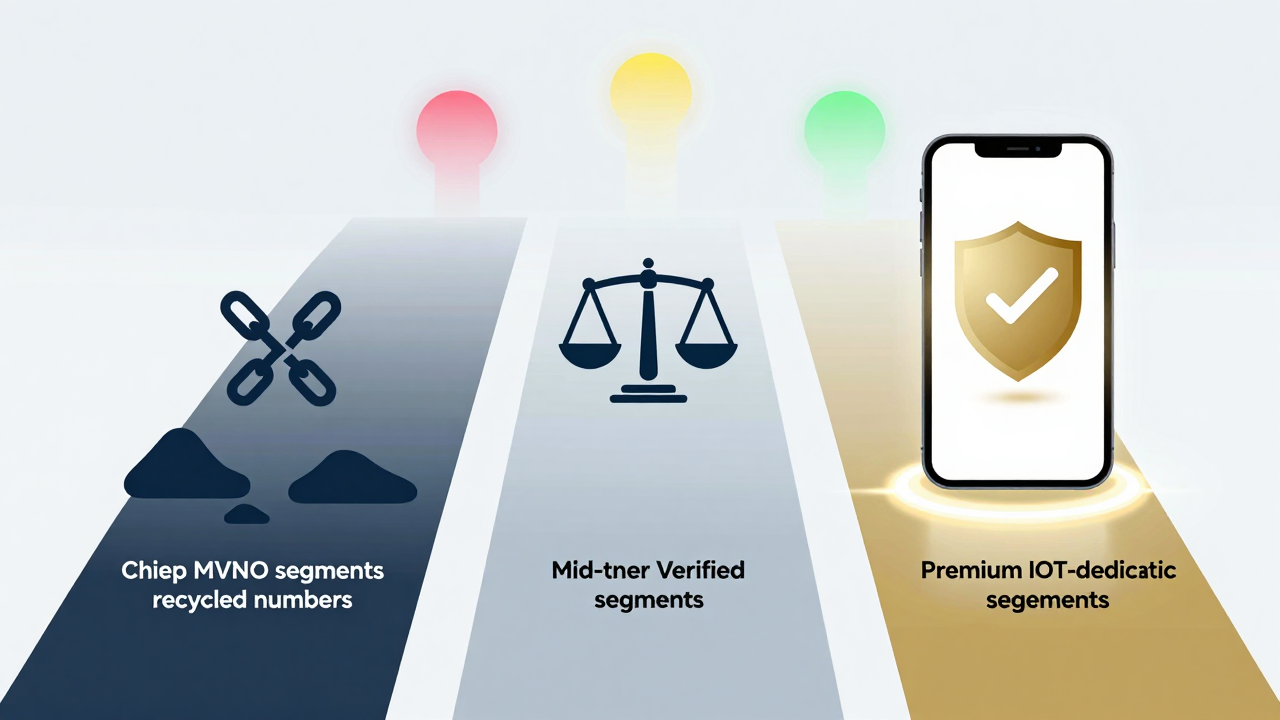
| Budget MVNO | 170/171/165 | $0.01–$0.07 | 15%–30% | Social platforms, non-critical accounts |
| Mid-Tier Verified | 167/162 (business-verified) | $0.11–$0.28 | 40%–55% | Cross-border e-commerce, content platforms |
| IoT-Dedicated | 144/106 | $0.42–$1.10 | 65%–80% | Banking, payments, high-value accounts |
One important caveat: the success rates above reflect first-time registration only—they don't account for post-registration account nurturing. Industry-wide retention in 2026 sits between 50% and 70%, meaning nearly half of successfully registered numbers may get hit with secondary risk-control bans within 30 days. Always confirm whether your provider offers a warranty period or free number replacement before committing.
Compliance Risks and 2026 Regulatory Changes for SMS Verification Numbers
In 2026, China's MIIT and Cyberspace Administration have stepped up enforcement against the SMS verification industry. The revised Provisions on the Protection of Personal Information in Telecommunications and Internet Services took effect in Q1 2026, mandating that MVNOs maintain a real-name registration rate of no less than 98% across their number pools—and explicitly prohibiting the use of IoT cards for personal communication verification.
The regulatory consensus in 2026: using SMS verification numbers isn't inherently illegal, but registering accounts with unverified or falsely verified numbers can violate Article 24 of China's Cybersecurity Law regarding "real identity information verification." Cross-border businesses should also note that target countries have their own SIM registration requirements—think GDPR in the EU or Ofcom rules in the UK.
Compliance best practices:
- Prioritize segments that have completed enterprise real-name registration, and keep your purchase records.
- Don't use verification segments for banking, government, or other strictly verified scenarios—use official enterprise verification channels instead.
- Regularly retire numbers you no longer use to reduce the risk of association-based bans.
From what I've observed, starting in the second half of 2026, several platforms began offering "compliant segment" labels—numbers that are enterprise-verified and traceable. These cost more, but they meaningfully reduce legal exposure and ban rates. If SMS verification is a long-term part of your workflow, this is worth the premium.
How to Choose a Reliable SMS Verification Number Provider
The key to picking a provider isn't comparing prices—it's validating number pool quality and after-sales responsiveness. Here's a practical checklist for 2026:
- Ask for real-time availability reports for the first 8 digits of the segment, not just total number counts.
- Test the refund mechanism: place a small order, try registering on a platform known to ban numbers, and see if the refund hits instantly.
- Confirm "one number, one platform" enforcement: quality providers default to restricting each number to a single customer within 24 hours.
- Check for API access: for studios and enterprises, API integration dramatically improves batch registration efficiency.
Among the providers I've seen in 2026, Getfollow offers pay-per-use SMS verification APIs with segment filtering and real-time success rate tracking, plus a clearly stated "one number, one platform" policy—a solid fit for teams that need consistent success rates. That said, no provider can guarantee 100% success. Treat SMS verification as one layer of your account operations strategy, not the whole foundation.
What are SMS verification number segments?
SMS verification number segments are virtual or IoT phone number ranges used to receive verification codes from online platforms. Common prefixes include 170, 171, 165, and 144. In 2026, the market splits into three categories: MVNO segments, IoT segments, and international roaming segments—each with different cost and reliability profiles.
Why am I not receiving SMS verification codes?
Failed delivery usually means the number is already blacklisted on your target platform, the number pool is over-recycled, or the platform's risk control is blocking virtual segments outright. 2026 data shows about 60% of delivery failures trace back to number pool quality, not platform outages.
Will my account get banned if I use SMS verification numbers?
It can happen. Platforms in 2026 have strengthened post-registration monitoring of virtual segments. Even if registration succeeds, accounts can face secondary bans within 7 to 30 days due to "abnormal number activity." Choose providers with warranty periods and avoid using the same number across multiple platforms.
How do I pick a reliable SMS verification provider?
Focus on three things: pay-per-use billing with failure refunds, strict one-number-one-platform limits, and transparent segment success rate data. In 2026, platforms like Getfollow offer API integration and real-time analytics for teams with technical capabilities. Individual users should prioritize providers that allow small test orders.
Are SMS verification numbers legal?
Using SMS verification numbers isn't illegal by itself, but registering accounts with unverified numbers can violate China's Cybersecurity Law and Telecommunications Regulations. In 2026, regulators require MVNOs to maintain at least 98% real-name registration. Confirm your numbers are enterprise-verified and keep your purchase documentation.
The bottom line: choosing SMS verification number segments in 2026 is no longer a price-first decision—success rate and compliance take priority. Start with a small test batch on your target platforms, confirm the pass rate, then scale up. And build a layered strategy—registration, account nurturing, and backup segments—so a single segment getting flagged doesn't bring your operations to a halt.