US TikTok SMS Verification: The Hidden Hurdle in Cross-Border Account Registration
US TikTok SMS Verification: The Hidden Hurdle in Cross-Border Account Registration
If you're doing cross-border business on TikTok US, chances are you've hit the SMS verification wall at some point. Since 2025, the platform has tightened its registration environment controls significantly. A clean US phone number now determines whether your account lands in the normal recommendation pool or gets flagged as suspicious traffic. The old approach—grabbing any random verification code from a cheap platform and calling it a day—simply doesn't cut it anymore, and plenty of cross-border operators can vouch for that.
This article isn't another "Top 10 SMS Verification Platforms" listicle. You can find those anywhere, and most are thinly veiled ads anyway. Instead, I'm going to walk you through what actually separates one US TikTok SMS verification service from another, where the real risks hide, and how to make a decision you won't second-guess later in a market that's crowded with both serious players and fly-by-night operations.
Why US TikTok SMS Verification Became a Non-Negotiable
Here's something I've observed firsthand. TikTok's US market is massive and its users have serious spending power—which makes it the battleground for cross-border sellers and social media operators alike. But the platform's registration system requires a foreign phone number, and that single requirement has spawned an entire verification service industry.
A lot of people assume SMS verification is just "receiving a code." It's not that simple. What you're actually getting is a number with a credit history attached. TikTok's risk control system evaluates whether that phone number belongs to a real user, whether it's been shared across multiple accounts, and whether it has any violation history tied to it.
Industry consensus points to three main service models currently on the market:
- Shared number pool model: One number gets sold over and over. It's cheap, but the risk control is terrible. These numbers are basically "use once and discard," and they can even trigger account association bans.
- Privately aged number resale: Providers bulk-register numbers, "age" them for a while, then sell them as "exclusive." Stability depends entirely on how well the aging process was handled—but you have no way to verify that.
- Compliant API integration model: Providers maintain legitimate partnerships with overseas carriers. Number origins are traceable, and real-time reception is supported. In my experience, platforms like Getfollow have built a solid reputation in this space precisely because they operate on this compliance-first logic.
Once you understand these three models, you'll see why one service charges $0.30 per US TikTok SMS verification while another asks for $3. The price gap isn't arbitrary—it reflects a massive difference in number quality and service reliability.
A Real Case: Cutting Corners Cost More Than $5
A friend of mine runs a home goods dropshipping store. Last year, to save money, he bulk-registered 50 TikTok accounts using a budget verification platform for his matrix traffic strategy. Within two weeks, every single account was flagged as "non-genuine user" and permanently banned.
Here's where it got ugly. He had linked one of those accounts to his store's domain and business email. TikTok ended up flagging his entire IP range, and even his main account with 50,000 followers—which had been running perfectly fine—got throttled. When we debriefed afterward, he told me: "The few hundred yuan I saved on verification codes cost me at least a quarter of organic traffic. That lesson was expensive."
This story plays out all the time in the cross-border community. Too many operators fixate on the sticker price of SMS verification while ignoring the hidden variables: IP purity, device fingerprints, number segment origins. TikTok's risk control doesn't just check whether a code arrives—it scores the entire registration environment for authenticity.
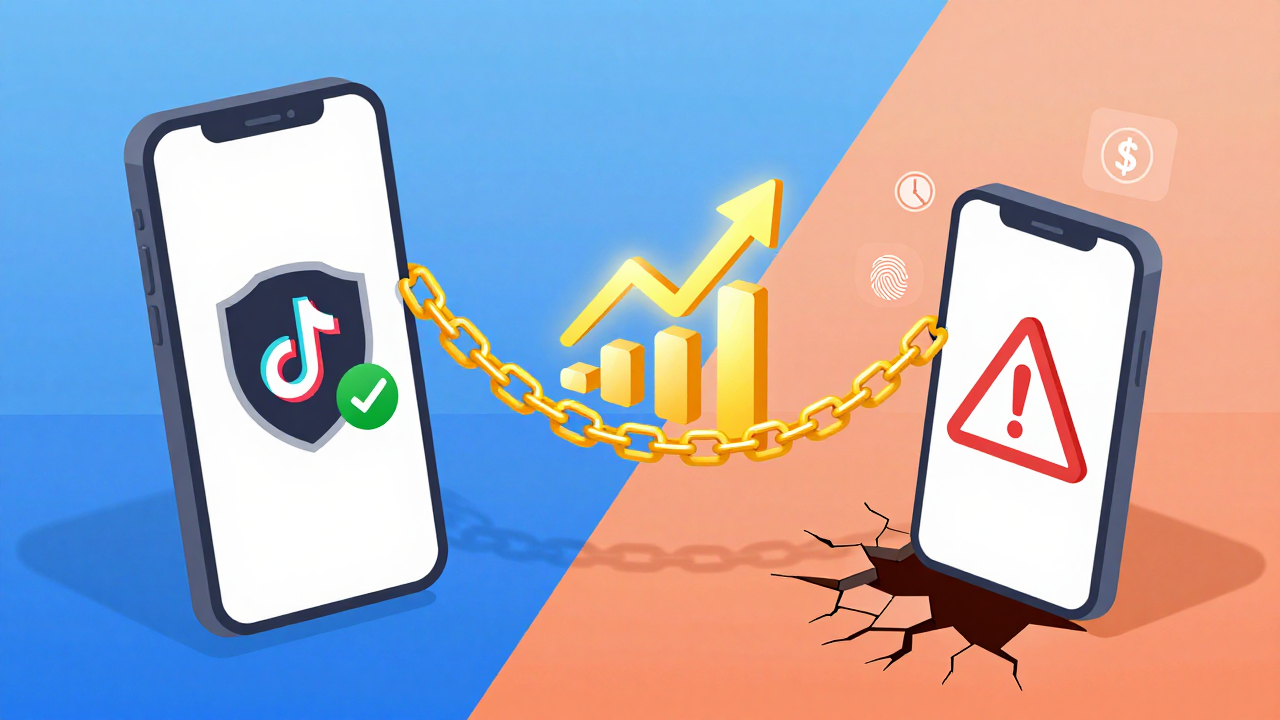
Three Hidden Risks in US TikTok SMS Verification (Must-Read Before You Buy)
If you're making a purchasing decision, these are the things you need to understand before committing to any provider. Most won't tell you this proactively.
Risk One: Recycled Numbers and Blacklist Contamination
Many budget verification platforms rely on "second-hand" numbers—lines that were canceled by previous users and recycled back into the carrier's pool. These numbers have likely been blacklisted by major platforms or already tied to other accounts. Registering TikTok with one of these is like starting life with a criminal record.
Practical advice: Don't rush into registration when you receive a number. Test it first—see if it can receive verification codes from other international platforms like Telegram or WhatsApp. If it can't even handle those, the number's cleanliness is highly questionable.
Risk Two: Verification Timeouts from SMS Delay
TikTok verification codes typically expire within 60 seconds to 2 minutes. Many platforms suffer from severe SMS forwarding delays due to high concurrent demand on their number pools. The code arrives after the link has already expired—and this instability compounds exponentially during bulk registration.
Industry consensus says a reliable provider should deliver US TikTok SMS verification within 10 seconds. Anything slower turns your registration workflow into a nightmare, and repeated verification failures also raise your account's risk score.
Risk Three: Missing After-Sales and Compensation Mechanisms
This is the most overlooked factor. Many verification platforms operate on a "one-and-done" basis—you pay, you get your code, and if something goes wrong later, there's nobody to contact. Providers who plan to stay in business long-term typically offer "number after-sales support," like partial refunds or replacement numbers when registration fails or accounts get banned.
From what I've seen in the industry, API-integrated platforms like Getfollow tend to have more standardized processes and faster response times on after-sales issues. But that doesn't mean you should rely entirely on any platform. Every service has a probability of failure—what matters is whether the provider is willing to own that risk.
How to Choose a Reliable US TikTok SMS Verification Provider
Based on everything above, here's my core advice: Don't make price your primary decision factor. Make failure cost your benchmark.
Here's a practical framework for evaluating any provider across four dimensions:
- Number source transparency: Will the provider clearly state whether numbers come from direct carrier contracts, card dealer partnerships, or recycled sources? Vague answers are a red flag—walk away.
- Self-service testing support: Legitimate platforms usually offer small top-ups or free test channels so you can verify number quality before committing to bulk purchases. If a provider demands a large upfront deposit, the risk is extremely high.
- Risk control adaptability: When TikTok tightens its risk controls, does the provider have backup number segments ready? Or will they just say "it's the platform's problem, nothing we can do"?
- Verifiable user reputation: Don't just look at screenshots on their website. Search cross-border forums and communities for real user feedback—especially from customers who've been using the service for over three months.
One more thing: regardless of which provider you pick, start with a small test before committing to a long-term partnership. Buy five numbers, run through the entire registration flow, and monitor account activity and verification triggers for a week. Once you've confirmed stability, scale up your purchase. That's the responsible approach.
To wrap this up: US TikTok SMS verification might seem like a minor detail, but it's the foundation of your entire operation. A shaky foundation will undermine everything you build on top of it, no matter how polished the rest looks. In this industry, stability and compliance will always beat cheap. I hope this guide helps you avoid some costly mistakes and make a smarter call.
Frequently Asked Questions
Can I use a virtual number for TikTok US registration?
You can, but the risk is significantly higher. TikTok's risk control system is designed to detect virtual numbers, and accounts registered with them are more likely to be flagged or banned. A real US carrier number with a clean history gives you a much better chance of long-term account stability.
How much should I expect to pay for a reliable US TikTok SMS verification service?
Pricing varies widely, but as a general rule, anything under $0.50 per number is likely a shared pool with poor quality. Reputable providers with compliant carrier partnerships typically charge between $2 and $5 per number. Consider it an investment in account survival rather than a transaction cost.
What should I do if my TikTok account gets banned after using a verification service?
First, document everything—screenshots of the ban notice, the verification code receipt, and your registration timeline. Then contact the provider's support team. Providers with proper after-sales policies will offer a replacement number or partial refund. If they don't, you've learned an expensive lesson about that provider's reliability.
How can I test if a US phone number is clean before registering TikTok?
Try receiving verification codes on other international platforms like Telegram or WhatsApp first. If the number can handle those without issues, it's a decent baseline. You should also check whether the number has been previously registered on major platforms—though this is harder to verify without tools. When in doubt, start with a small batch and observe account behavior for a week.