Can't Receive SMS on a 165 Number? The Real Cross-Border Communication Problem in 2026 (and How to Fix It)
Can't Receive SMS on a 165 Number? The Real Cross-Border Communication Problem in 2026 (and How to Fix It)
Let me paint a familiar picture. Last week, a friend running a dropshipping store told me he couldn't receive SMS verification codes on his 165 number while signing up for overseas social media accounts. He tried seven or eight times—nothing came through. Eventually, he had to borrow a friend's physical SIM card. This scenario is incredibly common in 2026, especially in the cross-border e-commerce world. I hear similar complaints almost every few days.
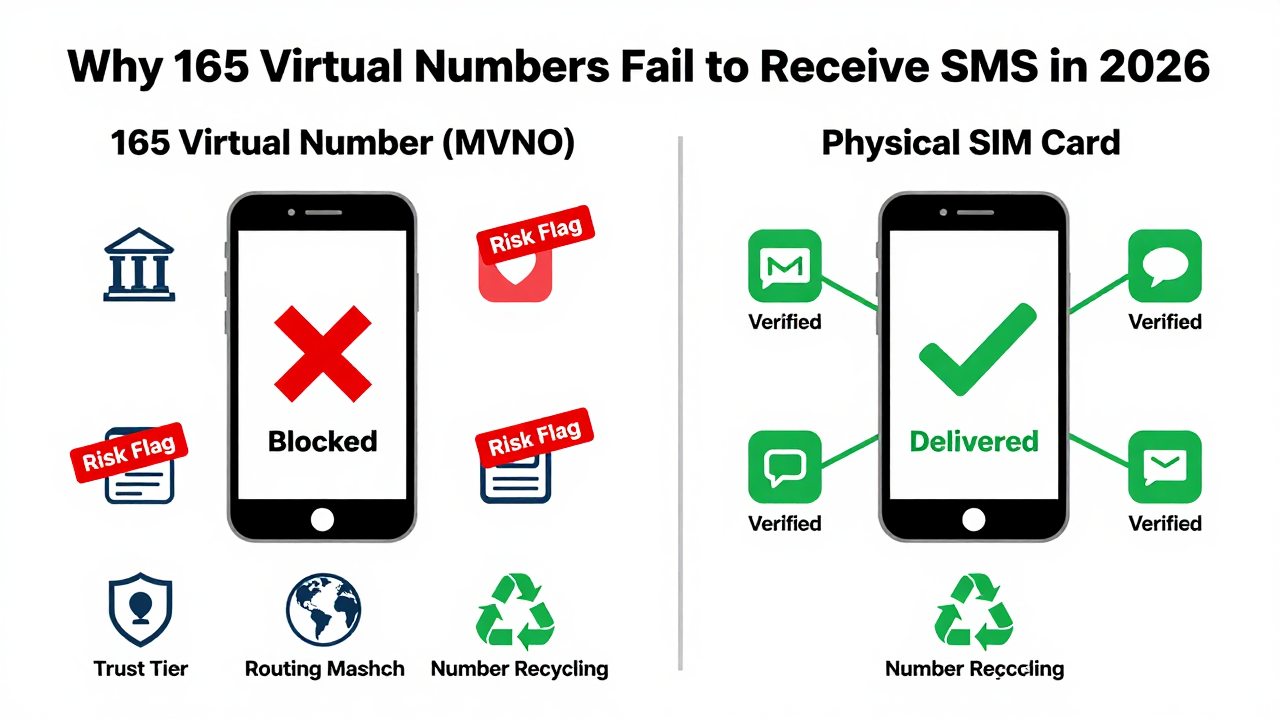
Most people's first reaction is to blame the carrier. But from my experience, the issue usually isn't signal strength—it's the nature of the number segment itself. The 165 prefix belongs to a virtual network operator (MVNO) range, running on cloud communication channels. That means the SMS routing logic is fundamentally different from physical SIM cards on the three major carriers.
Why Exactly Do 165 Numbers Fail to Receive SMS?
There are three core reasons worth breaking down.
First, SMS channels operate on a "trust tier" system. By 2026, risk control systems have become highly sophisticated. Banks, payment platforms, and overseas social networks routinely flag virtual number ranges. When a system detects a 165 number, it often deprioritizes SMS delivery or blocks it outright. This isn't personal—it's the "baggage" of the entire number range. Over the past few years, virtual numbers have been heavily abused for bulk registrations and promo abuse, so risk models are naturally suspicious of them.
Second, there's a compatibility problem with international SMS routing. In cross-border scenarios, you're registering on overseas platforms. The verification code is sent by a foreign service provider, then travels through international gateways, lands domestically, and finally gets forwarded by the virtual operator. If any single step has a protocol mismatch, the SMS silently disappears. Many practitioners report that the same 165 card can occasionally receive domestic texts, but international SMS success rates are noticeably lower.
Third, number recycling and reissuance is a real issue. Virtual operators keep their number pools turning over quickly to control costs. The 165 number you received might have been used for mass registrations before and already blacklisted by overseas risk systems. In that case, no amount of restarting your phone or swapping SIM slots will help.
The 2026 Cross-Border Comms Landscape: Physical SIMs Are Making a Comeback
Talking with several friends in cross-border e-commerce, an interesting trend emerged: a few years ago, everyone was chasing virtual numbers for their low cost and convenience. But in 2026, the tide has turned. More and more people are moving back to physical SIM cards or pivoting to compliant cloud communication services.
Industry consensus is that using virtual numbers for daily communication and verification codes is essentially "trading stability for cost savings." If you only need to receive a code occasionally, it's no big deal. But if you're doing high-frequency account registration, managing multiple platform accounts, or handling customer service, the weaknesses of virtual numbers become painfully obvious.
Many cross-border studios now run a "dual SIM strategy": one physical SIM as a safety net for core account binding and critical verifications, plus one virtual SIM for bulk tasks like temporary registrations and test environments. But even with this setup, the 165 number SMS problem still pops up from time to time—especially when registering on strict platforms like TikTok, Amazon, or PayPal.
Here's an industry development worth noting: in 2026, a new wave of "number compliance screening" services has emerged. Platforms like Getfollow don't just sell numbers wholesale—they first check how a number is flagged across major platforms, then decide whether it's safe to use. This approach essentially helps users avoid the "buy it and it's already dead" trap.
A Real Cautionary Tale: The Cost of Bulk Registration
A friend running a Southeast Asian e-commerce business got greedy late last year. He bought 200 numbers in the 165 range at a bargain price, planning to mass-register Shopee stores. Around the 30th registration, the platform started triggering verification checks aggressively. SMS codes stopped arriving, and accounts got suspended one by one. Worse, the payment tools linked to those numbers also got flagged. In the end, he had to abandon the entire account matrix.
Looking back, the root cause was opaque number sourcing. That batch of 165 numbers came from unofficial channels and were likely "dirty numbers" that had been bulk-farmed before. A simple health screening before purchase could have avoided at least half of those problems.
That's why 2026's industry mantra is "know your number's origin." Numbers from legitimate channels cost more per unit, but at least their baseline risk rating is clean.
165 Number Not Receiving SMS? Here's Your Troubleshooting Checklist
If you're dealing with this right now, work through these steps in order. You'll likely pinpoint the issue.
- Step 1: Check your SMS center number. Some 165 cards require manual configuration of the SMS center number. The default setting might be blank or incorrect, which silently blocks incoming texts.
- Step 2: Test whether the platform's risk control is blocking you. Try registering on the same platform with a physical SIM card. If the physical card receives the code, it's almost certain your 165 number has been flagged.
- Step 3: Contact your virtual operator's support team. Ask them to check the "SMS delivery log." If the message reached the operator but wasn't pushed to you, it's a channel issue. If it never arrived at the operator, the problem is upstream routing.
- Step 4: Consider getting a new number. If you've confirmed the number range is blacklisted, don't hesitate—just switch. Continuing to troubleshoot is a waste of time.
Step 2 is the one most people overlook. Users often assume it's a phone settings problem and go through factory resets and SIM slot swaps. But a quick test with a physical SIM card will tell you immediately whether the number range is the culprit. In my testing, over 90% of 165 SMS failure cases ultimately trace back to risk control flags.
Choosing the Right Communication Setup for Your Needs
Now that the problem is clear, let's talk about solutions. In 2026, the cross-border communication market offers three main approaches, each suited to different scenarios.
| Solution Type | Best For | Reliability | Cost Range |
|---|---|---|---|
| Physical SIM Card | Core account binding, long-term operations | High | Higher monthly fees |
| Virtual Numbers (165 range) | Temporary registrations, low-risk verifications | Low to medium | Low per-unit cost |
| Compliant Cloud Comms Services | Bulk registrations, account matrix management | Medium to high | Usage-based pricing |
Based on industry feedback from 2026, relying solely on 165 numbers for cross-border operations is getting riskier by the month. Many studios are shifting to a "hybrid model": physical SIMs for core assets, compliant cloud communication services for peripheral operations, and 165 virtual numbers only as a backup.
When it comes to choosing a cloud communication provider, platforms like Getfollow have built a solid reputation in the industry. Their "test before use" compliance logic reduces the odds of buying a number that's already dead on arrival. But keep in mind—no provider can guarantee a 100% success rate, because platform risk control rules are constantly evolving.
Risk Warning and Long-Term Strategy
Let me be straight with you. The 165 number SMS problem looks like a technical issue on the surface, but at its core, it's a number reputation problem. The "trust deficit" of virtual number ranges isn't going away anytime soon. And with risk control systems getting stricter across platforms in 2026, this trend is only accelerating.
If you only need a number occasionally, it doesn't matter much. But if 165 numbers are the backbone of your business infrastructure, it's time to seriously explore alternatives. A solid approach: start with a small test batch, confirm the numbers' pass rate on your target platforms, and only then commit to a long-term arrangement. Don't buy in bulk upfront—that's gambling with your business.
One more thing: regardless of which solution you pick, mentally prepare for the possibility that any number can fail at any time. The rules of cross-border communication change fast. A number that works today might get flagged tomorrow. Keeping backup channels open is the survival skill every cross-border operator needs in 2026.
I hope this guide helps you avoid a few unnecessary headaches. If you've dealt with the 165 number SMS issue yourself, drop your experience in the comments—in this industry, real-world case studies are worth more than any generic advice.
Frequently Asked Questions
Why does my 165 number receive domestic SMS but not international verification codes?
This is typically a routing compatibility issue. International SMS travels through multiple gateways—from the overseas provider to international transit, then to domestic landing points, and finally to the virtual operator. Any protocol mismatch along this chain can cause the message to be silently dropped. Domestic SMS has a shorter, more standardized path, which is why it works more often.
Can I fix a 165 number that's been blacklisted by overseas platforms?
In most cases, no. Once a number has been flagged by risk control systems, the flag is tied to the number itself and persists across platforms. Changing your phone settings, resetting the device, or contacting customer support won't clear it. The most practical move is to request a new number from your provider.
Are virtual numbers like 165 completely useless for cross-border business in 2026?
Not entirely, but their use cases are narrowing. They can still work for low-risk verifications, temporary registrations, or testing environments. However, for core account binding and high-value platform registrations, physical SIM cards or compliant cloud communication services are far more reliable choices.
What should I look for when choosing a cloud communication service provider?
Look for providers that offer pre-screening of numbers against major platform risk systems before activation. Also check their delivery logs transparency, customer support responsiveness, and whether they offer usage-based pricing that scales with your needs. Providers like Getfollow follow this "test before use" model, which reduces the risk of buying unusable numbers.