2020 SMS Verification Apps in 2026: The Compliance vs. Efficiency Battle Cross-Border Sellers Can't Ignore
2020 SMS Verification Apps in 2026: The Compliance vs. Efficiency Battle Cross-Border Sellers Can't Ignore
Plenty of cross-border operators still search for "2020 SMS verification software" when looking for tools, but honestly, the verification ecosystem in 2026 looks nothing like it did five or six years ago. The old playbook of grabbing any random platform and mass-registering accounts simply doesn't work anymore. From my conversations with people running overseas social media operations and e-commerce storefronts over the past six months, the consensus is clear: getting the code isn't the hard part—keeping the account alive after verification is where things get brutal.
Why? Because in 2026, mainstream platforms don't just check whether your phone number is real. Device fingerprints, IP purity, behavioral patterns, and even the time distribution of your registrations all feed into the risk engine. In other words, no matter how fast you receive that code, if the other signals don't check out, your account gets flagged within seconds. That's exactly why the industry has shifted toward bundled "verification + account warming environment" solutions rather than buying a barebones SMS API.
How SMS Verification Tools Are Actually Used in 2026: From Mass Registration to Account Matrix Maintenance
If you still think of SMS verification as "registering burner accounts," you're behind the curve. In 2026, I'm seeing more solo operators and small cross-border teams use these tools in two specific scenarios. First, routine verification for multi-platform account matrices—think Instagram, Telegram, WhatsApp logins or phone number swaps that require a code. Second, supplementary verification for e-commerce storefronts, especially those steps where you need a verification code but don't want to expose your primary number.
But here's the catch that catches most people off guard: many of the verification platforms that were popular back in 2020 have number pools that platforms have long since flagged into oblivion. Industry consensus says the only numbers that still reliably receive codes in 2026 come from direct carrier connections or localized number segments from specific countries—not the recycled virtual numbers floating around shared pools. I've personally tested several legacy platforms, and registration success rates on TikTok can vary by more than threefold depending on which number segment you draw from.
So the first rule of choosing a tool isn't price—it's how frequently the number pool refreshes and how isolated the numbers are. Some platforms advertise "unlimited SMS reception," but in reality, a single number gets shared across dozens of users simultaneously. Registering on any serious platform with one of those numbers is a guaranteed instant ban. Reputable providers, by contrast, cap concurrent usage per number and regularly purge segments that risk engines have burned.
The State of SMS Verification in 2026: Retention Rate Is the Metric That Matters
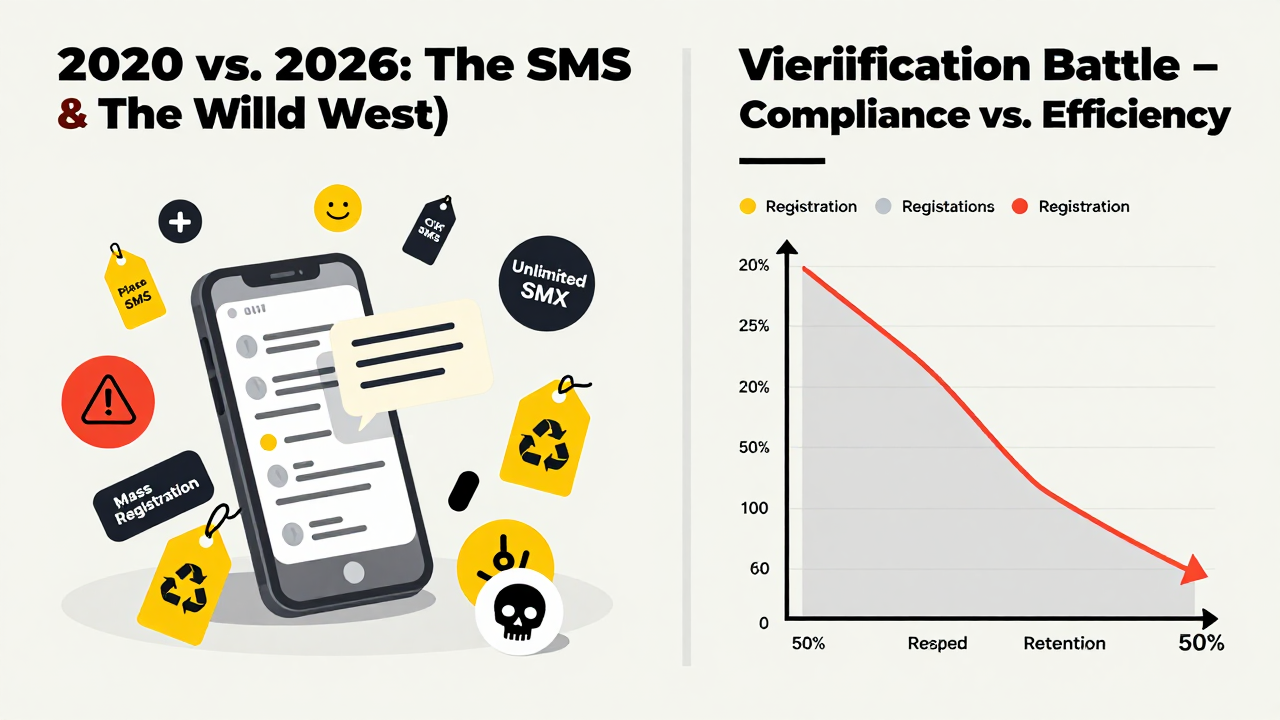
Cross-border operators report that account retention rates after SMS verification hover between 50% and 70% in 2026, and providers that consistently hit above 80% are rare. Why does retention matter so much? Because receiving a code is just step one. The real money goes into warming up the account, publishing content, and running ads. If your account dies within a week, all of that investment evaporates.
The biggest factor driving retention, beyond number quality, is whether your verification provider supports second verification. Some platforms only handle one-time SMS reception. But in 2026, many platforms trigger a secondary verification within 72 hours of registration. If your provider can't receive a second code on the same number, your account is as good as dead. Almost nobody explains this upfront, yet it's one of the most fatal operational details in practice.
Another trend worth noting: the SMS verification market has stratified sharply. The low end still offers shared numbers at pennies per hundred, but those are only good for registering low-stakes community accounts. The mid-to-high end now features dedicated number segments bundled with isolated IP binding—significantly pricier, but account survival rates improve dramatically. Which tier you choose depends entirely on how critical account stability is to your business model.
Real-World Cautionary Tale: What One Friend Learned the Hard Way
Last month, a friend running an e-commerce operation told me he'd bought 500 numbers from a budget verification platform to register Amazon buyer accounts for product reviews. Within three days, over 400 got banned, and most of the survivors had review privileges restricted. He eventually switched to a provider offering dedicated number segments—four times the unit price, but account survival jumped to over 75%. One thing he said stuck with me: "The money I saved on SMS codes didn't even cover the losses from a single ban wave."
That story is painfully typical. In 2026, accounts are assets, and SMS verification is just the first step in asset allocation. If you start with a contaminated number pool, every subsequent operation is just feeding your accounts to the platform's risk engine.
How to Pick a Reliable SMS Verification Provider: Three Non-Negotiable Criteria
Based on industry consensus and my own testing, any SMS verification provider you consider in 2026 should pass these three checks:
- Number Pool Transparency: Will the provider disclose where numbers come from (carrier direct, virtual operator, IoT SIM)? Do they let you filter number segments by country or region? If they dodge the question, it's almost certainly a shared pool.
- Second Verification Support: Ask directly whether the same number can receive multiple codes within 7 days of registration. Many platforms only guarantee the first SMS—that's a hidden trap.
- Failure Compensation Policy: If a number never receives a code or the account gets banned immediately after registration, does the provider offer any refund or credit? By 2026, any halfway legitimate platform offers "invalid number refunds." A provider willing to make that commitment signals confidence in their number quality.
Also, if you're running a long-term project, prioritize providers that offer API access and integrate with your automation stack. Manually copy-pasting verification codes in 2026 is painfully inefficient, especially for batch operations. Platforms like Getfollow have built a solid reputation in this space by combining dedicated number segments, API integration, and failure compensation into a compliance-first operating model. They're not the cheapest option, but they save you the headache.
That said, I wouldn't recommend signing a long-term contract with any provider right out of the gate. The smart play is small-scale testing—buy 10 numbers, try registering on the platforms you actually use, and monitor survival rates and second-verification pass rates over a week. That test costs almost nothing, but it'll help you dodge 90% of the traps out there.
Risk Warning: Compliance Red Lines and Ban Triggers for SMS Verification in 2026
Now for the reality check. In 2026, mainstream platforms have become extremely good at identifying virtual numbers—Google, Meta, and Amazon in particular can flag them in near real-time. If your business touches core features on these platforms (like ad delivery or payment binding), accounts registered via SMS verification are highly likely to get restricted, and in some cases, they can even drag down your primary accounts.
The standard practice across the industry is the "isolation principle": SMS-verified accounts only handle peripheral actions (browsing, liking, adding to cart), while core business runs on physical SIMs or formal registration flows. It's a conservative approach, but it's the most effective way to minimize risk. Additionally, accounts created via SMS verification should complete identity verification or bind alternative authentication methods as quickly as possible. The longer you wait, the higher the chance the risk engine flags you.
One more thing most people overlook: the privacy policy of your SMS verification provider. In 2026, data compliance isn't just a buzzword. Some national regulators are actively auditing cross-border businesses that use SMS verification services. Choose providers that explicitly state they don't store SMS content or log IP addresses, and keep all transaction records on hand in case you need to demonstrate compliance.
Bottom line: the "2020 SMS verification software" keyword still has real utility in 2026, but the playbook has completely changed. Stop chasing rock-bottom prices and unlimited codes. Put account survival rates and compliance first—that's the only strategy that holds up in today's cross-border landscape. Test small, then scale. In the SMS verification world, that advice beats any ad campaign you'll ever run.
Frequently Asked Questions
Why do my SMS-verified accounts keep getting banned in 2026?
Most bans come from shared number pools that platforms have already flagged. Even if the code arrives instantly, risk engines evaluate device fingerprints, IP history, and behavioral patterns. If any of those look suspicious, the account gets banned regardless of verification success. Switch to providers offering dedicated number segments with isolated IPs to see meaningful improvement.
Can I still use free or low-cost SMS verification platforms for cross-border business?
You can, but only for low-stakes accounts like community forums or disposable profiles. For anything tied to revenue—e-commerce storefronts, ad accounts, payment-linked profiles—cheap shared numbers are a false economy. One ban wave will cost you far more than you saved on verification codes.
What's the difference between shared numbers and dedicated number segments?
Shared numbers are used by multiple customers simultaneously, which means risk engines quickly flag them. Dedicated number segments are exclusive to your account or a small group, dramatically reducing the chance of prior contamination. In 2026, the gap in account survival rates between the two can be as wide as three to five times.
How do I test an SMS verification provider before committing?
Buy a small batch—10 numbers is enough—and register on the platforms you actually operate. Track survival rates over 7 days, note whether second verifications pass, and check response times. This costs a few dollars and gives you the data you need to decide whether to scale up or walk away.