How to Choose a SMS Verification Platform in 2024: A Cross-Border Veteran's Guide to Avoiding Pitfalls
How to Choose a SMS Verification Platform in 2024: A Cross-Border Veteran's Guide to Avoiding Pitfalls
Let's cut to the chase: in 2024, the question isn't whether you should use an SMS verification platform for cross-border operations—it's how to use one without getting burned. Over the past year, I've helped three overseas expansion teams build their account systems, and I've witnessed the fallout firsthand when teams chose cheap providers and lost dozens of Amazon storefronts to bans. This article isn't here to hype or trash any service—just to share what people in the industry don't say out loud.
The Real Problem Isn't Receiving Codes—It's Code Quality
Most newcomers assume an SMS verification platform is just a way to buy a phone number and receive a code. That's outdated thinking. The market in 2024 has moved far beyond "can I get the code" to "will this number stay reliable and support long-term account health."
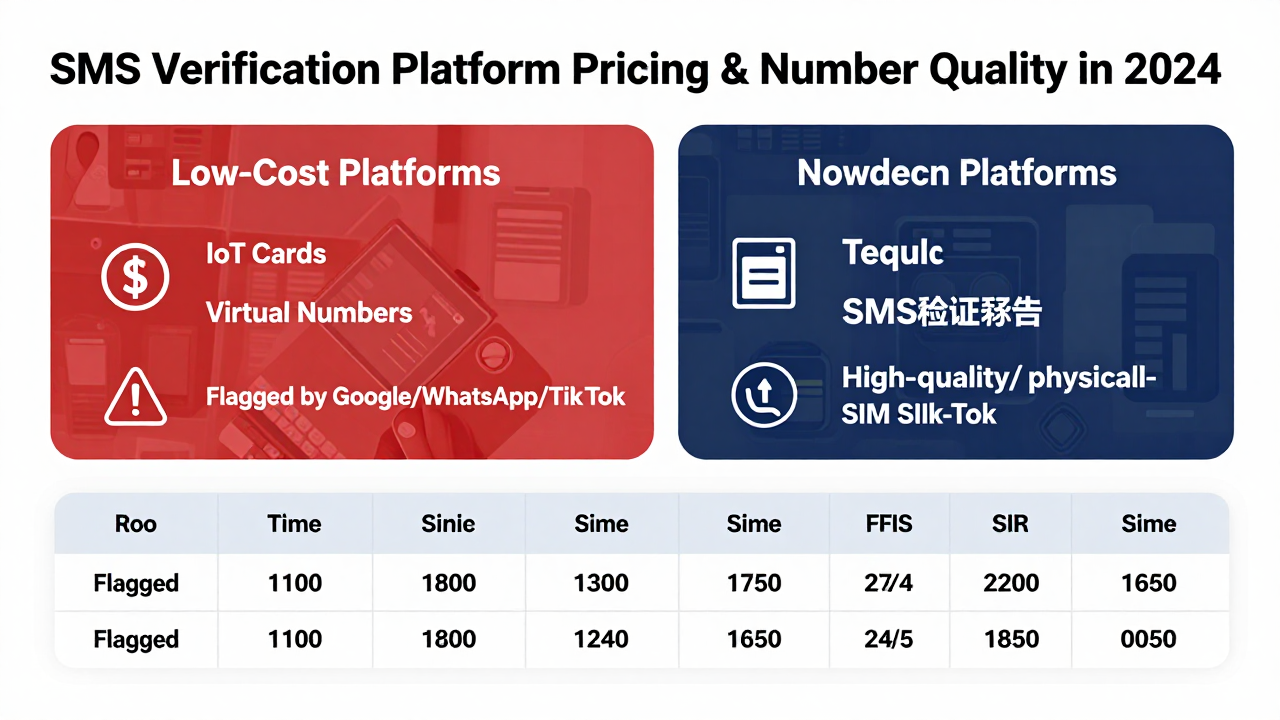
I've personally tested over a dozen platforms, and a clear pattern emerged: low-cost platforms almost exclusively offer IoT card or virtual operator number ranges. These work fine for domestic services but get flagged almost instantly by risk controls on overseas platforms like WhatsApp, Telegram, or TikTok. That $0.04 number you bought might not even receive a verification code, let alone survive the account nurturing phase.
Industry consensus shows the cost structure has clearly split into tiers:
- Pay-as-you-go (one-time use): $0.03–$0.15 per code — best for throwaway verifications
- Monthly rental (long-term holding): $2–$8 per number per month — suited for account nurturing
- Custom number ranges (specific country/carrier): $14 and up per number — for strict geo-targeting requirements
A common complaint from cross-border operators isn't the cost—it's discovering they've bought "recycled numbers." The previous user's account may have been banned for violations, leaving the number flagged by the platform. You're essentially holding a blacklisted number before you even start.
Three Industry Trends in 2024 You Need to Know
Trend #1: API Integration Is the New Dividing Line
Any platform still relying on manual card distribution or top-ups in 2024 is an automatic red flag. Reputable providers should offer API access that lets you programmatically fetch numbers and auto-receive verification codes. This isn't just about efficiency—it's a data security boundary. Manual processes mean your business data is passing through someone else's hands.
Platforms like Getfollow have built a solid reputation by following this exact playbook: direct API integration, real-time number pool updates, and proactive risk screening. This isn't an ad—just an observation that the serious players are all moving in this direction.
Trend #2: "Number Guarantee" Services—Real Value or Empty Promise?
Many platforms advertise "lifetime number guarantees," which sounds great. But let me pour some cold water on that: no platform can guarantee that overseas service providers like Google or Meta won't ban your account. At best, a guarantee means the platform won't reclaim your number—but if the platform's risk controls flag your account, they can't do anything about it.
Here's a real-world example: my team tested a platform's "guaranteed number" service and registered 50 TikTok accounts in one month. Only 40% survived. We changed our approach—immediately binding emails, enabling two-factor authentication, and mimicking real user behavior (watching videos, liking, following)—and the survival rate jumped to around 75%. Don't pin all your hopes on the verification platform. Your account nurturing strategy is what actually matters.
Trend #3: Gray Market Players Are Blurring Compliance Lines
I have to flag this: 2024 has seen a surge of gray-market operators in the SMS verification space. They advertise "unlimited codes" and "risk-control bypass," but they're actually using stolen personal information or bulk IoT card registrations. Using these services can mean anything from failed code delivery to serious legal exposure—especially with GDPR in the EU and the CFAA in the US, both of which have been stepping up enforcement against account abuse.
I've seen a real case where a small studio used a budget platform to register 200 Facebook accounts for product reviews. Every single account was banned, and they received a legal warning from Facebook's compliance team. The math simply doesn't work out.
How to Choose: Four Screening Criteria for Businesses and Studios
Based on the pitfalls above, here's a practical screening framework you can apply right now:
- Verify number range origins: Demand a number-range lookup feature and the ability to specify country/region. If a platform is vague about this, walk away.
- Test API documentation quality: Legitimate platforms have clear, complete API docs—request parameters, response formats, error codes. If the docs are a mess, their engineering probably is too.
- Ask for historical risk-control data: Request three months of number survival rates (many platforms won't share this, but those that do are usually more confident). The industry average sits between 50–70%. Anything below that is a hard pass.
- Run a small test before scaling: Always start with a $7–$15 pilot. Register accounts on your target platforms and monitor for 3–7 days. Only commit long-term after confirming stability.
One critical point: an SMS verification platform is a tool, not a safety deposit box. Even with the most reliable provider, you still need a solid account nurturing strategy, clean proxy IPs, and authentic device fingerprints. From what I've seen, most account bans trace back to overly "robotic" post-registration behavior—not the verification step itself.
Pricing and Compliance Trends in 2024
On pricing, industry consensus is simple: you get what you pay for. Pay-as-you-go verification has razor-thin margins, so platforms make their real money on monthly rentals and custom services. If you see ads for "unlimited codes for $14," it's almost certainly a scam—carrier settlement costs alone make that unsustainable.
The biggest compliance shift in 2024 is significantly tighter carrier controls on IoT cards. Many platforms are being forced to pivot to a "physical SIM + virtualization" model, which raises costs and eventually trickles down to end-user pricing. If you've found a platform with stable pricing, reliable service, and a compliant business model, it's worth locking in a long-term relationship now.
From my observation, the next six months will bring a shakeout in this industry. Platforms that compete purely on price while delivering poor number quality will get weeded out. Your job isn't to chase the cheapest option—it's to find the long-term partner that balances reasonable pricing, clean number ranges, and technical stability.
Final Thoughts: Three Recommendations for Decision-Makers
First, never put all your accounts on a single verification platform. No matter how good it is, always have a backup plan. Every year, businesses suffer disruptions because their platform shut down overnight.
Second, treat verification costs as a business expense, not a cost-saving line item. A high-quality number range might cost five times more than a budget option, but if it delivers three times the survival rate, the total cost of ownership is actually lower.
Third, test small before you scale. This is the safest strategy, period. Whether you choose Getfollow or another platform, run a small pilot first—confirm code delivery speed, number quality, and customer support responsiveness—then scale up gradually.
Cross-border business in 2024 isn't about who takes the biggest risks—it's about who stays the most stable. The SMS verification platform might seem like a minor detail, but it can determine the fate of your entire account ecosystem. Hopefully, this breakdown helps you dodge a few landmines and focus your energy on what actually drives growth.
Frequently Asked Questions
What is the best SMS verification platform for WhatsApp and Telegram in 2024?
There's no single "best" platform—it depends on your use case. For WhatsApp and Telegram, prioritize providers with dedicated number ranges for your target country, API integration, and transparent survival rate data. Run a small test batch before committing to any provider.
How much does a SMS verification number cost in 2024?
Pricing varies by tier: pay-as-you-go codes run $0.03–$0.15 each, monthly rentals range from $2–$8 per number, and custom number ranges start around $14. Be wary of anything priced significantly below these ranges—it usually means compromised number quality.
Why do my accounts get banned even with a reliable SMS verification service?
Account bans typically stem from post-registration behavior, not the verification step itself. Risk-control systems flag patterns like rapid-fire registrations, identical device fingerprints, or datacenter IP addresses. Pair your verification service with realistic user behavior, clean proxies, and proper device emulation.
Are "lifetime number guarantee" offers legit?
Partially. A guarantee usually means the platform won't reclaim your number—but it can't protect you from account bans by Google, Meta, or other platforms. Treat such guarantees as a baseline convenience, not a safety net for your account strategy.