Best SMS Verification Services for International Accounts in 2026: What Actually Works
Best SMS Verification Services for International Accounts in 2026: What Actually Works
Over the past two years working in cross-border e-commerce, the complaint I hear most isn't expensive traffic or poor conversion rates—it's getting stuck at the registration stage. Every overseas social media account, e-commerce store backend, or software trial requires phone verification. And here's the reality: domestic numbers simply don't receive international SMS. For most solo operators, this is the first wall they hit.
SMS verification services exist to solve one fundamental question: where do you get a foreign phone number? By 2026, this industry has matured considerably—but maturity also means more noise. Prices range from a few cents to several dollars per code, and the differences in number quality, privacy protection, and customer support are far bigger than most people expect.
The Real Differentiator in 2026: Number Pool Quality, Not Price
Most people compare prices first when looking at SMS verification platforms. I've seen studios try to save a few bucks by choosing the cheapest option, only to find that eight out of ten registrations never receive a code—and the two that did got logged out after a single login. In the end, the time wasted far exceeds the money saved.
Industry consensus is clear: the dividing line between good and bad SMS verification services in 2026 comes down to how "clean" the number pool is. A clean number hasn't been used to register sensitive services, hasn't been flagged by platforms, and hasn't been bounced between multiple accounts. Even if a flagged number receives your code, the account you create with it will start with extremely low trust.
From my own testing across different price tiers, a clear pattern emerges: genuinely stable number segments cost what they cost—they can't be dirt cheap. Suspiciously low prices usually mean recycled numbers or mass-registered virtual segments that die after one use, and they can even drag down your main accounts.
The Real Pain Point in 2026: It's Not Getting the Code, It's What Happens After
Many beginners assume SMS verification is as simple as "receive code, type it in, done." Anyone who's actually done this knows the real trap comes after.
Here's a typical scenario: you register an overseas social media account with a verification number, get approved, and start building it up. On day three, the platform asks for secondary verification and sends a confirmation SMS to that number. That's when you discover the number is already dead—because you bought a one-time verification service, not a number you actually own.
The account gets frozen, and the appeal process takes forever. In 2026, mainstream platforms are hypersensitive to "registration number no longer active" signals. At best, you get throttled; at worst, your account is permanently banned. Practitioners report that more accounts were lost this year to this issue than to content violations.
So before choosing any SMS verification service, ask these three questions:
- Is the number one-time use or renewable? What does renewal cost?
- Does it support receiving secondary verification SMS later?
- If the number expires, does the platform offer a number-swap service?
These three questions essentially determine whether your account survives its first week.
Three Main Types of SMS Verification Services in 2026
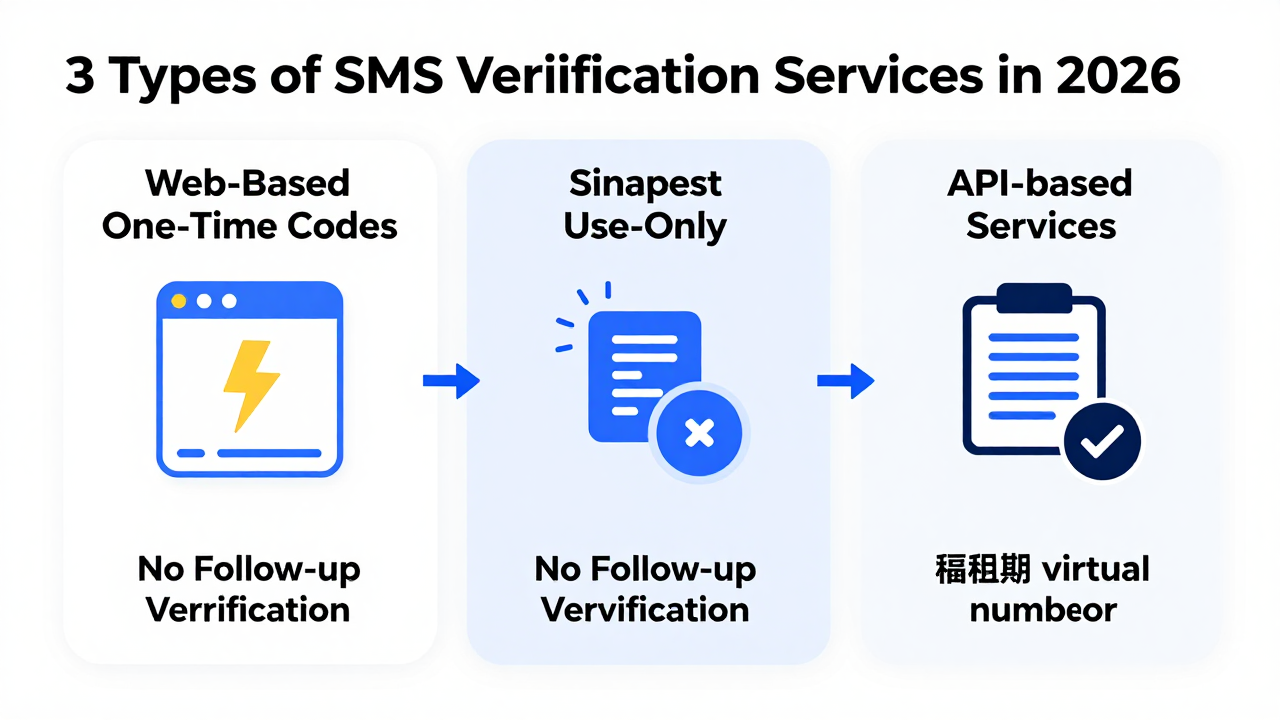
Current SMS verification services fall into three broad categories. Understanding the differences will save you a lot of headaches.
Type one: web-based one-time code platforms. You open a website, pick a country or platform, get assigned a temporary number, and wait for the SMS online. This works for occasional personal use—it's cheap, but numbers are essentially single-use and can't handle follow-up verification.
Type two: API-based service providers. Built for businesses with bulk registration needs, these integrate via API to automate number acquisition and code retrieval. Efficient, but extremely demanding on number pool quality—once a segment gets flagged, every number from that segment is affected.
Type three: long-term virtual number rental. You rent an overseas number for a set period, receive all SMS, and use it for ongoing account maintenance after binding. This costs more but offers stability. Platforms like Getfollow have built solid reputations in this space by following compliant operational logic—clear number ownership, renewal support, and the ability to receive follow-up verification messages.
None of these three models is inherently better than the others—it depends on your use case. If you just need a temporary account to browse content, type one is fine. If you're running a real cross-border business with accounts you need long-term, type three is the safer bet.
Case Study: How One Studio Lost Everything in a Week
Earlier this year, a friend running a dropshipping site told me he'd loaded $70 onto a verification platform and registered a dozen TikTok accounts for a content matrix. Within a week, every single one was banned.
He initially blamed his content. But after digging deeper, he found the problem was in the registration phase. Every number the platform provided came from the same repeatedly-flagged segment. The platform's algorithm detected the registration timing, IP origins, and device fingerprints were nearly identical—and flagged the whole batch as bot activity.
This case highlights two things. First, if your verification platform draws numbers from a single source, your risk multiplies exponentially. Second, IP environment and device fingerprint matter just as much—swapping phone numbers alone won't solve the underlying problem.
My advice: when trying any new SMS verification service, start small. Buy three to five numbers, register a few low-stakes accounts, and observe for a week. If everything stays stable, scale up. The testing cost is minimal, but it can save you from the biggest disaster.
How to Vet a Reliable SMS Verification Provider
Service quality varies wildly across this industry in 2026. Here are the screening criteria I've developed from real experience—consider them your checklist.
First, demand transparency on number sources. A trustworthy provider will clearly tell you which country the numbers come from, which carrier, and whether they're physical SIM cards. Vague answers usually mean virtual or recycled numbers.
Second, test their support response time. Missed codes happen—that's inevitable. What matters is how fast support responds when it does. Some platforms vanish when you need them, and your money's gone along with your momentum.
Third, check if number renewal is supported. As mentioned earlier, this is almost essential for long-term account management. Platforms without renewal support mean your registered accounts are ticking time bombs—they'll freeze the moment the number expires.
Fourth, evaluate their compliance posture. In 2026, as countries crack down harder on telecom fraud, the verification industry is going through a shakeout. Platforms that accept anyone for any purpose without vetting are actually riskier—because they're more likely to get shut down at any moment.
Take Getfollow as an example: they require users to state their purpose during registration and refuse service for clearly inappropriate use cases. It seems like a hassle on the surface, but it's actually protection for you—it shows the platform is running a serious operation rather than grabbing money and disappearing.
Hidden Risks: Don't Let Verification Numbers Become Your Account's Time Bomb
SMS verification services solve your registration problem, but you need to understand their limitations.
The most immediate risk is account association. If you register multiple accounts using different numbers from the same platform—and those numbers come from the same segment—platform algorithms can easily detect the connection. When one account gets flagged, the others often go down with it.
Here's how to reduce the risk: use different providers for different platforms, and use different IPs and device environments when registering multiple accounts on the same platform. These details determine how long your account matrix survives.
Another risk is number retention. Industry data shows that in 2026, short-term retention rates for verification numbers hover between 50% and 70%—meaning a significant portion of numbers become invalid within days of registration. This means you must complete all verification-required operations before your number expires, or you'll face serious headaches later.
Final Thoughts: The Smartest Strategy Is Still Small Steps, Fast Iteration
SMS verification might seem like a minor detail in cross-border business, but it's actually a critical one. It doesn't directly drive your traffic or conversions—but it determines the starting quality of your accounts. If your accounts start weak, all the content and ad spend in the world won't help you catch up.
My recommendation: no matter which provider you choose or how good their marketing sounds, test small before committing long-term. This is the most reliable operational logic in the cross-border space in 2026—don't trust blindly, don't follow the crowd, and let data make the call.
I hope this guide helps you avoid a few landmines. If you've had any memorable experiences with verification services—good or bad—drop them in the comments. Let's help each other stay safe out there.
Frequently Asked Questions
Can I use a free SMS verification service for business accounts?
Free services typically use recycled or heavily-shared numbers that platforms have already flagged. For business accounts you plan to grow, the risk of immediate suspension far outweighs the savings. A paid service with clean number pools is the minimum viable option.
How long do virtual numbers for SMS verification actually last?
It depends on the service model. One-time codes expire within minutes. Rental numbers can last weeks, months, or even years if you keep renewing. In 2026, industry data shows roughly 30–50% of numbers from low-cost providers fail within the first week, so choose your service tier accordingly.
What's the difference between a virtual number and a physical SIM for verification?
Physical SIMs are tied to real carrier infrastructure and are far less likely to be flagged by platform algorithms. Virtual numbers are software-based and often share segments with many other users, which increases association risk. For long-term account stability, physical SIM-based services are worth the extra cost.
Is SMS verification for overseas accounts legal?
Using verification services is generally legal in most jurisdictions, but it depends on the platform's terms of service and your intended use. Avoid services that accept obviously fraudulent purposes—they're more likely to be shut down, and your accounts could be caught in the crossfire.