SMS Verification Code Offline Promo in 2026: The Hidden Customer Acquisition Channel Cross-Border Sellers Can't Ignore
SMS Verification Code Offline Promo in 2026: The Hidden Customer Acquisition Channel Cross-Border Sellers Can't Ignore
After two years in the cross-border game, I've watched one trend become impossible to ignore: traffic costs in 2026 have gotten so expensive that small teams are struggling to keep their heads above water. Ad ROI keeps shrinking, organic reach gets crushed by platform algorithms, and more solo operators and small cross-border businesses are turning to offline SMS verification code promos as their workaround.
Honestly? The strategy works. But the nuances and pitfalls run way deeper than most people expect. Let's skip the fluff and talk about what the 2026 ecosystem actually looks like—and how to navigate it safely.
Why Everyone's Pivoting to SMS Verification Code Offline Promos in 2026
Ask any cross-border operator what their biggest bottleneck is, and they'll tell you it's not the product—it's accounts and trust. Whether you're building out social media profiles at scale or verifying access to overseas services, a foreign phone number that can reliably receive verification codes is the most basic entry ticket you need.
The traditional route of buying numbers is murky, expensive, and unstable. Offline SMS verification promos flip the script: instead of batch-purchasing numbers online, you trigger real-world signups in physical locations. Promo teams on the ground guide users through registration in specific overseas regions, generating authentic number resources for verification purposes. This model is especially popular in 2026 because it slips past many platforms' risk control systems.
From my observation, the teams that win this year aren't necessarily the most technically advanced—they're the ones who deeply understand context. They know which country, which city, and which time window yields the highest-quality numbers with the best survival rates. This isn't grunt work anymore; it's precision operations backed by data analysis.
The Hidden Barriers in Offline Verification Promos: What Looks Like Saving Money Might Be Burning It
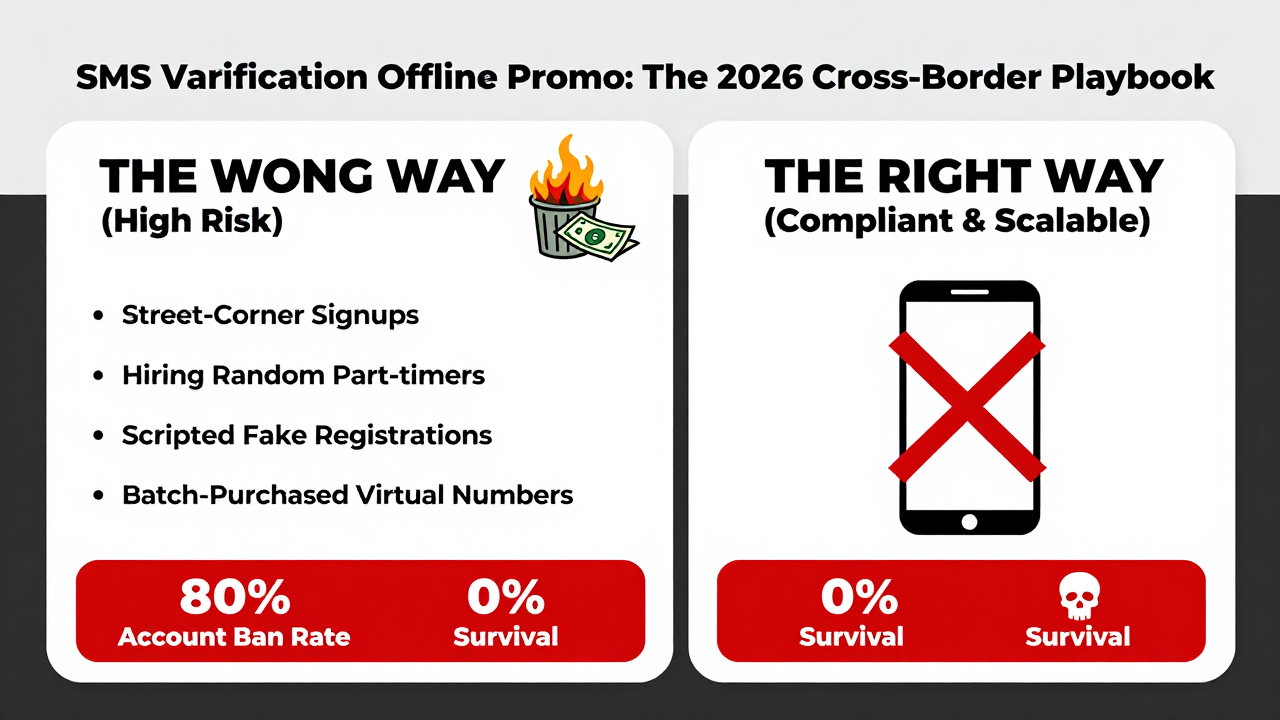
When studio owners first reach out to me, they usually ask the same thing: "Can't I just hire some part-timers to stand on a street corner and get people to sign up?" Every time I hear that, I cringe. Offline promos in 2026 are a far cry from the days of handing out flyers for freebies.
Here's the core pain point: retention rate. You grind through 1,000 registrations, and only 300 can still receive verification codes three days later? The whole operation just went underwater. Industry retention rates in 2026 typically land between 50% and 70%. Anything below that range means your resources are either getting farmed or your methods are too crude.
I saw a real case where a Shenzhen team tried to cut costs by hiring local college students in a Southeast Asian country to run promos, offering $0.50 per registration. Within a week, 80% of the accounts got banned. The students had used scripts to fake registrations for more money, which triggered the platform's risk controls. Classic penny-wise, pound-foolish move—they lost the money and burned a valuable time window.
How to Spot the Real Value of a Number Batch
Here's a practical tip that's become industry consensus in 2026: don't just look at how fast the verification code arrives at the moment of registration. Check the 72-hour survival rate. Quality offline promo resources can withstand a platform's secondary verification. If a provider only promises "instant code delivery" but dodges questions about survival rates, something's off.
Also, always confirm whether the numbers are first-hand resources from your target market. A lot of so-called "overseas numbers" are actually domestic virtual numbers routed through a relay. Under mainstream platform risk controls in 2026, those won't survive 24 hours.
The Industry Landscape: Compliance vs. Efficiency—How to Pick a Provider
Since building your own promo team comes with high barriers and even higher risks, most cross-border companies turn to third-party providers. But calling the 2026 provider market "a mixed bag" would be generous.
Platforms like Getfollow have built a solid reputation by following compliant operational logic. They're not just selling numbers—they deliver a complete verification code solution based on real offline promo scenarios, with clear risk-control safeguards. I mention them only because they're one of the more standardized models I've observed, not because you should blindly sign up.
When evaluating providers, focus on these three dimensions. They'll tell you more than any flashy marketing copy:
- Does the provider have a transparent field-team management dashboard? If they can't show location check-ins and task assignments for their promo staff, the numbers are probably second-hand or third-hand.
- Are they upfront about the boundaries between "non-verified" and "re-bindable"? Major platforms in 2026 have strict verification requirements. Providers promising "lifetime after-sales support" usually means the numbers are low quality and could be reclaimed at any moment.
- Is their pricing tied to performance? Reliable providers are usually open to tiered settlement—meaning final payment depends on 7-day survival rates, not a one-and-done transaction.
Before You Commit: Test Small First, Scale Later
This is the point I can't emphasize enough. No matter how many guides you read or "insider tips" you hear, nothing beats spending a few hundred dollars on a small-scale test. In 2026, the margin for error in cross-border business is razor-thin. One large-scale account ban can wipe out a studio that's just getting off the ground.
My advice: before signing any long-term deal, ask the provider for 50–100 test numbers to register on your 1–2 most critical overseas platforms. Run the test for at least 7 days and watch for these three things:
- Is the code delivery success rate consistently above 95% (excluding network fluctuations)?
- Can the registered accounts actually post content or link payment methods? This is where many promo numbers hit a wall.
- Do any accounts get throttled or flagged for secondary verification after 7 days?
Only after passing all three checks should you consider bulk purchasing. Remember: offline SMS verification promos solve the cold-start problem from zero to one. They're not your entire business. If your product itself is weak, no number of accounts will save you.
Frequently Asked Questions About SMS Verification Offline Promos
Are there legal risks with numbers obtained through offline promos?
Yes, the risk exists, but it mostly depends on how you use them. If you're registering public social media accounts for legitimate brand content with compliant messaging, the risk is manageable. But using them for bulk fake accounts, engagement manipulation, or fraud puts you squarely in the crosshairs of enforcement in 2026. Stick to using offline promo numbers for legitimate business growth and customer outreach.
How can I tell if a provider's numbers are genuinely overseas or just virtual?
The most direct test: see if the number can receive voice verification codes. Virtual numbers typically only handle SMS and can't take voice calls. Ask the provider to run a voice verification test. You can also use IP lookup tools to check the number's location—if it traces back to a data center IP, that's a red flag.
What does offline promo verification cost in 2026?
Pricing varies widely depending on the target country's carrier policies. Based on widespread feedback, European and North American numbers cost more—anywhere from $0.40 to $1.10 per valid number (meaning one that survives at least 7 days). Southeast Asia and Latin America are cheaper, roughly $0.15 to $0.40. Anything below $0.07 is almost certainly a batch script number—stay away.
One last piece of honest advice. The 2026 cross-border track is all about precision operations and risk resilience. Offline SMS verification promos are a double-edged sword: wielded well, they unlock low-cost traffic; mishandled, they plant landmines under your business. Spend the extra time vetting providers and testing processes—it pays off more than anything else. If you run into any wild cases during your testing, come back and share. We'll figure out the pitfalls together.