Best SMS Verification Websites in 2026: A Cross-Border Insider's Guide to Avoiding Costly Mistakes
Best SMS Verification Websites in 2026: A Cross-Border Insider's Guide to Avoiding Costly Mistakes
After two years working in cross-border e-commerce, I can tell you one thing has shifted dramatically: the account registration landscape in 2026 is a completely different beast. Back in the day, you could grab any prepaid SIM and register accounts all day. Now, platform risk-control algorithms are far more sophisticated—they're analyzing phone number geolocation, account activity patterns, and usage context with surgical precision. Several studio operators I know have complained that batch-registered accounts rarely survive past day three, and the root cause almost always traces back to the SMS verification step.
For those unfamiliar, SMS verification websites (often called sms-activation services or online SMS receive platforms) provide temporary or virtual phone numbers to receive verification codes. In the cross-border world, they're essential for registering overseas social media accounts, linking payment tools, and verifying e-commerce storefronts. But here's the thing: this industry has gotten murkier than most people realize. Some platforms operate on genuine IoT SIM card pools, others rely on pure virtual number ranges, and a few are outright powered by black-market card pools. The compliance standards and reliability across these three tiers? Night and day.
The 2026 SMS Activation Market: Three Distinct Tiers
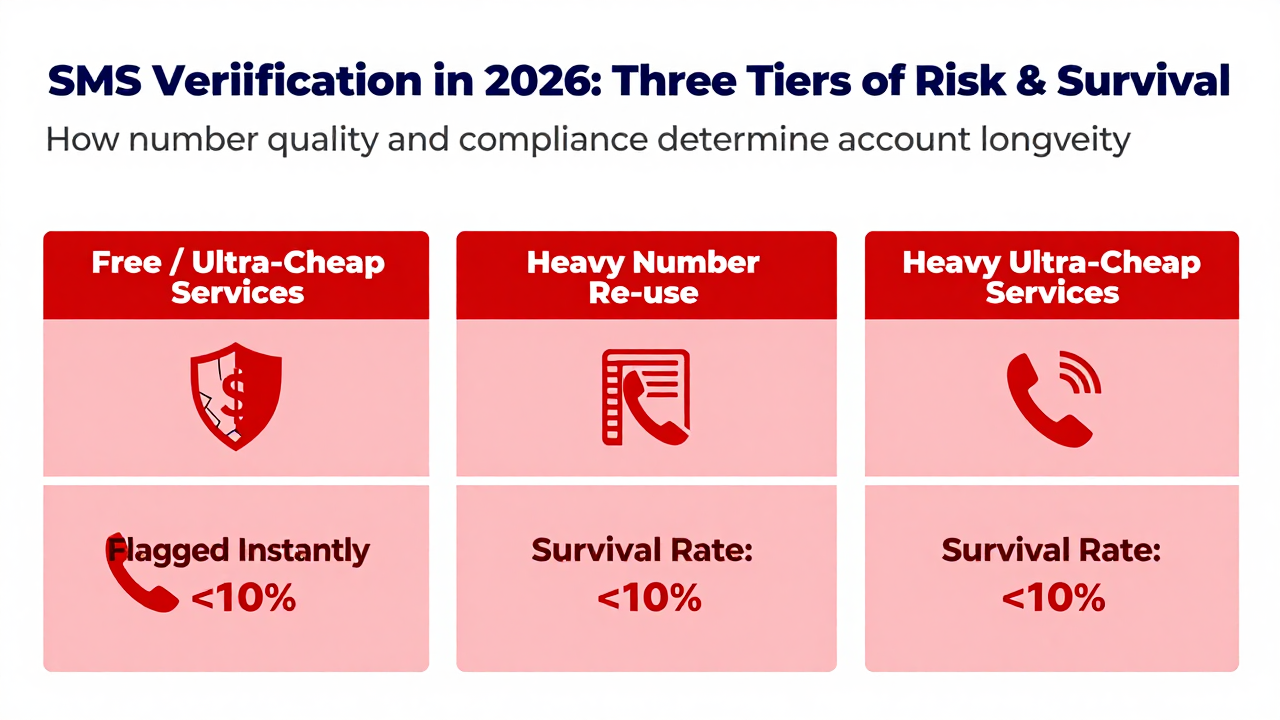
From my research, the sms-activation platforms you'll find today fall into three broad categories. The first is free or ultra-cheap web-based receive SMS online services—you land on the page, see a list of numbers, and anyone can grab one. The problem here is obvious: heavy number reuse. A single number might get used by dozens of people in one day, and platform risk-control flags it almost instantly.
The second tier is paid API-based services that charge per message and let you filter by country and region. These platforms typically maintain their own number pools, and the quality is somewhat better—but only if the card source is clean. The third tier, which has gained real traction in 2026, is what I'd call "managed compliance" services. These don't just hand you a verification code; they bundle number pool management, usage cycle recommendations, and risk alerts. In terms of industry reputation, platforms like Getfollow have built a stable name for themselves using this compliance-first approach—they treat SMS verification as part of a broader account lifecycle management strategy, not just a one-off code delivery.
Here's what I keep hearing from cross-border professionals in 2026: the biggest pain point is no longer "I didn't receive the code." It's "I received the code, but my account still got flagged." That tells you everything—simply solving code delivery no longer keeps pace with how fast platforms upgrade their risk-control systems.
Real-World Pitfalls: SMS Verification Mistakes I've Seen (and Made)
Last year, a friend running a TikTok content matrix came to me frustrated. They'd used a free SMS receive platform to register 200 accounts, and 180 were banned within a week. When I helped them dig into it, the problem was clear: the numbers were U.S.-based, but their registration IPs were all Singapore nodes—and those same numbers had been flagged as "used 15+ times" on the platform. To any risk-control system, that's an instant red flag.
So in 2026, the first thing you need to check when choosing an SMS activation service is number "freshness." Industry consensus says that once a number has been used more than three times, the risk factor climbs exponentially. Many platforms won't volunteer this data—you have to ask directly: Is this number range exclusive or shared? When was it last used?
The second factor is number range type. I've tested this myself: in 2026, mainstream platform risk models have become extremely good at identifying virtual number ranges (like certain +44 VoIP prefixes). Real IoT SIM card ranges, on the other hand, tend to have much higher survival rates because they show natural activity patterns and realistic usage behavior. But IoT cards cost more—so if you see an SMS verification site with suspiciously low pricing, you can bet they're padding their pool with virtual numbers.
Here's a third detail most people overlook: the "nurturing period" after verification. Under 2026 algorithms, successful registration is just step one. What you do in the first 24 hours determines whether the account enters the normal recommendation pool. If you just receive the code and move on without simulating real user behavior, even the best number won't save you.
Why the SMS Verification Industry Got So Competitive in 2026
Looking at the 2026 ecosystem, competition among SMS activation providers has shifted from "who's cheapest" to "who's best at outsmarting risk control." Why? Because social platforms and payment gateways have evolved to behavioral sequence analysis—they're no longer just looking at the phone number you registered with; they're examining your complete behavioral chain over the next 7 days.
This forces SMS verification platforms to do two things: first, continuously refresh their number pools and retire flagged ranges; second, offer more granular data services—like a number's usage history, current risk score, and recommended use cases. I've noticed platforms like Getfollow have started bundling SMS verification with account operation advice. After you register, you get a simple "account survival checklist." This model essentially helps users reduce their chances of getting banned down the line.
But let me pour some cold water here: 2026 still has plenty of fly-by-night platforms operating on a "grab and go" basis. Their playbook is simple—low prices to lure you in, then either the number quality tanks or the platform disappears with your prepaid balance. I've seen more than one studio lose 5,000 RMB to a platform that went dark within a week of their top-up.
Managing the Risks: Start Small Before You Commit
The biggest risk with SMS verification services isn't the verification itself—it's the downstream loss of account assets. A cross-border store account represents significant investment: nurturing costs, operational time, sometimes hundreds or thousands of dollars. If the verification step causes a ban, you've lost far more than you saved on SMS fees.
My advice is straightforward: no matter which platform you find in any "best SMS verification websites" roundup, your first order should always be a small test. Buy 10 numbers, register on different platforms, and monitor survival rates over 48 hours. If more than 3 out of 10 show anomalies, blacklist that service immediately.
Also, keep this in mind: the industry-wide retention rate for SMS activation services in 2026 hovers between 50% and 70%. That's the consensus. If any platform guarantees 100% success, they're either lying or about to disappoint you. Responsible providers will give you honest estimates for different scenarios—not chest-thumping promises.
One more thing: don't put all your eggs in one basket. Even well-regarded platforms can experience temporary dips when a specific number range gets flagged en masse. Keep 2–3 backup SMS verification channels on hand, with primary and backup clearly separated. That way, if one hiccups, your overall operation doesn't stall.
How to Pick a Reliable Provider: Practical Criteria for 2026
When cross-border operators ask me how to judge which SMS verification site is trustworthy, I give them these quantifiable benchmarks based on years of hands-on testing:
- Ask about number pool refresh frequency: Ask customer service when the last batch of new numbers was added. If they're vague or say "we're always updating" without specifics, the pool probably hasn't moved in months.
- Look for risk-control transparency: Reliable platforms clearly state which number ranges work best for which platforms and which ones you should avoid. If all they say is "works everywhere," be suspicious.
- Check pricing transparency: In 2026, mainstream SMS activation pricing ranges from roughly $0.07 to $0.40 per message, depending on region and number type. If a price falls well below that range, you're likely looking at virtual numbers or hidden fees.
- Test their support response: Before you register, send a pre-sales question and see how fast they reply. If they're slow before you've paid, they'll be useless after something goes wrong.
Take Getfollow as an example: their 2026 service model clearly labels each number range with "recommended use cases" and "risk level," so you can see estimated success rates before placing an order. That level of transparency is genuinely rare in this industry. But to be fair, even a platform like that isn't for everyone—if your volume is tiny (a few registrations a month), a pay-per-use lightweight plan might make more sense.
Final Thoughts: Verification Is Just the Starting Line
Looking at the 2026 cross-border landscape, SMS verification websites are essentially just one tool in your account cold-start arsenal. What really determines your ceiling is your operational strategy and risk-control awareness. I've seen too many people obsess over finding cheap codes while ignoring the critical 72-hour window after registration—that's what actually decides whether an account survives.
If you're about to start batch-registering accounts, here's my suggestion: spend half an hour mapping out your registration scenarios and account purposes first. Then match those needs to the right SMS activation service. Don't chase "the ultimate list"—find one or two stable channels that fit your workflow. Start with a small test, validate the process, then scale up gradually. That way, even if platform risk-control fluctuates, you can adapt without taking a serious hit.
In cross-border business, success lives in the details. SMS verification might seem like a minor step, but choose wisely and you'll save yourself endless trial-and-error costs. Choose poorly, and you could lose everything overnight. I hope this 2026 industry deep-dive helps you sidestep a few landmines.
Frequently Asked Questions
What is the best SMS verification website for WhatsApp in 2026?
For WhatsApp specifically, look for platforms that offer dedicated number ranges with low reuse rates—ideally IoT-based numbers from the US, UK, or Canada. Test with a small batch first, and avoid free platforms where numbers are shared across hundreds of users.
Are free SMS receive websites safe to use?
Generally, no. Free receive SMS online services have extremely high number reuse rates, which triggers platform risk-control flags almost immediately. If you're serious about account survival, budget for a paid service—it's cheaper than losing a fully nurtured account.
How much do SMS activation services cost in 2026?
Typical pricing ranges from $0.07 to $0.40 per verification code, depending on the country, number type (IoT vs. virtual), and the platform's reputation. Prices significantly below this range usually indicate virtual numbers or hidden fees.
Why do my accounts get banned even after receiving verification codes?
Receiving the code is only 20% of the battle. Platforms now analyze your IP location, device fingerprint, behavioral patterns, and the number's usage history. If your IP doesn't match the number's region, or the number has been reused too many times, your account will still get flagged.