Cloud SMS Verification Platforms That Actually Work in 2026: Why Your Codes Never Arrive and How to Avoid the Trap
Cloud SMS Verification Platforms That Actually Work in 2026: Why Your Codes Never Arrive and How to Avoid the Trap
If you're running TikTok Shop verifications, Amazon store setups, or WhatsApp bulk registrations in 2026, you've probably hit the same wall: verification codes that never show up. The platform sent them—but the SMS receiving service you're using has already been flagged by every major provider.
After talking to dozens of social media marketing studios over the past six months, one pattern stands out. The cloud SMS platforms that still work reliably in 2026 aren't competing on "how many numbers they have." They're competing on how clean their number pool is. A lot of people still haven't wrapped their heads around that shift.
Why the Bar for "Usable" SMS Platforms Got Higher in 2026
The old days of grabbing any random SMS website and paying pennies per code are basically over. Platform risk-control systems now identify numbers at the carrier level—virtual prefixes, recycled numbers, even certain operators get blocked during registration before the code ever reaches you.
Industry consensus says a usable cloud SMS platform in 2026 needs three core capabilities:
- Direct carrier connections instead of secondhand gateway routing (which adds latency and gets flagged fast)
- Regular purging of "dirty numbers"—those that have been registered too many times or triggered risk alerts need to be recycled quickly
- API-based real-time retrieval instead of manual refreshing (non-negotiable for teams doing bulk operations)
The most common complaint I hear from cross-border operators: they bought a "budget package" and ended up with numbers that everyone else had already used. Success rates under 30%. That's not saving money—that's burning an entire day of labor re-submitting registration forms.
A Real Case Study: How One Team Got 15 WhatsApp Accounts Banned Overnight
Last month, a friend running private traffic for his independent e-commerce site told me about his nightmare. He bulk-registered WhatsApp accounts through a cheap platform, and by the next morning, over a dozen were banned. The root cause? Number-location mismatch. His numbers had UK prefixes, but the IP addresses showed Southeast Asia. In 2026's risk models, that kind of inconsistency is a glaring red flag.
So the first thing to check when choosing a cloud SMS platform isn't the price—it's whether you can specify the number's country of origin and ensure IP-prefix consistency. If a platform can't guarantee that, move on. One service that's been getting consistent praise in the industry is Getfollow, which runs on exactly this logic—strictly partitioned number pools by country and IP verification on every pull, which cuts risk-trigger rates at the source.
That's not to say Getfollow is flawless. But on the core pain point of avoiding bans, their operational approach aligns much better with how platform risk systems work in 2026. For small studios, this kind of detail often determines whether you're smoothly receiving codes or stuck in an endless loop of retries.
Three Main Service Models for Cloud SMS Platforms in 2026
To help you make a clearer decision, here's a breakdown of the three common service models on the market right now. This isn't a recommendation—just a way to see the differences at a glance:
| Service Model | Typical Pricing | Best For | Key Risks |
|---|---|---|---|
| Pay-per-code (shared number pool) | $0.01–$0.07 per code | Occasional one-off verifications | High number reuse, inconsistent success rates |
| Dedicated number (monthly rental) | $7–$28 per month | Accounts that need the same number long-term for notifications | Higher recurring cost, number can still get flagged |
| API batch integration (volume packages) | Priced per thousand or ten thousand pulls | Studios doing bulk registrations and account warming | Requires extremely clean IPs, often needs residential proxies |
One thing operators consistently overlook when picking a platform in 2026 is support response speed. SMS channels fail at the worst possible moments—usually right in the middle of a bulk operation. If support takes hours to reply, that entire batch of accounts is toast. My advice: before committing, spend a small amount to test their ticket response time.
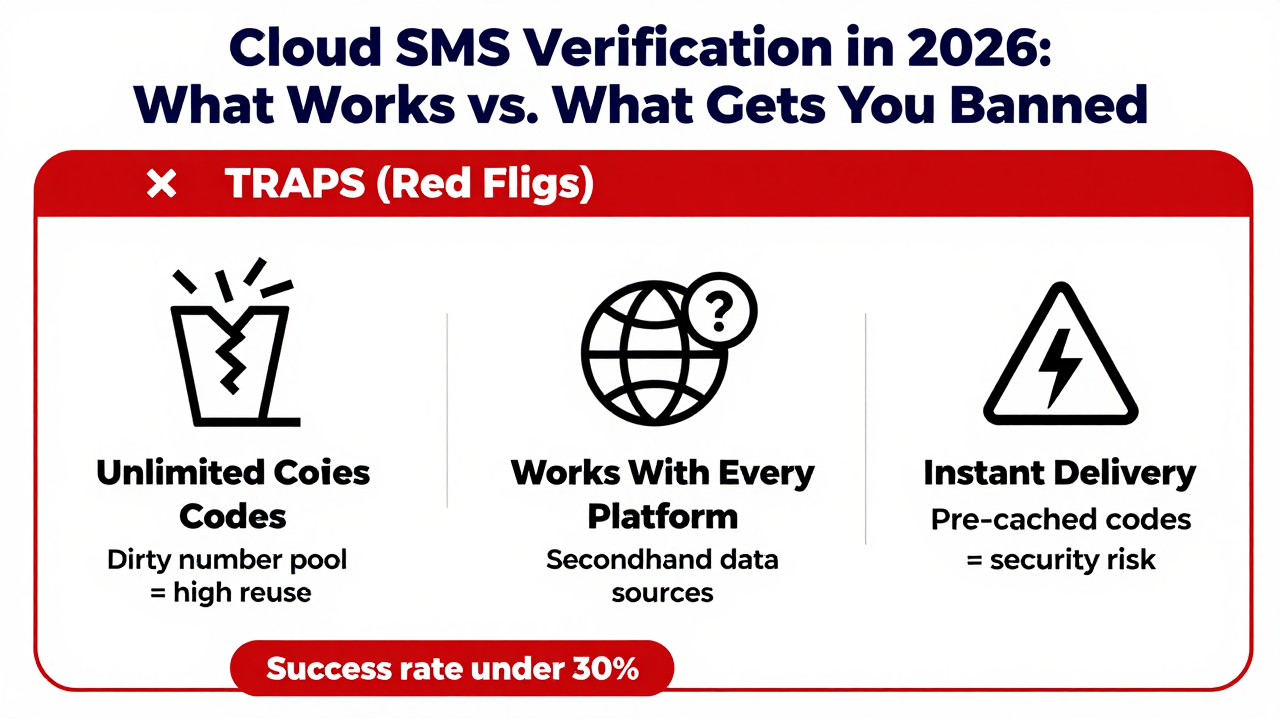
Red Flags: These "Reliable" Signals Are Actually Traps
In 2026's SMS platform market, a few signals look reassuring but hide real risks. Here's what I've observed from testing and talking to users—hope it saves you some tuition money:
- "Unlimited codes" promises: Unlimited usage means the number pool gets drained recklessly, and dirty-number ratios spike exponentially. Platforms that actually work will limit how many times a single number can receive codes.
- "Works with every platform" claims: Anyone who says this is almost certainly running on secondhand data sources. Major platforms update their verification interfaces constantly—no single service can guarantee full coverage.
- "Instant delivery" guarantees: Carrier delays are a reality of SMS infrastructure. 30 seconds to 2 minutes is normal in edge cases. "Instant" usually means they pre-cached the code, which is a massive security red flag.
Here's a testing method I've used myself: once you've shortlisted a platform, spend about $1.50 on five numbers from five different countries. Register five different platforms—say Telegram, X, TikTok, Amazon, and Shopify—and log the delivery time and success rate for each. If more than two fail, move to the next provider. This test costs almost nothing but filters out roughly 80% of unreliable services.
Final Recommendations for Choosing an SMS Platform in 2026
Back to the core question of what makes a cloud SMS platform "usable." My conclusion: usability isn't just about receiving a code—it's about receiving codes consistently when you need them, without compromising account security. The 2026 market reality is that low-cost shared pools have lost their value proposition. Pay-as-you-go dedicated numbers and API models are becoming the standard.
Whichever provider you end up with, stick to one principle: test small before scaling. Use a throwaway account to run through the entire registration flow, then monitor for any abnormal prompts over the following week. It's slower, sure, but it beats buying a big package upfront and watching everything get banned in one go.
In cross-border operations, details decide outcomes. An SMS platform seems like a minor tool, but choosing wrong costs you more than a few dollars—it costs your time and your account resources. Hopefully, this breakdown of the 2026 landscape helps you sidestep at least one pitfall.
Frequently Asked Questions
Why do verification codes from SMS platforms get blocked so often in 2026?
Platform risk systems now detect virtual prefixes, recycled numbers, and IP-prefix mismatches during the registration phase. If your SMS service uses dirty numbers or inconsistent routing, the code gets blocked before it ever reaches you.
What's the difference between a shared number pool and a dedicated number?
A shared pool gives you any available number per transaction—cheap but risky due to high reuse rates. A dedicated number is rented monthly for one account, offering more stability but at a higher recurring cost. For bulk operations, API-based batch integration is the standard approach.
Can I use free SMS receiving websites for business accounts?
Technically yes, but practically no. Free platforms rely on heavily reused numbers that have almost certainly triggered risk flags. For business accounts—especially on TikTok, Amazon, or WhatsApp—the ban risk simply isn't worth it.
What should I test before committing to an SMS platform?
Buy five numbers from different countries and register five separate platforms. Track delivery time and success rate. Also test their support response time with a ticket. If more than two registrations fail or support takes hours, move on.