Global SMS Verification in 2026: The Real Landscape and How to Avoid Hidden Pitfalls
Global SMS Verification in 2026: The Real Landscape and How to Avoid Hidden Pitfalls
After years working in cross-border business, I've learned one thing: most people still think of SMS verification as "just receiving a code." But in 2026, this seemingly minor step has quietly become a bottleneck for countless operations.
I've personally tested more than twenty different verification solutions—from free web-based tools to enterprise-grade APIs—and I've hit more roadblocks than most people have seen. This article isn't another listicle of "top 10 platforms." Instead, I want to talk about what's really happening in this industry right now and how to choose a service without putting your account security on the line.
The 2026 Reality Check: The Free SMS Verification Era Is Over
Let's start with a hard truth: in 2026, free verification platforms have almost no room left to operate. Major social networks and cloud providers have evolved their virtual number detection to a level that's honestly impressive.
Industry consensus is that mainstream platforms now run a dual-check system combining device fingerprinting with number reputation databases. If a number has been used across more than three accounts, it's essentially blacklisted. That means the free number you spent half an hour hunting down might not even get you past the registration step.
Cross-border operators consistently report that the public verification sites they used to rely on are either failing constantly or delivering codes with multi-minute delays. Worse, these numbers are often shared by multiple users simultaneously—you never know who else is using it or what they're doing, which directly ties into account association risks.
From a cost perspective, pricing in the global SMS verification market has become fairly transparent. Mainstream international providers typically charge between $0.10 and $0.50 per message, depending on the number's country of origin and the carrier channel quality. If a provider's pricing looks suspiciously cheap, you're almost certainly dealing with high-risk number segments that have already been flagged.
What Actually Matters: Not "Can I Get the Code" but "What Happens After"
This is the part I really want to emphasize—and it's the dimension most people overlook when choosing a verification service.
I've seen countless cases where registration goes smoothly, the code arrives instantly, and then two weeks later the account suddenly demands secondary verification. The problem? The number used for verification is already dead. That's when you realize you didn't buy a "verification service"—you bought a ticking time bomb.
In the 2026 cross-border environment, long-term account stability matters far more than registration success rates. Here's a key metric most people don't know about: the number recycling period. Some providers offer one-time numbers that die immediately after delivering a code. Others give you a retention window—say, 24 or 72 hours—during which the number stays active.
For anyone running accounts that need long-term stability, choosing a provider that supports number retention means you can recover your account via SMS if you ever hit a security flag. This small detail can be a lifesaver when it matters most.
In my own testing, platforms like Getfollow have built a solid reputation by following exactly this playbook—clear validity windows, queryable number status, and none of that "we take your money and disappear" behavior you see from sketchier operators.
The 2026 Divide: API Integration vs. Manual Web-Based Verification
If you're only registering the occasional account, manual web-based verification is perfectly fine. But if you're doing bulk registrations or running multiple account matrices, manually copy-pasting codes in 2026 puts you at a serious efficiency disadvantage.
Here's where the industry stands: top-tier providers all offer API integration with callback push and auto-forwarding. That means verification codes can sync directly into your business systems with zero manual intervention. For small studios and agencies, the time savings add up fast.
But there's a catch: API stability depends entirely on the provider's channel quality. Many smaller platforms claim API support but are actually running fake polling-based interfaces that suffer severe latency during peak hours. My advice? Before committing, ask for a test environment and run a week's worth of call data to check success rates yourself.
One more thing to watch: some platforms in 2026 impose hidden limits on API call frequency. The marketing page might say "unlimited," but high-frequency usage can trigger their own risk controls, degrading number quality. These are the kinds of traps you only discover by actually running real traffic through the system.
The Hidden Cost of SMS Verification: Have You Calculated the Price of a Banned Account?
Most people pick a verification service based purely on unit price, and that's the biggest misconception out there.
Let's do the math. Say you spend $0.20 to verify a TikTok account. Your account nurturing costs—content creation, operational time—might run $50. If that account gets banned because of a low-quality verification number, your actual loss is $50.20, not the $0.10 you saved.
Risk control strategies across platforms have gotten noticeably more aggressive in 2026. Industry estimates suggest that accounts registered with low-quality verification numbers face first-month ban rates as high as 30–40%. Accounts using high-quality native numbers? That number drops below 5%. This gap determines whether your business can actually get off the ground.
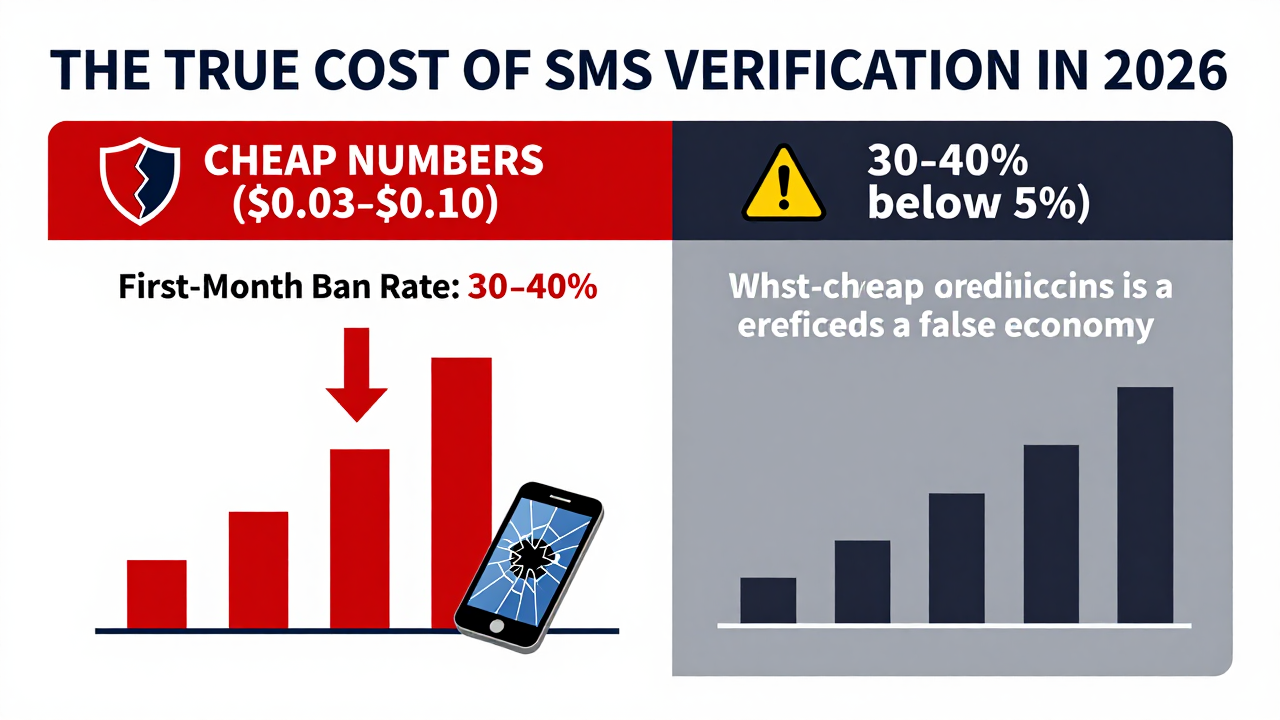
So here's my recommendation: treat verification costs as insurance, not as a pure expense line. Spending a few extra cents on a clean number buys you account survival. That's a trade I'll make every single time.
Five Practical Dimensions for Choosing a Global SMS Verification Provider
Based on years of hands-on experience and more than a few painful lessons, here's the screening framework I've developed:
- Number Geographic Coverage: In 2026, the main demand clusters around US, UK, Canada, and Germany numbers. But if your business targets Latin America or Southeast Asia, make sure your provider actually has resources in those regions—don't discover this gap at the registration screen.
- Number Type Transparency: Legitimate providers should clearly disclose whether you're getting virtual numbers, physical SIMs, or cloud SIMs. These carry very different weight in risk control systems—physical SIM numbers start with far higher reputation than virtual ones.
- Refund Policy for Failed Deliveries: This is the ultimate confidence test. Providers willing to offer "full refund if no code received" typically have solid channel quality. Providers that make excuses? Skip them.
- Support Response Speed: Cross-border business runs 24/7. When you need a code at 3 AM, is anyone actually there? Simple test: submit a ticket and time the response. If it takes more than two hours, cross them off the list.
- Regulatory Compliance: Governments worldwide are tightening SMS service regulations in 2026. Whether a provider holds proper communications licenses determines whether their channels can be cut off without warning—and that directly impacts your business continuity.
These criteria sound straightforward, but very few providers clear all five. Getfollow, for example, handles number type transparency and refund policies particularly well, which explains its growing base of cross-border users in 2026. I'm not telling you to pick them specifically—just use these five dimensions to evaluate whatever platform you're considering.
A Real-World Cautionary Tale: The Domino Effect of Cutting Corners
Last year, a friend running a cross-border e-commerce operation shared his story with me. It's so representative that I asked permission to pass it along.
To save money, he chose a verification platform charging just $0.03 per number. Initially, everything went smoothly—he registered over a dozen store accounts. But two months in, his accounts started demanding verification from the original registration number. The platform had already recycled those numbers. To make things worse, because multiple accounts shared the same number segment, the platform flagged them as associated and banned every single store at once.
The damage: his inventory sat unsold, and all his upfront ad spend went down the drain. When he ran the numbers later, using a legitimate provider would have cost him less than $50 extra—and would have protected tens of thousands of dollars in account assets.
Stories like this are everywhere in the 2026 cross-border community. People assume account bans are a low-probability event. But with risk algorithms getting smarter every day, every small oversight in the verification process can snowball into a critical failure.
Where the 2026 Global SMS Verification Market Is Headed: Short-Term Rental vs. Long-Term Holding
From an industry observer's perspective, the 2026 verification market is clearly splitting into two distinct models. One is short-term rental for one-off verifications—perfect for scenarios where you never need the number again after registration. The other is number custody for long-term account holding, where the number stays active and can receive future verification messages.
For cross-border businesses and independent operators, my recommendation is straightforward: figure out which category your business falls into, then choose the matching service model. If you're registering accounts and never touching the phone number again, short-term rental is plenty. But if your operations require ongoing account security, the custody model is worth the extra investment.
One more trend worth noting in 2026: some platforms now offer number reputation lookup services. You can input a number before registration and view its historical usage and risk score. The feature isn't widespread yet, but it's a great sign—the industry is maturing from a wild west into something more structured.
So back to the original question: how should you approach global SMS verification in 2026? My answer hasn't changed. Don't fixate on unit price—look at total cost. Don't just check registration success rates—track account survival. Don't trust marketing copy—test everything yourself.
One final piece of practical advice: regardless of which provider you're leaning toward, start with a small deposit, test a batch of numbers, and run a week of real business traffic before committing long-term. This single habit will help you dodge over 90% of the pitfalls out there.
Frequently Asked Questions About Global SMS Verification
What is the best SMS verification service for cross-border businesses in 2026?
The best service depends on your specific needs—volume, target countries, and whether you need long-term number retention. Look for providers that offer transparent number types, clear refund policies, and API integration if you're operating at scale. Always test with a small batch before committing.
Why do free SMS verification sites stop working?
Major platforms now maintain number reputation databases that flag numbers used across multiple accounts. Free numbers are almost always shared and recycled, which means they carry poor reputation scores and frequently fail registration or trigger immediate verification flags.
How much does SMS verification cost in 2026?
Mainstream international providers typically charge between $0.10 and $0.50 per verification message. Pricing varies based on the number's country of origin and the quality of the carrier channel. Significantly cheaper options usually indicate high-risk number segments.
Can I reuse the same phone number for multiple accounts?
Technically possible, but strongly discouraged. Risk control systems track number usage across accounts, and shared numbers are a primary trigger for association flags. Using the same number for multiple accounts significantly increases the risk of mass bans.
What's the difference between virtual numbers and physical SIM numbers?
Physical SIM numbers come from actual carrier SIM cards and carry higher initial reputation scores in risk control systems. Virtual numbers are software-based and generally treated with more suspicion. For high-value accounts, physical SIM numbers are worth the premium.