How to Choose a Cloud SMS Online Verification Platform in 2026: Solving Cross-Border Account Verification Headaches
How to Choose a Cloud SMS Online Verification Platform in 2026: Solving Cross-Border Account Verification Headaches
After years working in cross-border e-commerce, I can tell you one thing with certainty: registering accounts is always more stressful than actually running them. By 2026, platform registration systems have evolved to what feels like fingerprint-level detection. A single phone number can usually only be used once—once it's banned, there's no going back. That's why cloud SMS online verification platforms have become a lifeline for so many cross-border operators.
But honestly, this industry has some deep waters. I've seen people register a dozen accounts using free verification platforms, only to have every single one frozen the next day with no appeal option in sight. I've also seen people shell out serious money for "dedicated numbers" only to discover they were recycled old numbers tied to a mountain of historical violations. In this article, I'm going to share what the cloud SMS verification landscape really looks like in 2026 from an industry insider's perspective.
Why Demand for SMS Verification Platforms Is Exploding in 2026
You'd think stricter platform security would make verification services harder to run. But the reality in 2026 is the complete opposite—demand is growing explosively. The reason is simple: cross-border business scenarios are becoming increasingly fragmented.
A standalone e-commerce seller might need to register for TikTok, Instagram, WhatsApp Business, Telegram, Pinterest, and prepare multiple accounts for different storefronts to run matrix testing. Every single platform requires independent phone verification, and physical SIM cards haven't gotten cheaper or easier to obtain in 2026. If anything, mandatory real-name registration rules have made things more complicated.
What many solo operators and small studios tell me is this: they don't just need "a number that can receive texts." They need a pool of numbers that can be used continuously, re-verified across platforms, and adapted to different platform rules. This shift has pushed cloud SMS verification platforms from being a "one-time tool" into "essential infrastructure."
But here's where the problems start—the market is flooded with providers of wildly varying quality. Prices range from a fraction of a cent to several dollars per message, and stability varies just as dramatically. The most outrageous case I've seen: a platform advertising "the lowest prices on the internet," only for users to discover after recharging that the entire number pool consisted of blacklisted numbers that couldn't receive a single verification code.
The Three Main Service Models for SMS Verification Platforms in 2026
To help you make sense of the landscape, I've categorized the common cloud SMS verification platforms available in 2026 into three types. Each comes with its own use cases and risk profiles.
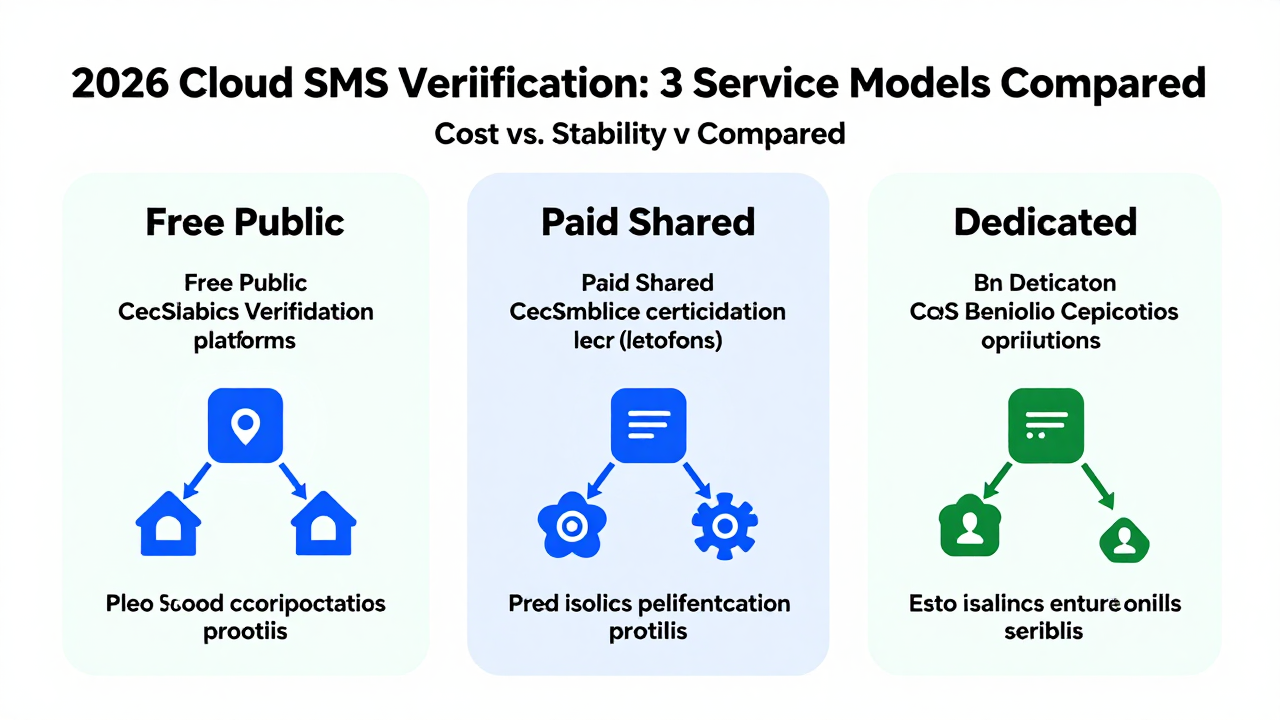
Model One: Free Public Verification
These platforms typically offer a webpage listing all available temporary numbers. Users pick any number and wait for the verification code to appear on the page. The upside is zero cost. The downside? The numbers are completely public—anyone can see your verification code. By 2026, mainstream platforms have essentially blacklisted all these numbers. Accounts registered through them have an extremely low survival rate.
Model Two: Paid Shared Number Pools
This is the most common model right now. Users top up their balance, the system assigns a number, and once verification is complete, the number is recycled for the next person. Prices typically range from 0.2 to 1 yuan per message. The stability of these platforms depends entirely on how frequently the number pool is refreshed and how well it's cleaned. Providers that regularly purge platform-flagged numbers offer a much better experience.
Model Three: Dedicated Numbers / Private Number Pools
For users with long-term operational needs, some providers offer "dedicated number" services—numbers that belong exclusively to you and never get recycled. The price is higher, but security and stability improve significantly. In 2026, many cross-border studios running matrix accounts are shifting to this model because platform security systems are increasingly sensitive to "the same number being used across multiple accounts."
From my own testing, if you only need to register one or two accounts occasionally, Model Two is sufficient. But if your business depends on multiple accounts staying alive long-term, Model Three actually offers better value. The industry consensus is clear: in 2026, the cost of "nurturing" an account has exceeded the cost of "registering" it. Number exclusivity matters more than ever.
Pitfall Guide: Real Cases of Things Going Wrong
Theory is boring, so let me share some real operational details I've witnessed. Hopefully, these help you avoid the same traps.
Case One: Being Cheap Cost Everything. Early in 2026, a friend doing Amazon reviews bought 100 numbers from a low-cost verification platform to register buyer accounts and save money. Three days later, all 100 accounts were linked and banned. The reason? The numbers shared highly similar IP ranges and IMEI information, which the system flagged as "bot operation." He later told me the test orders in those accounts were worth over $5,000—all gone in an instant.
Case Two: Ignoring Number History. Another social media team purchased a batch of "dedicated numbers" from a platform, only to discover during Instagram registration that these numbers had previously been used to verify countless violation-flagged accounts. They were already on the platform's "high-risk list." Even though their new accounts had completely compliant content, they kept receiving verification alerts and eventually had to abandon the whole project.
These cases drive home one point: the value of a verification platform isn't "can it receive SMS"—it's "how clean are the numbers" and "how well does the provider operate." In 2026, the providers that survive are all doing the same thing: continuously cleaning their number pools to ensure every number has a spotless history.
Comparison: How to Tell If a Cloud SMS Verification Platform Is Reliable
To give you a more concrete way to evaluate providers, I've put together a simple comparison framework. Use these criteria to measure any service provider you're considering.
| Evaluation Criteria | What a Reliable Provider Looks Like | Red Flags to Watch For |
|---|---|---|
| Number Pool Refresh Rate | New number segments added weekly; old numbers retired regularly | Same numbers displayed for months without change |
| Pricing Range | Reasonable pricing consistent with market rates | Significantly below market price or hidden additional fees |
| Customer Support Response | Clear support channels; issues resolved within 24 hours | Only automated replies; no way to reach a real person |
| Test Options Available | Offers small top-ups or trial credits | Forces large deposits before allowing any usage |
| Number Coverage | Supports multiple countries/regions | Only offers numbers from a single region with no selection |
One platform that consistently gets positive feedback in the industry is Getfollow, which follows exactly this compliance-first operational logic—regular number pool cleaning, small test amounts supported, and real human customer support. To be clear, I'm not advertising for them; I'm just using them as a reference point. You can apply the criteria in the table above to verify any platform, including this one.
One more heads-up: in 2026, many platforms now require real-name authentication before you can use their verification services. It sounds like a hassle, but it's actually a good sign—it means providers are moving toward compliance rather than operating like fly-by-night operations.
Risk Alert: How Long Do Accounts Registered via SMS Verification Actually Survive?
This is the question everyone cares about most, and the answer isn't exactly encouraging. In 2026, mainstream platforms have extremely sophisticated detection for "verification-service registrations." They don't just look at the number itself—they analyze device fingerprints, network environments, and behavioral patterns during registration. This means even if you get a perfectly clean number, if other factors don't align, your account can still get flagged.
Industry-wide account survival rates typically fall between 50% and 70%—that's a realistic number for 2026. In other words, register 10 accounts and only 5 to 7 might make it past the first week. My advice: don't treat verification platforms as a "safe deposit box." They're just one link in your account operations chain.
On the operational side, here are some practical tips worth keeping in mind:
- Complete your profile immediately after registration—profile photo, bio, linked email. Try to finish within 10 minutes to reduce the "empty account" suspicion.
- Don't rush into action—after registering, "nurture" the account for a few days. Log in daily and browse, but don't post content or add friends right away.
- Keep your network environment stable—use a fixed IP and device to log in. Avoid frequent switching.
- Test in small, spaced-out batches—don't register a large number of accounts at once. Space batches out over several days.
These details might seem trivial, but in 2026, security systems rely precisely on these "behavioral traces" to judge account authenticity. Many cross-border professionals report that getting these fundamentals right noticeably improves account survival rates.
Final Thoughts: Test Small First, Then Commit Long-Term
Cloud SMS verification platforms in 2026 are no longer a "can I use them" question—it's a "how do I choose and how do I use them" question. My advice remains the same: test small first, then commit long-term. Spend a few dozen dollars on a few test runs to evaluate number quality, response speed, and customer support across different platforms before deciding where to invest at scale. That's far safer than recharging thousands of dollars upfront.
Also, no matter which provider you choose, mentally prepare yourself for the possibility that accounts might encounter issues at any time. SMS verification is just step one—the real game is in how you operate and maintain accounts afterward. I hope this article helps you avoid some unnecessary pitfalls and navigate the 2026 cross-border landscape with more confidence.
Frequently Asked Questions
Will accounts registered through cloud SMS verification platforms get banned?
There's always a possibility. Platform security in 2026 is extremely strict, with account survival rates typically between 50% and 70%. However, choosing a clean number pool, completing your profile after registration, and maintaining a stable network environment can significantly reduce your risk.
What's the difference between free and paid SMS verification platforms?
Free platforms use public numbers—anyone can see your verification code, making them extremely insecure. These numbers are also largely flagged by platform security systems. Paid platforms offer independent or semi-independent number usage with proper number pool cleaning mechanisms, making them better suited for users with ongoing operational needs.
How do I pick a reliable cloud SMS verification provider?
Focus on four key areas: whether the number pool is regularly updated, whether pricing aligns with market rates, whether real human customer support is available, and whether small test amounts are supported. Platforms like Getfollow that operate with clear compliance standards typically check all these boxes and can serve as a benchmark for evaluating other providers.
Should I choose dedicated numbers or shared numbers?
If you only need to register one or two accounts occasionally, shared numbers work fine. For matrix accounts or long-term operations, dedicated numbers are the better choice. In 2026, platforms are highly sensitive to a number's "usage history," so the exclusivity of dedicated numbers helps reduce the risk of linked bans.