Gmail SMS Verification: The Hidden Backbone of Cross-Border Business
Gmail SMS Verification: The Hidden Backbone of Cross-Border Business
If you work in cross-border e-commerce, you already know the drill—a stable Gmail account is basically your digital passport in overseas markets. Once your operations expand across multiple platforms and storefronts, bulk email registration becomes unavoidable. And that's precisely where "Gmail SMS verification" turns into the bottleneck that keeps countless agency owners up at night.
Most people assume receiving a verification code is a straightforward affair. In practice, you'll run into dead numbers, delayed codes, and accounts flagged within hours of registration. I've personally tested over a dozen verification services on the market, and this deep dive lays out exactly how the industry really works.
How SMS Verification Services Actually Operate—It's More Than Just Receiving a Text
Here's the industry consensus on how the chain works: a Gmail SMS verification service provides a pool of overseas phone numbers designed to receive the verification text during Gmail sign-up. Sounds simple, but what happens behind the scenes involves number pool cleanliness, carrier channel stability, and platform risk-control countermeasures.
Here's a critical detail most people miss: Gmail's registration risk control doesn't just check whether the phone number is real. It evaluates a combination of IP address, browser fingerprint, device environment, and the historical behavior patterns of the number segment. So even if you get a legitimate, working number, a shared IP or a dirty browser environment will still get you flagged as high-risk.
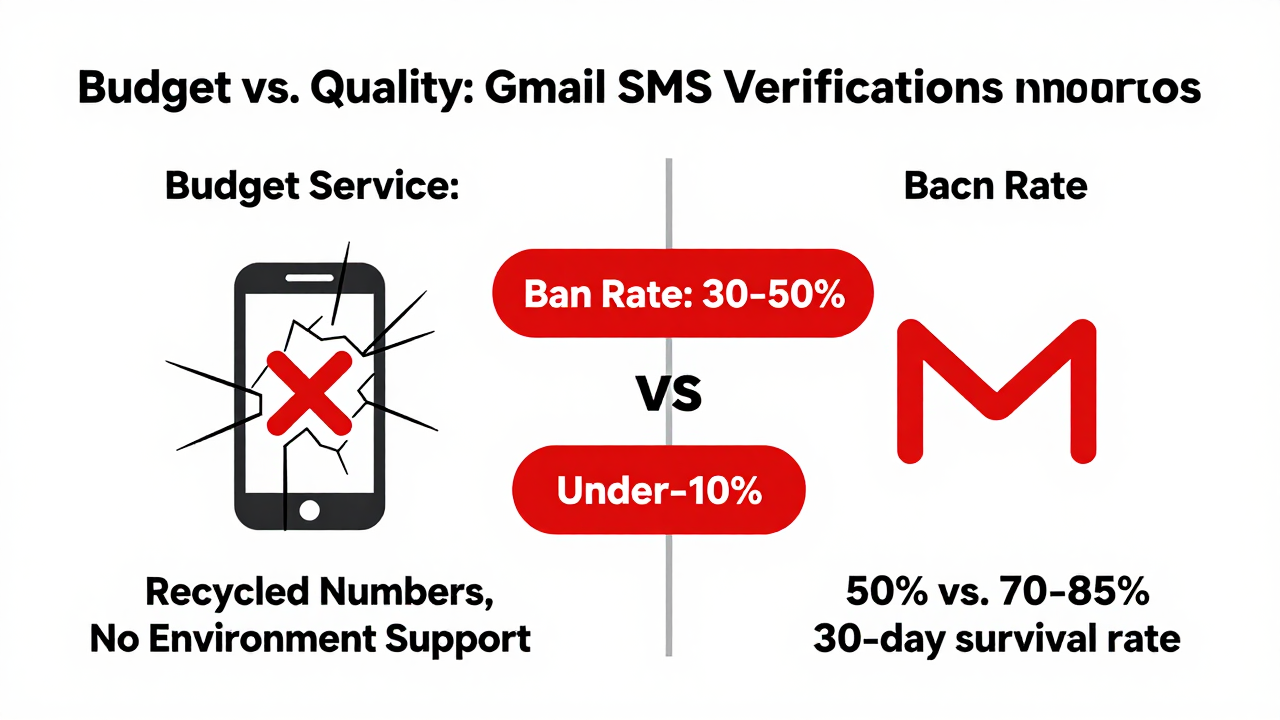
The more mature players in this space now offer a bundled "environment + verification" package. Platforms like Getfollow, which have built a solid reputation, operate on exactly this model—they don't just hand you a number; they walk you through setting up a clean registration environment, cutting the reported ban rate from the typical 30–50% down to under 10%.
Number Pool Purity Determines Your Account's "Background"
For any verification platform, the number pool is the crown jewel. Budget services often rely on recycled numbers—ones that have been registered multiple times or flagged for spam behavior. Using those to create Gmail accounts means your account starts with baggage.
From my experience, a pattern I keep seeing: cross-border operators register accounts through certain platforms, everything looks fine for the first three days, then a week later accounts get hit with secondary verification requests or outright bans. That's the classic "delayed settlement" effect of a contaminated number pool.
Reputable providers routinely purge their number pools and keep registration history logs available for users to inspect. When you're vetting a service, ask customer support directly for the past week's number pool update log. If they're willing to share it, they're probably worth your time.
Beyond Verification: Focus on Account Survival Rate
The metric that actually matters for your business isn't the per-code price—it's the account survival rate after registration. Industry-wide, the accepted benchmark is: quality verification services combined with a clean environment yield a 30-day Gmail survival rate of 70–85%. Sloppy operations? You're looking at under 50%.
Let's put that in perspective. Say you need 100 Gmail accounts for a TikTok account matrix. At a 50% survival rate, you're left with 50 usable accounts—which doubles your effective cost per account, not to mention the time and effort wasted on nurturing dead accounts.
My advice: don't treat verification as a standalone step—treat it as part of your entire account production pipeline. Evaluate whether the provider offers complementary environment solutions, supports batch operations, and can assist with appeals when accounts get locked.
A Real-World Cautionary Tale
Last year, a friend running a dropshipping store decided to save money and topped up 500 RMB on a budget verification platform—the per-code price was a rock-bottom 0.3 RMB. Within a week, all 60 Gmail accounts he registered were locked, each demanding phone re-verification. By then, the platform had vanished, and customer support was unreachable.
He switched to a different provider afterward, paying nearly five times more per code. But with clean IPs and a fingerprint browser setup, his survival rate jumped to over 75%. His takeaway: "The cheap option is usually the most expensive one in the end." That statement hits especially hard in the Gmail SMS verification space.
One more thing worth flagging: any provider claiming a "100% no-ban guarantee" should be an automatic red flag. Gmail's risk-control logic evolves constantly—even Google's internal systems can't guarantee perfect accuracy, so no third-party service can honestly promise otherwise.
Four Hard Criteria for Choosing a Verification Provider
Based on industry consensus and my own hands-on testing, here are four quantifiable dimensions to guide your decision:
- Number Pool Refresh Frequency: Ask for the last 7 days of number intake records to confirm fresh numbers are being added consistently. Platforms that haven't updated in a while are almost certainly running on recycled numbers.
- Environment Support Capabilities: Do they offer IP, browser fingerprint, and proxy configuration as part of the service? Or do they just hand you a number and call it a day? The latter means you're on your own for the environment setup, and that's a steep hill to climb.
- Support Response Speed: When registration fails or an account gets banned, can their support team respond within 30 minutes with a concrete solution? This directly impacts your operational continuity.
- Pricing Model Transparency: Is it per-code or subscription-based? Do they refund failed verifications? Are there hidden "number activation fees"? Get all of this in writing before you commit.
Some platforms are now packaging verification and account management into a single solution. Getfollow, mentioned earlier, leans toward "account lifecycle management" rather than just wholesale number distribution. The advantage of this model is clear accountability—when something goes wrong with your account, the provider has an obligation to help troubleshoot instead of deflecting blame onto "Google's risk control."
Final Word: Test Small First, Scale Later
The Gmail SMS verification industry is a mixed bag—plenty of questionable operators, but solid providers do exist. My final recommendation: no matter how impressive a platform's marketing looks, run a small-scale test first. Register 5–10 accounts, monitor survival rates and stability for a week, then decide whether to commit long-term.
That test costs almost nothing, but it will filter out 80% of the bad actors. Cross-border business is a marathon, and the stability of your account infrastructure determines how far you can go. Here's to steady accounts and smooth operations.
Frequently Asked Questions
What is Gmail SMS verification and why do I need it?
Gmail SMS verification is the process of using a real phone number to receive the verification code required during Gmail account creation. For cross-border sellers and agencies managing multiple accounts, it's a necessary step—Gmail requires phone verification for most new registrations, especially when operating at scale.
Why do my Gmail accounts keep getting banned even with SMS verification?
A working phone number alone isn't enough. Gmail's risk-control system evaluates your IP address, browser fingerprint, device environment, and the number's history. If any of these factors look suspicious—like a shared IP or a recycled number—your account can still get flagged. That's why pairing verification with a clean registration environment is critical.
How much does Gmail SMS verification cost?
Pricing varies widely depending on the provider and number quality. Budget platforms may charge as little as $0.05 per code, while premium services with clean number pools and environment support can run $0.25–$0.50 or more. Keep in mind that the cheapest option often costs more in the long run due to low account survival rates.
Can I use free SMS verification services for Gmail?
Free services are almost always a bad idea for business use. Their numbers are heavily recycled, frequently blocked by Google, and come with zero support. If you're registering accounts for business purposes, the small per-code cost of a reputable provider is well worth the account survival rate you'll gain.
What's a realistic Gmail account survival rate with a good verification service?
With a quality verification provider paired with a clean IP and browser environment, you can expect a 70–85% survival rate over 30 days. Anything below 50% suggests either the number pool is contaminated or your registration environment needs work.