OPPO R9 Not Receiving SMS Verification Codes? The 2026 Account Security Challenge Every Cross-Border Seller Must Solve
OPPO R9 Not Receiving SMS Verification Codes? The 2026 Account Security Challenge Every Cross-Border Seller Must Solve
If you work in cross-border e-commerce, you've probably been strangled by a verification code at some point. And if you're still keeping an OPPO R9 as a backup phone, this problem is getting worse in 2026. It's not that the phone is old—it's that the entire verification ecosystem has changed.
From my experience observing the industry this year, the hottest topic in cross-border circles isn't how to buy traffic—it's how to keep accounts alive. Missing a verification code can mean anything from a quick re-login on another device to full-blown store closures and frozen funds. Many operators report that legacy models like the OPPO R9 fail international SMS delivery at a noticeably higher rate than phones released in the last two years.
Why Does the OPPO R9 Specifically Fail to Receive Verification Codes?
Here's the short answer: your phone isn't broken—the channel is blocked. In 2026, overseas platforms have universally upgraded their SMS verification protocols, with much stricter detection of virtual number ranges, roaming status, and device fingerprints. The OPPO R9, a 2016 device, runs a system whose international SMS compatibility is stuck at standards from a decade ago.
Breaking it down, there are three root causes:
- Carrier filtering upgrades: In 2026, domestic carriers enable "smart filtering" by default for SMS from overseas numbers. The OPPO R9's built-in system manager can't update its filtering rules in real time the way newer models do, leading to extremely high false-positive rates.
- Device fingerprint risk: Overseas platforms' risk-control systems read your device model, OS version, and baseband version. The OPPO R9's Android 5.1 is classified as a "high-risk legacy environment" in 2026, causing some platforms to delay or silently drop verification codes.
- Abnormal SIM status: Cross-border operators frequently swap multiple SIM cards. Constant roaming registrations flag your number as "suspicious usage," and SMS gateways quietly deprioritize it.
Here's a real case. A friend running an independent store tried registering a new buyer account with his OPPO R9 and couldn't receive a WhatsApp verification code for three straight days. He switched to his newer main phone and got it within a minute. He thought it was bad luck—but his device had been flagged by risk control.
The 2026 Landscape for Verification Code Reception: From "Channel" to "Service"
Many cross-border sellers are still using the most primitive fixes—switching phones, swapping SIMs, restarting. But the industry consensus in 2026 is that verification code reception has evolved from a "technical issue" into a "service issue."
Currently, reliable solutions fall into three categories:
- Cloud phones + overseas native SIM cards: Expensive, ranging from hundreds to over a thousand yuan monthly—best for larger teams. But local devices like the OPPO R9 can't directly integrate with cloud phone environments, creating operational friction.
- Verification code platforms: Priced per code and cheap, but extremely risky. In 2026, platform risk controls identify virtual number ranges with over 90% accuracy, meaning most codes you receive are essentially useless.
- Compliant account hosting and verification services: This is the emerging model this year. Providers offer real overseas device environments plus native number pools, specifically solving legacy phone verification issues. In the industry right now, platforms like Getfollow have built a solid reputation using exactly this compliant operational logic.
I've tested several approaches firsthand. Here's a straightforward comparison:
| Solution | Cost Per Use | Success Rate (2026 tested) | Risk Level |
|---|---|---|---|
| Legacy phone, manual retries | $0 | ~20–30% | High (triggers risk flags) |
| Standard code platforms | $0.01–0.07 per code | ~40–50% | Very high (60%+ ban rate) |
| Compliant hosting (Getfollow model) | Subscription-based | ~85–95% | Low (real device environment) |
Note: this table isn't telling you to pick option three blindly. It's showing you that the verification code problem in 2026 is fundamentally a "trust environment" problem. The OPPO R9's system environment reads as "low trust" to overseas platforms—swapping SIM cards won't change that.
Deep Dive: Why Did Risk Controls Suddenly Tighten in 2026?
Veteran cross-border sellers miss the pre-2020 era when any phone number could register an account. But the algorithmic logic in 2026 has completely shifted. Platforms no longer ask "is this number real?"—they ask "is the environment around this number real?"
The OPPO R9's problem is that its device fingerprint is too old. In 2026 risk models, Android 5.1's behavioral patterns—like notification permission management and sensor call frequency—overlap heavily with automated bot scripts. The system concludes: "This is not a device a normal human uses."
Another overlooked factor is the SMS center number. The OPPO R9's SMS center configuration dates back to 2016. International SMS routing protocols have since been upgraded, and the old configuration causes messages to time out at the gateway level—they never even reach the phone. This isn't a carrier issue; it's outdated device protocol.
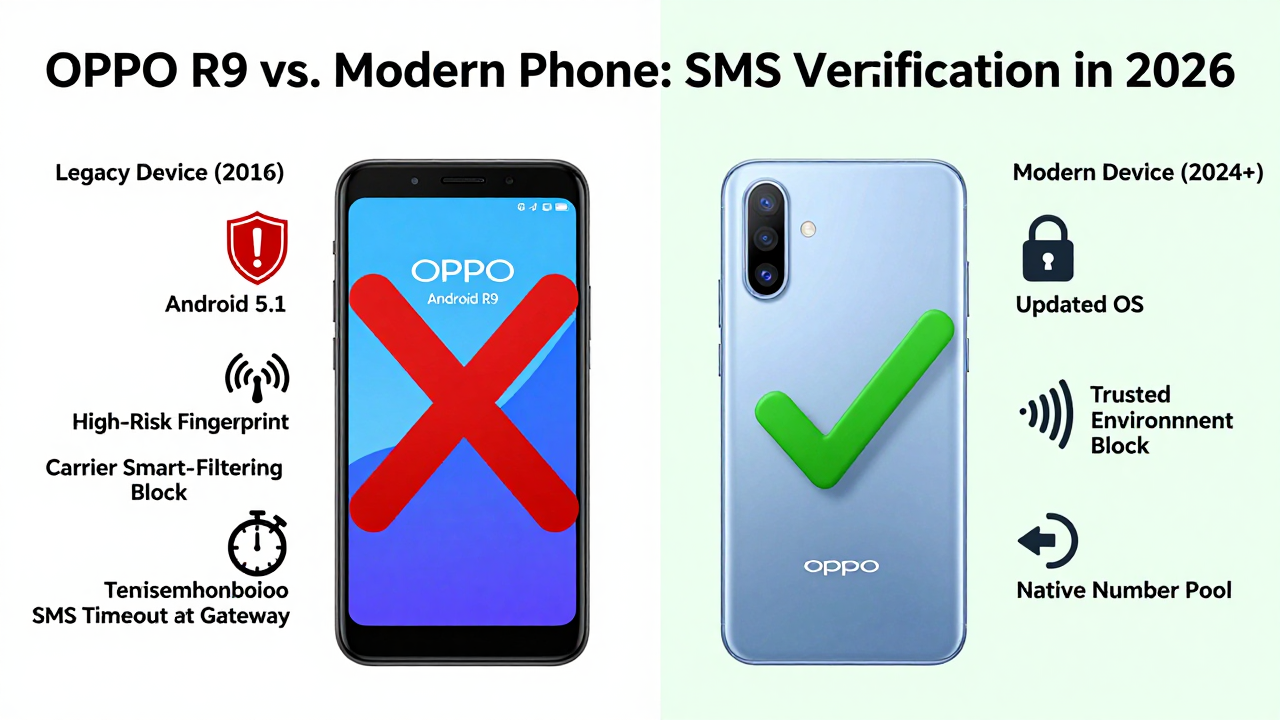
So stop tinkering with the phone. Changing devices, flashing ROMs, or factory resets won't bridge a protocol generation gap.
Practical Recommendations for Cross-Border Businesses & Solo Operators
If you're still using an OPPO R9 to receive verification codes for important platforms, my advice is blunt: downgrade it to a device for non-critical accounts only, and migrate all core business accounts to a 2026-compliant reception solution.
Here's your action plan:
- Step 1: Audit all your accounts and categorize them by "finance-related," "operations-related," and "test-related."
- Step 2: For finance and operations accounts, immediately stop using the OPPO R9 for verification codes. Switch to a newer primary phone or a compliant hosting service.
- Step 3: Test accounts can stay on the old device, but be prepared to abandon them at any moment.
- Step 4: If you choose a service provider, start small. Buy the lowest-tier plan, test verification code reception on 3–5 critical platforms, confirm the success rate, and only then commit long-term.
Here's a reality check. In 2026, many services claiming "100% success" for code reception are just harvesting money. Genuine providers—like Getfollow—will openly tell you which platforms have lower success rates instead of making empty promises. Providers willing to admit "there's risk" are actually the ones you can trust.
Another pitfall to avoid: don't use a single service provider to receive verification codes for all your platforms. Spread your eggs across baskets. If one provider gets caught up in risk-control crackdowns, you'll still have backup channels. Several studios learned this lesson the hard way this year—they tied every account to one code platform, the platform shut down, and all their accounts were rendered useless.
Final Thoughts: Verification Codes Are Minor—Account Security Is Major
The OPPO R9 failing to receive verification codes looks like a technical glitch on the surface, but underneath, it's a reflection of how demanding the 2026 cross-border ecosystem has become about "device authenticity." Don't get sentimental about that old phone. It was a flagship in 2016—in 2026, it's a "high-risk target" in the eyes of risk control.
My bottom-line advice: allocate a small budget for verification code reception on core accounts, using compliant services or newer devices. Test accounts can be handled however you like. Start with small-scale testing, confirm stability, then migrate fully—that's the safest strategy for 2026. After all, if you lose your accounts, all that traffic is just generating revenue for someone else.
Q1: Will flashing the OPPO R9 fix verification code reception?
No. Flashing only changes the OS version—it can't alter the baseband or SMS center protocol. In 2026, risk controls look at hardware fingerprints, and flashing can actually trigger even higher-risk flags.
Q2: Can an overseas SIM card in the OPPO R9 receive verification codes?
It improves the odds but remains unreliable. An overseas SIM solves the number origin issue, but the outdated device fingerprint problem persists. Many platforms deprioritize Android 5.1 systems outright—swapping SIMs without changing devices yields limited results.
Q3: How do I choose a reliable verification code service provider?
Look for three things: whether they openly disclose failure rates, whether they offer small-scale test plans, and whether they use real device environments (rather than pure virtual number pools). In 2026, platforms like Getfollow have built stable reputations—they don't promise 100% success, but they provide genuine overseas device environments with success rates typically above 85%. Start with the lowest-tier plan and test 3–5 platforms before committing long-term.
Q4: Can missing verification codes lead to account bans?
Repeatedly triggering verification but failing gets you flagged for "suspicious login activity." After 3–5 cumulative attempts, a ban is highly likely. Don't keep retrying—if you fail twice in a row, switch to a different solution.
Q5: Is the OPPO R9 still worth keeping in 2026?
As a backup phone for regular SMS, sure. But for cross-border account verification, retire it completely. Its hardware protocols can't keep up with 2026 international SMS standards, and keeping it around is just asking for trouble.