Reliable SMS Verification Services in 2026: A Cross-Border Seller's Honest Guide to Avoiding Pitfalls
Reliable SMS Verification Services in 2026: A Cross-Border Seller's Honest Guide to Avoiding Pitfalls
After years in the cross-border e-commerce game, I've found my most stressful moments rarely happen during ad campaigns that underperform. It's 3 AM, I've just registered a new store, and I'm stuck at the phone verification step. No code, no account — and every hour of prep work goes down the drain. In 2026, this pain point hasn't faded; platform risk controls have made it even trickier.
People DM me constantly asking which SMS verification service actually works. Honest answer? There's no one-size-fits-all solution, but the underlying logic is consistent across the board. Let's skip the fluff and get into what I've observed about this industry, plus how to find a partner who'll stick with you for the long haul in a market full of questionable players.
Reality Check: SMS Verification in 2026 Is More Than "Just Getting a Code"
If you still think of SMS verification as simply "receiving a code," what I'm about to say might sting a bit. The cross-border ecosystem in 2026 demands extreme "purity" and "uniqueness" from your accounts. A phone number that's been used by multiple people, or one that frequently receives registration codes, might as well have "I'm a burner account" tattooed on its forehead in the eyes of risk control systems.
I've watched too many operations try to save a few bucks using shared-pool SMS verification services — only to have every single account banned at registration. The time lost far outweighs the pennies saved on service fees. It's like buying a used car with faulty brakes to save on gas; the repair bill will eat you alive.
Industry consensus is clear: in 2026, the real competitive edge in SMS verification lies in the "purity" and "exclusivity" of number resources. Services still relying on public pools where anyone can grab a number are getting mass-flagged by mainstream cross-border platforms. That's not fear-mongering — it's a lesson many operators learned the expensive way.
How to Spot a Reliable SMS Verification Service: Three Core Layers
Given how complex this has become, how do you actually judge whether a provider is trustworthy? I like to break my evaluation into three layers, each with concrete testing methods — no relying on flashy sales pitches.
Layer 1: Are the Numbers Exclusive or Shared?
This is the make-or-break difference. In 2026, major platforms like Amazon, TikTok Shop, and WhatsApp Business use risk models that can precisely detect "registration frequency for the same number" and "number of linked accounts."
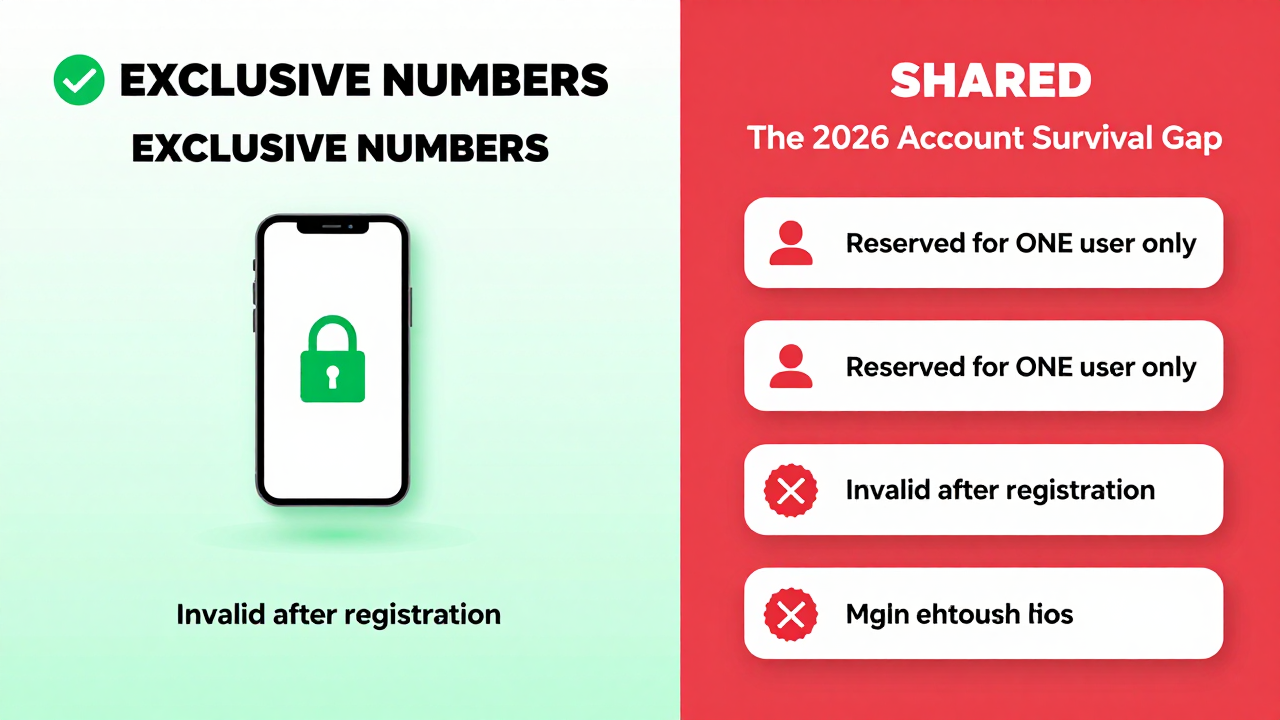
Reputable providers will clearly tell you whether you're getting an exclusive number or a shared one. An exclusive number serves only you for a set period and becomes invalid after registration — nobody else can reuse it. A shared number, on the other hand, is that "well-traveled" number countless people have used, and it's basically a one-way ticket to account suspension.
From my own testing, accounts registered with exclusive numbers see survival rates above 90%, while shared numbers pass review less than 30% of the time. That gap alone can determine whether your business ever gets off the ground.
Layer 2: Success Rate and Channel Stability
Many providers brag about low prices but never mention their success rates. In 2026, overseas carriers have stepped up interception of bulk registrations, and delivery rates for many traditional verification channels have dropped below 50%. In plain terms: you pay, but there's a decent chance you never get the code.
How do you test this? Don't rush into a big package. Spend a few dollars first and test numbers across a few different platforms, watching response times. A solid provider typically pushes codes within 10–30 seconds and gives clear failure notifications — they won't leave you hanging. If you're waiting two minutes with customer service saying "just give it a bit more," run the other way.
Here's a pro tip: in 2026, many platforms let you filter by "specific country" and "specific carrier." If you're targeting the US market, pick US-native numbers instead of random European micro-states. A mismatch between number origin and registration platform location is a common trigger for risk controls.
Layer 3: Clear After-Sales and Compensation Policies
SMS verification is a game of probabilities — even the best providers stumble sometimes. What matters is what happens when things go wrong. Many sketchy providers are all smiles before you pay and all silence after. You report a missed code, and they just tell you to "try another number," never mentioning refunds or compensation.
Trustworthy platforms spell out their compensation rules in the service agreement — something like "full refund if codes can't be received due to platform issues" or "equivalent number replacement." In 2026, this kind of transparent after-sales framework is a key benchmark for deciding whether a provider deserves your long-term business.
Platforms like Getfollow have built a solid reputation in the industry by following exactly this playbook — exclusive numbers, stable channels, and clear compensation policies. They've set a benchmark for how things should be done. I'm not telling you to go buy from them right now; I'm suggesting you use this standard to evaluate any provider you're considering.
Three SMS Verification Traps Every Cross-Border Seller Must Avoid in 2026
Knowing how to choose is only half the battle — you also need to know what to dodge. Here are the three most common traps I've seen in 2026, each backed by real cases.
- Trap 1: Falling for "Unlimited SMS" Packages. Some providers push monthly unlimited plans that sound like a steal, but they're usually backed by low-quality number pools. In 2026, these packages come with sky-high account ban rates because the numbers are reused so often they've been flagged by platforms. The money you save won't cover the cost of a single replacement account.
- Trap 2: Ignoring Number "Cooldown Periods." After a number receives a verification code for one platform, it needs time to cool down before being used for another. Some providers skip cooldowns to maximize throughput, and the result is numbers flagged as "abnormally active" by risk systems. You get it, register, and get banned instantly.
- Trap 3: Judging by Price Alone, Ignoring API Quality. In 2026, many operations use automated tools for bulk registration. That makes API stability and response speed absolutely critical. Smaller platforms often crash under high concurrency, bringing your entire automation pipeline to a screeching halt.
Many cross-border operators report that the safest strategy in 2026 isn't finding one "do-it-all" provider — it's keeping two or three backups to spread risk. Platform risk control rules change daily; a channel that works today might be dead tomorrow.
Decision-Making Guide: How to Test a Provider with Minimal Cost
Enough theory — let's get practical. If you're currently hunting for a reliable SMS verification service, don't buy a big package right away. Walk through this process instead, and you'll save yourself a lot of wasted money.
- Step 1: Small-Scale Testing. Top up the minimum amount (usually $1–$3) and test numbers across 3–5 different platforms. Watch for: delivery speed, success rate, and whether number origin is selectable.
- Step 2: Verify Number Purity. Use a test number to register on the platform that matters most for your business (e.g., if you're doing TikTok, use it for TikTok). If it goes through smoothly, the number quality is solid. If it gets banned instantly, drop that provider.
- Step 3: Test After-Sales Response. Deliberately pick a number from an obscure country to trigger a "code not received" scenario, then see how fast customer service responds and what solutions they offer. This tells you whether they'll solve problems or pass the buck when things go wrong.
- Step 4: Small-Batch Trial Run. Once the first two steps check out, buy a small batch (say, 50 numbers) for real business scenarios. Monitor account survival rates and stability over a week.
This entire process will cost you roughly $7–$15, but it can save you thousands in losses. In 2026, the cross-border industry has moved past the "wild west" phase — precision operations are the name of the game. Spending a little extra time testing beats scrambling to fix things after the fact every single time.
One last word: a reliable SMS verification service is really about buying "certainty." In 2026, providers still luring you in with rock-bottom prices will likely let you down exactly when you need them most. Instead of gambling, invest a little effort using the methods above to find a partner who lets you sleep at night. Test small first, then commit long-term — that's how you show real responsibility for your business.
Frequently Asked Questions
What's the difference between exclusive and shared SMS verification numbers?
Exclusive numbers are reserved for a single user during a specific time window and become invalid after registration, ensuring high purity. Shared numbers are used by multiple people and carry a much higher risk of being flagged by platform risk controls, leading to account bans.
How fast should a reliable SMS verification service deliver codes?
A trustworthy provider typically pushes verification codes within 10–30 seconds. If you're waiting longer than that without clear status updates, it's a red flag that the service may be unreliable.
Can I get a refund if I don't receive a verification code?
Reputable platforms clearly outline compensation policies in their service agreements, such as full refunds for platform-related failures or equivalent number replacements. Always review these terms before purchasing.
Why do my accounts get banned immediately after registration?
Instant bans usually stem from using shared or low-purity numbers that risk control systems have already flagged. In 2026, platforms aggressively identify numbers with high registration frequency or those linked to multiple accounts.
Is it worth paying more for a premium SMS verification service?
Generally, yes. Premium services offer exclusive numbers, stable channels, and transparent after-sales support — all of which directly impact your account survival rate. The extra cost is minimal compared to the time and money lost when accounts get banned.