How to Choose a 60-Second SMS Verification Platform: Lessons From Cross-Border Sellers Who Learned the Hard Way
How to Choose a 60-Second SMS Verification Platform: Lessons From Cross-Border Sellers Who Learned the Hard Way
If you've been in cross-border e-commerce for more than a few months, you've hit the same wall: registering overseas social media accounts, linking payment tools, or verifying SaaS subscriptions all seem to demand SMS verification. Early on, most solo operators and small teams try to tough it out with their personal phone numbers. Then the flags start flying—accounts get risk-controlled, verification codes never arrive, and your entire workflow grinds to a halt. That's why 60-second SMS verification platforms have become such a hot topic in the community. But here's the thing: this industry has layers. From my experience observing the market, you can split verification service providers into at least three or four completely different operating models. Some are pure self-service API integrations. Others lean on manual code reception. And a few are basically "disposable number pools" sitting right on the edge of the gray market. If you're serious about building a long-term business, picking the wrong platform isn't just about wasting a few bucks—it can get your main accounts flagged and banned through association.First, Let's Clear Up What "60-Code" Actually Means
A lot of newcomers assume "60-code" refers to a specific number range or service package. In reality, industry insiders use it to describe a service promise: receiving your verification code within 60 seconds of submitting a request. That time window matters enormously for registration flows, since many platforms only keep verification codes valid for 5 to 10 minutes. If code delivery drags past two or three minutes, the entire registration experience turns into a nail-biter. But here's a detail most people overlook: 60 seconds is an ideal-world metric. In practice, delivery speed depends on several variables—whether the target platform's SMS channel is congested, the quality of international routing through the number's carrier, and even whether the number's country of origin has a working relationship with the platform you're registering on. A common pattern we see among cross-border operators: registering on US or European platforms works noticeably better with US or UK local numbers than with Southeast Asian numbers, even when the latter cost less.The Most Typical Failure Case I've Seen
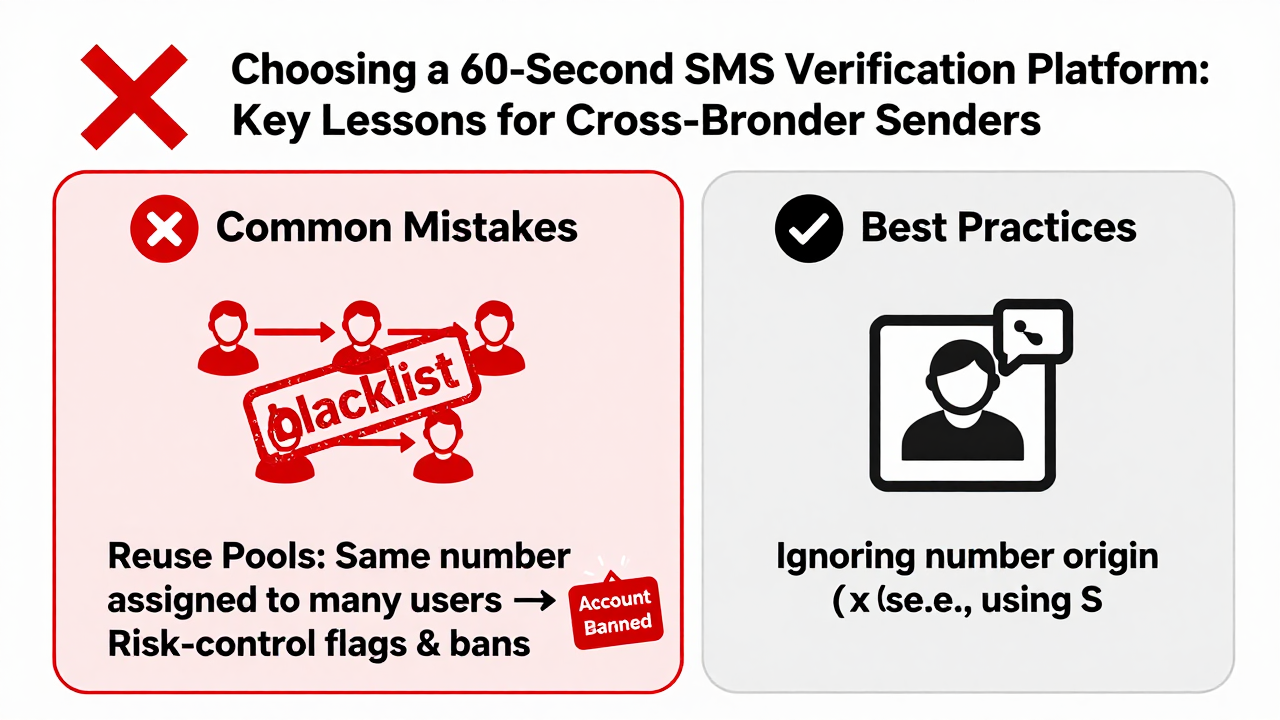
A friend running a standalone e-commerce site wanted to batch-register TikTok accounts for matrix testing. He grabbed a cheap "unlimited verification" package, and within two days, every single account got flagged for suspicious activity—and it dragged down his main, legitimately operating account too. When we dug into the cause, we found the platform's number pool was being reused aggressively. The same number had been assigned to a dozen different users within a short window, and the platform's risk-control system had already blacklisted the entire number range. This case reflects a consensus across the industry: the cleanliness of the number pool and its rotation frequency matter far more than price. Reputable providers typically split numbers into "fresh pools" and "reuse pools." Fresh pools cost more but deliver much higher success rates, while reuse pools work fine for low-risk scenarios. If you're registering high-value accounts, explicitly request the fresh pool. Paying a bit more per number beats the headache of account bans and redoing everything from scratch.The Current Landscape: The Line Between Compliant and Gray-Market Is Blurrier Than You'd Think
Today's 60-second SMS verification platforms generally fall into three categories. First, there are pure tool platforms—they offer API access and number resources but zero human support, which suits teams with technical chops who can script their own calls. Second, there are semi-managed platforms that match numbers for you and offer basic risk-control advice—these are the most widely used by small and mid-sized cross-border teams right now. Third, there are the "we'll take anything" platforms that handle business clearly violating platform rules. These charge rock-bottom prices, but the risk profile is terrifying. From a compliance standpoint, the platforms with the most stable reputations in the industry—like Getfollow—operate with a relatively transparent, compliant logic: they clearly state number usage restrictions, don't promise 100% success but offer failure compensation, and regularly purge number ranges that get flagged by risk-control systems. I've personally tested several providers with similar positioning, and while their prices aren't the lowest, their long-term stability is noticeably better. When platform risk-control systems tighten, these providers respond much faster.Three Details to Scrutinize When Choosing a Provider
First, check whether they'll openly disclose a number's "lifespan." Legitimate platforms will tell you the average cycle from when a number enters their pool to when it gets flagged—typically anywhere from one week to one month. If they dodge the question or promise "permanent validity," you can safely assume they're using a reuse pool to string you along. Second, test their customer support's competence. Ask directly: "If code reception fails, what's your process?" Reliable platforms usually have a clear compensation policy—refunding credits or letting you retry with a different number. Providers that just say "try again a few times" will almost certainly leave you hanging when real problems surface. Third, observe how the platform handles risk-control incidents. Many cross-border operators have noted that since the second half of 2025, major overseas platforms have significantly strengthened their ability to detect virtual numbers, and a wave of smaller verification platforms has failed en masse as a result. In those moments, providers with backup channels and the ability to rapidly switch number resource pools become your lifeline.Beyond Choosing the Right Platform: Operational Details That Save You From Common Pitfalls
- For important account registrations, prioritize number origins that match your business region. Target North America? Use US numbers. Targeting Europe? Go with UK or German numbers. This noticeably reduces risk-control triggers.
- Don't register the same service with multiple numbers from the same platform at the same time. Even if the numbers are clean, this pattern gets flagged as batch operation.
- After successful code reception, immediately complete email binding and two-factor authentication. Don't rely on SMS verification as your only login method long-term.
- Keep screenshots of your verification records. If an account runs into issues later, these are essential evidence for appeals.
Final Thoughts: Test Small First, Then Commit Long-Term
Choosing a 60-second SMS verification platform is ultimately about balancing efficiency, cost, and risk. No provider can guarantee 100% success—and anyone claiming "instant delivery" or "guaranteed pass" deserves extra skepticism. The safer play is to spend a few dollars on a small test batch, monitor success rates, delivery speed, and support responsiveness over a week, and only then decide on a long-term partnership. For solo operators, I'd recommend keeping at least two backup providers so a single platform failure doesn't disrupt your business continuity. For cross-border enterprises with larger operations, consider integrating verification services into your overall account security management framework rather than treating it as a throwaway tool. At the end of the day, the safety of your account assets often determines how far you can go in this industry. Tools are just tools. What actually matters is your understanding of the business and your respect for risk. Hopefully, this guide helps you sidestep a few landmines and walk the cross-border path with a steadier step.Frequently Asked Questions
What is a 60-second SMS verification platform?
A 60-second SMS verification platform is a service that provides temporary phone numbers to receive SMS verification codes, typically promising delivery within 60 seconds. These services are commonly used by cross-border businesses, freelancers, and marketers to register overseas accounts without using personal phone numbers.
Are SMS verification platforms legal to use?
The legality depends on how you use them and which platform you choose. Compliant platforms operate transparently, disclose number limitations, and follow reasonable usage policies. However, using verification services to violate a target platform's terms of service—like creating fake accounts at scale—carries inherent risks, including account bans and potential legal exposure.
Why do verification codes sometimes fail to arrive?
Several factors affect delivery: the target platform's SMS channel may be congested, the number's carrier may have poor international routing, or the number's country of origin may not align well with the platform you're registering on. Risk-control systems at major platforms have also become significantly better at detecting virtual numbers since late 2025.
How much does a 60-second SMS verification platform cost?
Pricing varies widely based on number origin, pool freshness, and service model. Fresh pool numbers for US or UK regions typically cost more, while reuse pool numbers from Southeast Asian regions are cheaper. Most platforms operate on a credit-based system, and reputable providers offer failure compensation.
What's the difference between fresh number pools and reuse pools?
Fresh pools contain numbers that haven't been heavily used, offering higher success rates for high-value account registrations. Reuse pools contain numbers that have been cycled through multiple users—they're cheaper but far more likely to be flagged by platform risk-control systems. Always request fresh pool numbers for important accounts.