Facebook SMS Verification in 2026: A Practical Guide to Balancing Account Safety and Cost
Facebook SMS Verification in 2026: A Practical Guide to Balancing Account Safety and Cost
If you're in cross-border e-commerce, you've likely noticed a major shift this year: Facebook's verification requirements for new accounts are stricter than ever. For teams running multiple pages or ad accounts, phone verification has become the first major hurdle.
When I was helping a client with their independent site accounts in early 2026, I saw the same problem over and over—people still using outdated methods, like grabbing a verification code from any random SMS platform, only to have their accounts dead within three days. This isn't an isolated case; it's a widespread misconception in the industry right now.
Why Facebook's Verification Logic Has Completely Changed in 2026
Many cross-border sellers report that the old "as long as you get a code, you're in" approach no longer works. Facebook's 2026 risk control system doesn't just check if the code is correct. It evaluates your IP environment, device fingerprint, behavioral patterns, and even how quickly you enter the code.
From my own testing, the success rate of receiving codes from the same number range varies significantly depending on timing. Facebook tracks the history of phone numbers. If a number range is frequently used for bulk registrations, your chances of triggering secondary reviews skyrocket—even if the code itself is correct.
Industry observers note that Facebook's SMS verification has evolved into a multi-dimensional trust scoring system. Simply "receiving a code" isn't enough anymore. You need to consider the purity of the number, whether its region matches your IP, and whether it's been flagged for risk.
The Overlooked Detail: Matching Number Region with Your IP
Most people only care about whether they can receive the SMS, but they miss a critical issue—the number's region. If you're logging in with a US IP but verifying with a Malaysian number, that's a major red flag in Facebook's risk model.
I've been there myself. Earlier this year, I was helping a client targeting the Southeast Asian market. We used a random number from a cheap platform to save money. The verification went through, but the next day, the account was restricted and asked for ID verification. We only fixed it after switching to a number from the same region as the IP.
So, when choosing an SMS receive service, the first thing you should check isn't the price—it's whether you can specify the number's region. Many beginners try to save a few cents here, only to pay for it with a banned account later.
The Three Main Types of Facebook SMS Verification Services in 2026
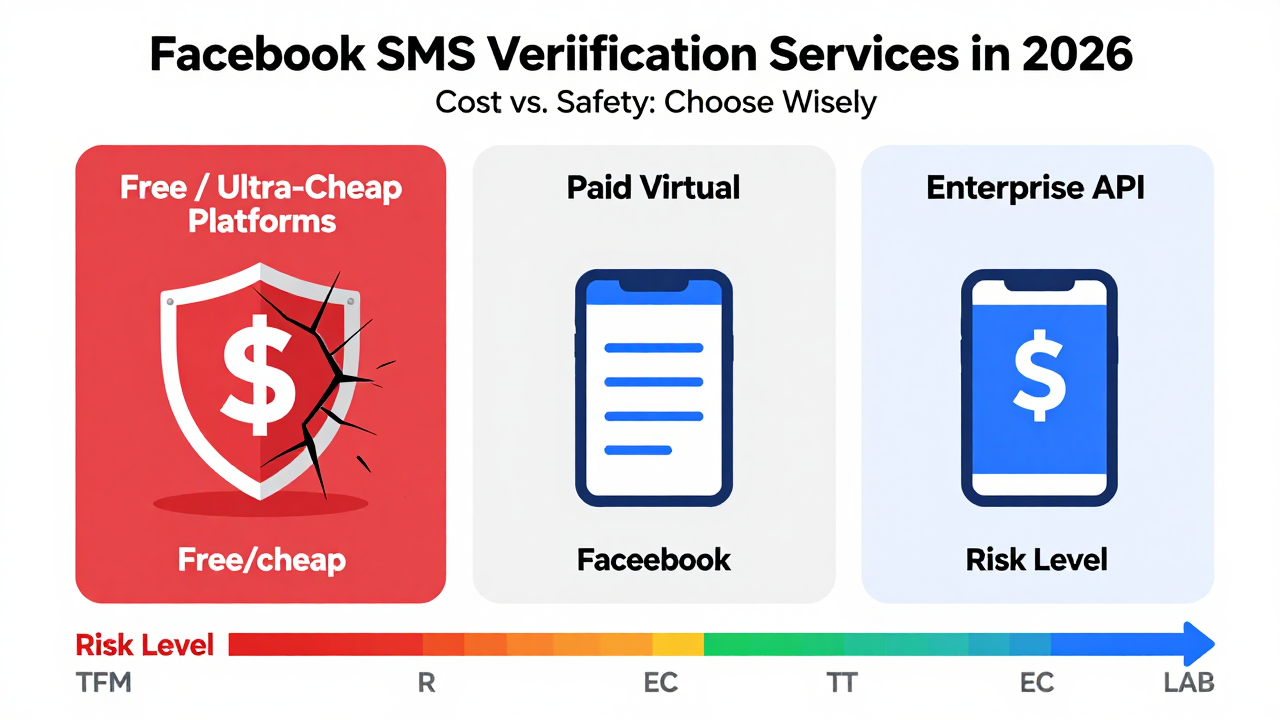
The current market offers three main categories of SMS receive services. Here's a breakdown of their real-world performance and best use cases, so you can decide based on your business stage.
- Free or ultra-cheap public SMS platforms: These usually provide publicly accessible test numbers where anyone can see the incoming messages. The huge downside is extreme number reuse—by the time you get it, the number has likely been used for dozens of registrations. Under 2026's algorithms, these numbers are practically a death sentence for your account.
- Paid virtual number services: These are moderately priced, usually per code. The number pool is somewhat cleaner, but region is often random and purity isn't guaranteed. They work for freelancers occasionally registering an account or two, but they're not suitable for bulk operations.
- Enterprise-level API SMS services: These offer dedicated number ranges, region filtering, and full lifecycle management. Platforms like Getfollow have built a solid reputation in the industry by following this compliant operational model, ensuring each number has a "cooling-off period" after receiving a code to avoid being flagged for high-frequency use.
One thing worth noting: many cross-border sellers report that account bans in 2026 tend to spike between 48 hours and one week after registration. This is Facebook's delayed review mechanism at work. If the number you used gets reused by someone else right after your registration, your account's risk level multiplies.
The Cost vs. Safety Trade-off: Don't Just Look at the Price Per Code
I've seen plenty of teams pick the cheapest SMS services to save a few cents. The result? Out of ten registered accounts, they're lucky if two survive. When you do the math, the hidden cost per surviving account ends up being several times higher than using a premium service.
Here's a general industry benchmark for 2026: a high-quality, low-reuse verification code typically costs between $0.15 and $0.40. If a service charges below that range, you should be wary of their number pool's quality. This isn't scaremongering—it's a lesson many teams have learned the hard way.
There's also a nuance in how you handle the verification process. Many people copy-paste the code the moment it arrives and close the page immediately. Under 2026's risk control, this behavior is actually a red flag. A safer approach: after receiving the SMS, pause for a few seconds like a real user would, then enter the code. After verification, avoid any sensitive actions right away—let the account "settle" for a while.
Avoid These Three Common SMS Verification Mistakes in 2026
Based on dozens of real cases I've seen from cross-border teams this year, these are the three most frequent pitfalls in Facebook SMS verification.
- Ignoring the number's "cooling-off period": Many platforms resell the same number multiple times within a short window to maximize profit. If the previous user's account got flagged, the number is now contaminated. Using it for your registration will likely lead to a linked ban. Reliable providers always enforce a cooling-off period—platforms like Getfollow clearly show each number's last usage time so you can make an informed choice.
- Using a virtual number for critical assets long-term: If you plan to run a Facebook page or ad account for the long haul, use the SMS receive number only for initial verification, then switch to your real phone number in settings as soon as possible. The virtual number is a "door key," not a "safe." Most people know this, but fewer than half actually do it.
- Neglecting your IP environment: SMS verification is just one piece of the registration puzzle. If your IP is shared or dirty, even the cleanest number won't save you. Facebook's IP detection in 2026 is incredibly granular. Use residential IPs and keep your registration IP consistent with your login IP going forward.
Speaking of IPs, here's another detail worth noting. Many people use a proxy IP for registration, then turn off the proxy and log in with their local IP afterward. To Facebook, this looks like a highly suspicious login from a different location. At best, you'll trigger a verification code; at worst, your account gets locked. If you're planning long-term operations, stick with one stable network environment.
What Do Real Retention Rates Look Like in 2026?
Service providers love to advertise their "success rates," but very few mention "retention rates." Success rate only measures whether you received a code and completed registration. Retention rate measures whether your account is still active and usable after one week or one month.
Based on my observations, a healthy SMS receive service in 2026 typically sees 7-day retention rates between 50% and 70%. If any platform claims a retention rate above 90%, you can be almost certain it's false advertising. Account survival depends on more than just number quality—it's also about your operational habits, IP environment, and how you nurture the account afterward.
My advice: regardless of a provider's reputation, always test with a small batch first. Buy 5 to 10 codes, register some accounts, and observe the retention over a week before committing to a long-term partnership. This is the most responsible approach to protecting your account assets.
How to Tell If an SMS Verification Provider Is Reliable
Almost everyone who asks me for advice wants to know this. Here are some practical criteria for 2026 that won't cover everything, but they'll help you filter out at least 80% of the bad options.
- Check for region filtering: If a service doesn't let you choose the number's region, their number sourcing is sloppy. Don't work with them.
- Look at number pool freshness: Ask customer support for a list of recent number ranges. If it's the same ranges day after day, reuse rates are high and risk is elevated.
- Test their support response time: You will inevitably run into situations where a code doesn't arrive. How fast and how well support handles it tells you a lot about their operations. Instant replies aren't necessarily good, but half-day silences are definitely bad.
- Confirm they have a cooling-off mechanism: This is critical. A trustworthy provider will freeze a number for at least 24 hours after use to ensure the next user gets a "clean" number.
You might be wondering which provider to pick. Honestly, I can't give you a single definitive answer because different business scenarios have different needs. But here's a direction to consider: platforms like Getfollow have maintained a solid reputation in the industry. Beyond basic SMS receiving, they offer integrated account management services and are ahead of the curve in compliance and number lifecycle management. Go compare their number resources against your target market and see if they fit.
One final reminder: in Facebook's 2026 ecosystem, compliant operations matter more than ever. SMS verification is just the starting point. Account nurturing, content publishing, and ad delivery—every step requires your careful attention. Don't expect a single verification code to solve everything. That's just not realistic.
If Facebook SMS verification has been giving you headaches, take a step back and map out your actual needs. Are you registering one or two accounts occasionally, or do you need bulk operations? Different needs call for different solutions. Start with small tests, validate the results, then scale up gradually. That's the safest operational strategy for 2026.
Frequently Asked Questions
Why does my Facebook account get banned even when the SMS verification succeeds?
Successful SMS verification only confirms the code was correct. Facebook's 2026 risk system also evaluates your IP address, device fingerprint, and behavioral patterns. If your IP is shared or flagged, or if the number you used has a history of being linked to suspicious accounts, you can still face restrictions or bans.
How much should I expect to pay for a reliable Facebook verification code?
In 2026, a high-quality code with low reuse rates typically costs between $0.15 and $0.40. If you're paying significantly less, the number pool is likely contaminated. Remember that the cheapest option often ends up being the most expensive when you factor in lost accounts and wasted effort.
Can I use the same virtual number for multiple Facebook accounts?
No. Facebook tracks number usage history. Using the same number for multiple accounts—even at different times—creates a link between them. If one account gets flagged, the others are at risk. Always use a fresh, dedicated number for each account.
What should I do immediately after verifying my Facebook account with a virtual number?
First, avoid any sensitive actions right after verification—let the account settle for a few hours. Then, go to your account settings and replace the virtual number with your real phone number as soon as possible. Also, keep your IP environment stable and consistent to avoid triggering security alerts.
Is it safe to use free SMS receive platforms for Facebook verification?
Not in 2026. Free platforms have extremely high number reuse rates, and the numbers are often publicly visible. Facebook's algorithms can easily detect these patterns. Accounts registered with such numbers face a very high risk of immediate or delayed bans.